Month: December 2025

  • Crypto Market Dynamics: Bitcoin vs Altcoins in 2025

    Crypto Market Dynamics: Bitcoin vs Altcoins in 2025

    The crypto market is no longer a monolithic asset class. As we move through late 2025, a clear structural hierarchy has emerged. Bitcoin is increasingly behaving as a “safe haven” anchor—a stabilizer defined by lower volatility and massive supply lock-up. In contrast, the altcoin market—ranging from Ethereum and Solana to Dogecoin—has become a speculative amplifier, translating market sentiment into sharper, high-beta swings.

    This divergence is not accidental. It is rooted in fundamental differences in consensus architecture and how these various assets respond to global liquidity shocks.

    The Price Divergence Snapshot

    As of December 20, 2025, price data reveals a distinct divergence in daily performance and volatility across the digital asset complex.

    • Bitcoin (BTC): Trading near 88,274 dollars with a daily change of +1.37 percent. Signal: Stability and safe-haven anchoring.
    • Ethereum (ETH): Trading near 2,985 dollars with a daily change of +2.23 percent. Signal: Moderate upside, driven by Decentralized Finance and Non-Fungible Token adoption.
    • Solana (SOL): Trading near 126.37 dollars with a daily change of +2.88 percent. Signal: Higher beta and speculative momentum.
    • XRP: Trading near 1.90 dollars with a daily change of +3.41 percent. Signal: Institutional settlement focus with mid-range volatility.
    • Cardano (ADA): Trading near 0.37 dollars with a daily change of +3.21 percent. Signal: Mid-tier altcoin with higher relative swings.
    • Dogecoin (DOGE): Trading near 0.13 dollars with a daily change of +3.94 percent. Signal: Meme-driven extreme volatility.

    Bitcoin currently acts as the market’s primary stabilizer. This reflects its dominance and the fact that 74 percent of its supply is held by immobile, long-term wallets. Altcoins, conversely, are higher-beta assets that offer more upside for speculation but carry significantly higher systemic risk during periods of volatility.

    Mining vs. Staking: The Scarcity Ledger

    The divergence in price behavior is mirrored by the divergence in consensus mechanisms. How a coin is “minted” dictates its scarcity narrative and its role in an investor’s portfolio.

    Mining Scarcity (Proof of Work)

    • Assets: Bitcoin, Dogecoin, Litecoin.
    • Dynamics: Supply is released via block rewards through energy-intensive computing power.
    • Investor Signal: Bitcoin enforces scarcity through its halving schedule, anchoring its role as digital gold. While Dogecoin and Litecoin use mining, their supply dynamics are more inflationary, offering a weaker scarcity narrative than Bitcoin.

    Staking Scarcity (Proof of Stake)

    • Assets: Ethereum, Solana, Cardano, Polkadot.
    • Dynamics: Security comes from locked coins used as collateral, not mining. Rewards are paid to validators.
    • Investor Signal: These are ecosystem-driven growth assets. Scarcity comes from “staked supply,” and returns are tied to yields and network adoption. They attract capital seeking growth, but their volatility remains higher than Bitcoin.

    Pre-Mined Models

    • Assets: XRP.
    • Dynamics: Fixed supply at launch, with distribution controlled by a central foundation or consortium.
    • Investor Signal: Adoption depends on institutional partnerships and settlement rails, such as Central Bank Digital Currency pilots. Trust is rooted in corporate governance rather than algorithmic scarcity.

    Correlation vs. Volatility: The Sentiment Loop

    Even though altcoins utilize different consensus models, their pricing remains sentiment-coupled to Bitcoin. However, the magnitude of their response is the decisive differentiator.

    • Bitcoin Sets the Tone: As the dominant anchor, Bitcoin’s moves dictate the overall market mood. When Bitcoin rises or falls, altcoins rarely diverge in trend.
    • The Volatility Index: The real divergence is magnitude. Altcoins swing harder across the board. While Ethereum is relatively moderate, Solana and Cardano are sharp, and Dogecoin remains extreme.
    • Investor Implication: Bitcoin provides directional clarity, while altcoins amplify the move. For an investor, owning altcoins is effectively a leveraged bet on Bitcoin sentiment, carrying both higher potential reward and catastrophic downside risk.

    In the crypto hierarchy, there is correlation in direction but divergence in volatility. Bitcoin is the compass; altcoins are the high-beta extensions of that compass.

    The Liquidity Shock: How the Vacuum Cascades

    The recent Bank of Japan rate hike has provided a significant challenge for this hierarchy. The end of the “yen carry trade”—as analyzed in our master guide, Yen Carry Trade: The End of Free Money—has added a severe stress test to the system.

    When a liquidity vacuum is created, the capital drain cascades across the entire complex:

    • Bitcoin Absorption: As the anchor, Bitcoin absorbs the initial shock. While it faces downward pressure, its scarcity and immobile supply cushion the impact.
    • Altcoin Amplification: Altcoins mirror Bitcoin’s downward move but with amplified volatility. Their internal fundamentals, such as staking yields or meme culture, do not shield them from the macro vacuum; instead, their thinner liquidity accelerates their decline.

    Bitcoin is the anchor asset in times of liquidity stress, while altcoins act as the amplifiers of liquidity shocks. The systemic signal is clear: in a deleveraging event, altcoins will always bleed faster and deeper than the anchor.

    Conclusion

    To navigate this era, investors must distinguish between the stability of the anchor and the magnification of the amplifier. Bitcoin’s scarcity anchors the floor, while altcoin volatility defines the ceiling.

    In a world of central bank liquidity mop-ups, the anchor survives the vacuum, while the amplifier feels the squeeze.

  • Bitcoin: Scarcity Meets Liquidity in 2025

    Bitcoin: Scarcity Meets Liquidity in 2025

    The investment thesis for Bitcoin has long been anchored by its programmed scarcity. However, as 2025 comes to a close, this built-in supply squeeze is colliding head-on with an exogenous “liquidity mop-up” orchestrated by global central banks.

    As detailed in our feature analysis, Yen Carry Trade: The End of Free Money, the Bank of Japan’s historic rate hike has pulled the plug on three decades of cheap funding. The result is a structural shift: the capital required to buy Bitcoin is becoming significantly more expensive to borrow.

    The Collision of Scarcity and Policy

    Bitcoin’s scarcity acts as a “slow-burn” bullish driver, while sudden liquidity shocks represent immediate bearish pressure. These two forces are currently defining the asset’s price discovery phase.

    Scarcity vs. Liquidity Dynamics

    • The Supply Squeeze: Bitcoin is entering an acute phase of its emission schedule. Over the next six years, only approximately 700,000 new BTC will be mined, further tightening the available float.
    • The Liquidity Drag: Simultaneously, the Bank of Japan has ended the yen carry trade, forcing a global deleveraging. While the supply squeeze remains a long-term anchor for higher prices, analysts warn of a 20 to 30 percent structural decline risk in the short term as the “liquidity vacuum” dominates market sentiment.

    Scarcity provides the “oxygen” for long-term growth, but liquidity provides the “atmospheric pressure.” When the pressure drops, the oxygen alone cannot sustain the price.

    The BoJ Vacuum—Removing the Oxygen

    The December 19, 2025, interest rate hike to 0.75 percent—the highest in 30 years—decisively ended the yen subsidy. This move did more than simply raise rates; it removed the “oxygen” for all leveraged risk trades.

    • Structural Deleveraging: With cheap yen funding gone, hedge funds and institutional desks have been forced to unwind leveraged bets in both equities and digital assets.
    • The December Settlement: The 140 billion dollar market capitalization wipeout in Bitcoin earlier this month served as the physical settlement of this vacuum. Investors scrambled to repay yen loans before the Japanese currency strengthened further.
    • The Federal Reserve Constraint: While the United States Federal Reserve can provide some relief through rate cuts, it cannot replicate the negative-rate substrate that Japan provided for a generation.

    Mass Adoption vs. Safe-Haven Lock-Up

    While the macro environment is tightening, the internal structure of Bitcoin ownership is becoming more resilient. We are witnessing a historic convergence of mainstream penetration and supply immobility.

    The Adoption and Lock-Up Ledger

    • Mainstream Scale: Approximately 28 percent of United States adults—roughly 65 million people—now own digital assets. This participation rate is now comparable to traditional stock market involvement, signaling that crypto is a standard part of household portfolios.
    • Supply Immobility: A staggering 74 percent of the circulating Bitcoin supply is currently held by long-term holders who have not moved their coins in over a year. This level of immobility is unprecedented and effectively reduces the “liquid float” available for trading.

    Mass adoption creates structural upward demand, while the “lock-up” by long-term holders amplifies the scarcity premium. However, this also makes the remaining liquid supply hyper-sensitive to macro shocks and volatility.

    The Ownership Hierarchy—Bitcoin as the Anchor

    Despite the proliferation of thousands of altcoins, Bitcoin remains the definitive anchor of the asset class. Ownership data confirms a “Bitcoin-First” reality for the majority of investors.

    Breakdown of U.S. Crypto Ownership (2025)

    1. Bitcoin (BTC): Dominates the field, held by 70 to 75 percent of all crypto owners (approximately 45 to 50 million people).
    2. Ethereum (ETH): Holds a strong second position with 40 to 45 percent ownership (approximately 26 to 29 million people), primarily driven by its role in Decentralized Finance and Non-Fungible Tokens.
    3. Other Altcoins: Tokens such as Solana, Dogecoin, and Cardano make up the remainder, with ownership spread across 25 to 30 percent of the base.

    For most investors, Bitcoin is no longer a speculative play; it is the “Sovereign Collateral” or the “savings account” for their broader digital exposure.

    Conclusion

    Bitcoin is caught in a tug-of-war between the slow-burn logic of its protocol and the instant-fire reality of central-bank policy.

    The asset is scarce and the adoption is real, but the capital used to fund it is no longer free. To survive the 2026 cycle, investors must distinguish between the “math” of scarcity and the “mechanics” of liquidity.

  • The Great Migration: SEC to CFTC and What It Means for Crypto

    The Great Migration: SEC to CFTC and What It Means for Crypto

    By January 2026, the United States Securities and Exchange Commission will enter unprecedented territory. For the first time in the agency’s history, all five commissioners will be Republicans. As noted in a Financial Times analysis by Michelle Leder published in December 2025, titled “The SEC is heading into dangerous territory,” this “monochromatic” tilt risks pushing Wall Street’s primary watchdog into an era of purely partisan oversight.

    For the crypto ecosystem, however, this shift is being choreographed as a “Great Migration.” The objective is clear: to move digital assets from the restrictive “securities” cage of the Securities and Exchange Commission into the expansive “commodities” rail governed by the Commodity Futures Trading Commission. This represents more than a mere change in rules; it is a fundamental shift in the grammar of financial legitimacy.

    The End of Neutrality: A Partisan Watchdog

    The Securities and Exchange Commission has traditionally functioned on a bipartisan model to ensure that investor protection remains a structural constant rather than a political variable. The shift to an entirely Republican commission signals three major breaches in that institutional tradition:

    • The Partisan Imbalance: A monochromatic board eliminates the “friction of dissent” that has historically safeguarded market confidence and balanced enforcement.
    • Politicized Enforcement: Eighteen Republican Attorneys General have already sued the Securities and Exchange Commission for “unconstitutional overreach” regarding digital assets. An all-Republican board is unlikely to contest these claims; it is more likely to surrender jurisdiction entirely.
    • The Reputation Risk: Global markets rely on the perception of the Securities and Exchange Commission as an objective referee. If oversight is perceived as a tool for political patronage, the long-term institutional trust in American capital markets may begin to erode.

    Securities vs. Commodities: The Fight for “Oxygen”

    The core of the Great Migration is the legal classification of tokens. In the current regime, digital assets are often suffocated by the heavy requirements of securities law. The monochromatic Securities and Exchange Commission aims to provide “oxygen” to the sector by reframing tokens as commodities.

    The Securities Cage (SEC Oversight)

    Under Securities and Exchange Commission oversight, the burden is high. Tokens treated as securities must register, file exhaustive quarterly disclosures, and undergo expensive audits. Furthermore, lawsuits against exchanges for “unregistered securities” have acted as a permanent brake on innovation and listing velocity, resulting in high compliance costs that favor only the most capitalized incumbents.

    The Commodities Rail (CFTC Oversight)

    In contrast, the Commodity Futures Trading Commission offers a “lighter touch.” Oversight focuses on market integrity—preventing fraud and manipulation—rather than the heavy paperwork of disclosure. Under this logic, crypto is treated like gold or oil: assets that trade on supply and demand mechanics rather than the performance of a centralized management team. This environment allows for rapid listing, higher liquidity, and a lower barrier to entry for new participants.

    The Legislative Hinge and Investor Scenarios

    While a partisan Securities and Exchange Commission can soften enforcement, permanent clarity requires an act of Congress. The Great Migration currently sits in a state of regulatory limbo, presenting investors with two primary paths.

    Scenario A: Commodity Classification (The Bill Passes)

    If legislation formally transfers power, investors should expect a structural re-rating of crypto assets as they transition from “illegal securities” to “legitimate commodities.” This would likely trigger massive capital inflows as United States exchanges gain the legal cover to list hundreds of new tokens, supported by codified anti-fraud rules that provide a “floor” of legitimacy for institutional entry.

    Scenario B: Lighter Enforcement Only (The Bill Stalls)

    If the bill fails, the result is a fragile reprieve. The Securities and Exchange Commission may stop suing firms, but the legal “Sword of Damocles” remains. This could lead to a short-term relief rally that remains vulnerable to the next political cycle. Without statutory changes, the “Wild West” returns, potentially leading to systemic instability and a collapse in long-term confidence.

    Commodity classification offers a structural re-rating; lighter enforcement offers only a temporary boost. For the investor, the decisive signal is not the regulator’s silence, but the Congressional vote that makes that silence permanent.

    The Reversal Risk: The Pendulum Problem

    The greatest danger of a monochromatic commission is that it grants “Rented Legitimacy.” In a system where rules follow a partisan tilt rather than architectural law, the risk is always a violent reversal of the pendulum.

    If a future administration returns to a Democratic majority, the Great Migration could be reversed almost overnight. Tokens could be re-labeled as securities, forcing companies that scaled under commodity rules into retroactive compliance or costly market exits.

    If legitimacy is granted through proximity to power rather than rule-based compliance, it becomes a liability. Companies scaling in this era must build for “pendulum resilience,” ensuring their architecture can survive a return to stricter securities framing.

    Conclusion

    The Securities and Exchange Commission is entering dangerous territory not because it is deregulating, but because it is politicizing the ledger. For the citizen-investor, this demands a new forensic discipline:

    1. Audit the Law, Not the Tone: Softened enforcement is an optic. Only a Congressional bill provides the actual architecture for the Commodity Futures Trading Commission to take control.
    2. Watch the Attorneys General: The 18 Republican state prosecutors are the vanguard of this shift; their filings serve as lead indicators for federal policy moves.
    3. Prepare for the Pendulum: Assume that current “commodity oxygen” is a timed release. Build portfolios that can withstand a sudden return to “securities suffocation.”

    The monochromatic Securities and Exchange Commission is a signal that the protocol of American finance is drifting from code to power. The Great Migration offers a window of growth, but it is a growth built on a partisan stage. In this environment, the investor must read the choreography before the actors change.

  • Nvidia’s H200: Caught in China’s Semiconductor Gamble

    Nvidia’s H200: Caught in China’s Semiconductor Gamble

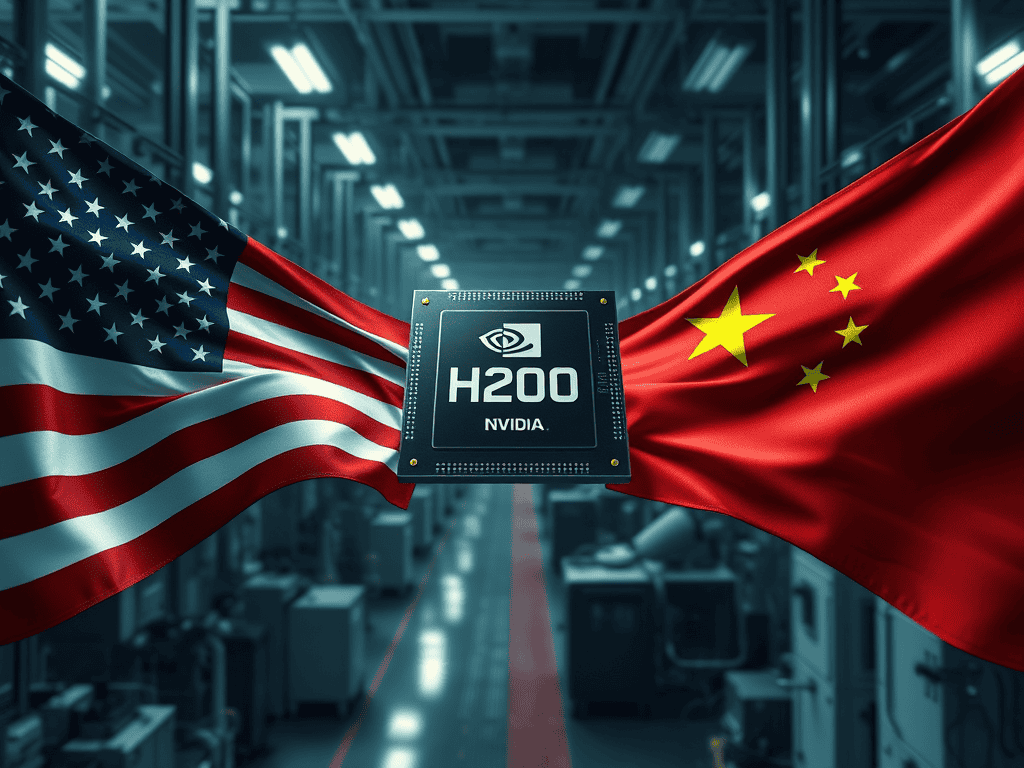
    The global semiconductor landscape has entered a phase of “Crossfire.” Nvidia’s H200 Artificial Intelligence chip, once viewed as the inevitable bridge to the Chinese market under a new United States administration, is increasingly becoming a stranded asset.

    According to a Financial Times report published in late 2025, titled “China boosts AI chip output by upgrading older ASML machines,” Chinese semiconductor fabrication plants are boosting output by retrofitting and upgrading older lithography equipment. This “Retrofit Strategy” allows Beijing to bypass Western export controls while reducing its reliance on American silicon. Simultaneously, Meta Platforms Inc.’s “Mango and Avocado” initiative is creating a high-urgency demand for Nvidia’s Graphics Processing Units, offering a partial, albeit incomplete, “Replacement Strategy” for the revenue at risk.

    Retrofit Sovereignty: China’s Strategic Pivot

    China is no longer waiting for Western permission to advance its hardware. Fabs such as SMIC and Huawei are repurposing deep ultraviolet lithography systems—once dismissed as obsolete—to create a domestic supply chain that effectively undermines United States export leverage.

    • The Upgrade Method: Chinese engineers are retrofitting older ASML machines with secondary-market components, including wafer stages, lenses, and sensors. The goal is to achieve near-advanced performance without requiring the latest generation of Western tools.
    • Target Output: These upgraded systems are now producing Artificial Intelligence chips and advanced smartphone processors that compete directly with high-end Western hardware.
    • The Geopolitical Impact: This shift exposes the fundamental fragility of export control regimes. When older machinery can be enhanced through local engineering, enforcement becomes difficult, and China’s “Silicon Sovereignty” remains intact despite ongoing sanctions.

    The H200 Flashpoint: Trapped in the Crossfire

    Nvidia’s H200 was engineered as a “compromise chip” for the Chinese market, yet it is now pinned between United States export levies and Beijing’s drive for independence.

    • The U.S. Strategy: The administration authorized H200 sales to China with a 25 percent fee, aiming to keep Nvidia dominant in the region while slowing China’s domestic progress.
    • The Chinese Counter: Beijing is signaling a firm rejection of the H200. Interpreting the American fee as a “dependency trap,” China is prioritizing domestic designs and ASML retrofits over Western-designed silicon.
    • The Revenue Blow: Historically, China accounted for 20 to 25 percent of Nvidia’s data center revenue. With the H200 sidelined, investors are now facing a potential 10 billion to 12 billion dollar annualized revenue hole as market forecasts begin to exclude the world’s largest growth market.

    The H200 is caught in a pincer move. Every successful retrofit in a Chinese fab narrows the technology gap and erodes Nvidia’s commercial leverage.

    The Meta Replacement: Capturing Compute Oxygen

    While China attempts to delete Nvidia from its regional map, Meta is providing a necessary buffer. Chief Executive Officer Mark Zuckerberg’s announcement of the Mango and Avocado models signals an urgent “crash-back” into Artificial Intelligence that requires massive amounts of external compute.

    The Opportunity Ledger

    In terms of Hardware, Meta currently lacks proprietary silicon and specialized Tensor Processing Units, making the firm entirely dependent on external hardware. Nvidia dominates this supply, positioning its H100, H200, and Blackwell chips as the indispensable backbone for Meta’s 2026 rollout.

    Replacement Math: Buffer vs. Parity

    To navigate the 2026 cycle, investors must decode whether Meta can truly replace the lost Chinese market. The “Replacement Math” reveals a structural bifurcation in Nvidia’s revenue outlook.

    • The Lost China Market: Nvidia faces a historic share loss that represents roughly 10 billion to 12 billion dollars in annualized revenue at risk. This market is shrinking permanently due to domestic chip independence.
    • The Meta Replacement Opportunity: Nvidia could see a potential 5 billion to 8 billion dollar surge in demand from Meta. While Meta provides higher margins due to the urgency of their catch-up strategy, the total demand does not reach parity with the lost Chinese share.

    Meta offers a strategic buffer, but it cannot fully substitute for the structural loss of the Chinese engine.

    Conclusion

    Nvidia is currently caught between the erosion of its dominance in the East and the capture of dependency in the West. For the investor, the decisive signal remains the Replacement Math: how many buffers does it take to fill a 12 billion dollar hole?

  • Yen Carry Trade: The End of Free Money Era

    Yen Carry Trade: The End of Free Money Era

    The “yen carry trade” is the hidden structural lever of global financial markets. For three decades, it provided a near-permanent subsidy for global leverage. Because the Bank of Japan maintained negative or near-zero rates, investors could borrow yen at effectively no cost to chase higher yields in United States equities, emerging markets, and Bitcoin.

    On December 19, 2025 the Bank of Japan raised its benchmark rate to the highest level in 30 years. This was not a mere policy tweak; it was a systemic liquidity mop-up. By ending the era of “free money,” the Bank of Japan effectively switched off the oxygen supply for global risk trades. This move proves that Bitcoin’s volatility is not illogical, as some have suggested; rather, the asset has functioned as a leveraged macro bet tethered to Japanese monetary sovereignty.

    Decoding the Yen Carry Trade Dynamics

    The carry trade operates as a global rotation mechanism. When Bank of Japan rates are negative or zero, the yen functions as a “funding currency,” providing a structural floor for global risk appetite that lasted for a generation.

    • The Historical Subsidy: For 30 years, the Bank of Japan essentially paid the world to take its currency and invest it elsewhere. This “free leverage” inflated valuations across every liquid risk asset.
    • Global Rotation: Capital flowed relentlessly into high-beta assets. Bitcoin, in particular, became a primary beneficiary of this yen-funded liquidity, offering the highest potential “carry” against the cheapest possible funding.
    • The Policy Shift: When the Bank of Japan raises rates, the “cost of carry” flips. Funding costs rise, and the trade becomes a liability. This triggers an immediate, violent unwind. Investors are forced to sell Bitcoin and other risk assets to pay back the original yen loans before the strengthening yen makes the debt unserviceable.

    The 2025 Liquidity Mop-Up and the Structural Vacuum

    The December 19 marks the first time in a generation that the “yen subsidy” has been decisively removed. This creates a Structural Vacuum in global liquidity that cannot be easily patched.

    The Dynamics of a Global Liquidity Vacuum

    Borrowing in yen is no longer free. This change forces hedge funds and institutions to deleverage. The 140 billion dollar market capitalization wipeout in Bitcoin on December 17 served as the anticipatory settlement of this vacuum. (We have analyzed the flash crash in our earlier article, Understanding Bitcoin’s December 2025 Flash Crash Dynamics

    In terms of global risk assets, we are witnessing a liquidity rotation out of crypto and technology stocks. Analysts warn that with cheap yen funding gone, the “leverage floor” has dropped. Bitcoin could face a structural decline of 20 to 30 percent as the capital that powered its “risk-on” cycles repatriates to Japan.

    The response in the bond market acted as a warning flare. Ten-year Japanese Government Bond yields breached 2 percent for the first time since 1999. This signals that the “mop-up” is systemic, raising yields and tightening liquidity across the entire global debt landscape.

    Can the Federal Reserve Provide the Oxygen?

    As the Bank of Japan creates a vacuum, the market looks to the United States Federal Reserve to provide the “Oxygen” needed to sustain valuations. However, there is a fundamental mismatch in the chemistry of this liquidity.

    The Federal Reserve’s Constraint

    The Federal Reserve is starting from a significantly higher base (3.5 to 3.75 percent) than the Bank of Japan. While the central bank can cut rates to provide relief, it cannot replicate the “negative-rate substrate” that Japan provided for thirty years.

    • Can the Fed fill the vacuum? Only partially. A Federal Reserve rate cut to 2 percent is still “expensive” compared to the near-zero yen. The Fed can provide a “re-breather” tank of liquidity, but it cannot restore the “atmospheric pressure” of free money that the market grew accustomed to since the late 1990s.
    • The Divergence Squeeze: If the Federal Reserve eases while the Bank of Japan tightens, the interest-rate differential narrows. This causes the yen to strengthen rapidly against the dollar, making carry-trade debt even more expensive to pay back and accelerating the Bitcoin liquidation cascade.

    The Federal Reserve can provide “Oxygen,” but it is expensive oxygen. The Bank of Japan was the “atmosphere” of the market; the Fed’s cuts are merely “re-breather” tanks. Even with cuts, the cost of capital remains structurally higher than it was during the “Yen Subsidy” era.

    Conclusion

    The Bank of Japan’s move marks the end of the global subsidy for leverage. While the Federal Reserve can provide liquidity, it cannot provide “free” liquidity. We are entering a new regime where the cost of carry is real and the “oxygen” is metered.

    The December 19, 2025 hike is historic because it transforms the yen from a “free funding currency” into a “liquidity mop-up lever.” Bitcoin volatility is no longer a mystery; it is the most visible expression of the yen carry trade vacuum.

  • Late Entry Risks: Meta’s Challenge Against Google and OpenAI

    Late Entry Risks: Meta’s Challenge Against Google and OpenAI

    On December 18, 2025, Chief Executive Officer Mark Zuckerberg announced Meta Platforms Inc.’s newest Artificial Intelligence models, Mango and Avocado. This announcement signals an aggressive attempt to reclaim relevance in a landscape currently dominated by the “Sovereign Giants,” Google and OpenAI.

    This is more than a product launch; it is a “Crash-Back” Strategy. Meta is attempting to bypass its late-entrant status by hiring elite talent and focusing on “World Models”—Artificial Intelligence systems that learn by ingesting visual data from their environment. While the announcement feels urgent, it reveals a structural fragility: Meta remains dependent on the very compute supply chains that its rivals are actively working to bypass.

    The Mango and Avocado Choreography

    Meta is positioning Mango (image and video generation) and Avocado (text reasoning) as direct counters to Google’s Gemini 3 and the OpenAI Sora and DALL-E ecosystem. Slated for release in early 2026, these models represent Meta’s high-stakes bid for “AI stickiness.”

    The Talent Acquisition Signal

    Meta has moved to “crash the party” by aggressively recruiting from its rivals. Mr. Zuckerberg has hired more than 20 ex-OpenAI researchers, forming a team of over 50 specialists under Meta Superintelligence Labs, led by Alexandr Wang. This mirrors OpenAI’s own early strategy of disintermediating gatekeepers through talent density and speed, as analyzed in our earlier article, Collapse of Gatekeepers

    Meta’s Mango and Avocado represent a “crash-back” move leveraging talent and urgency. Meanwhile, Google choreographs permanence with sovereign stack ownership, and OpenAI choreographs urgency by bypassing traditional gatekeepers.

    Late Entrant Risk: Urgency vs. Entrenched Sovereignty

    Google’s Gemini 3 suite and OpenAI’s multimodal systems were already being integrated into massive user bases by late 2025. This creates a significant “Late Entrant Risk” for Meta.

    The Late Entrant Risk Ledger

    • Timing: Meta is a late entrant with a 2026 release window. Rivals already enjoyed established user loyalty and entrenched ecosystems before Meta’s announcement.
    • User Loyalty: Meta must fight to overcome switching costs as users adopt Google’s search and productivity tools or OpenAI’s creative suites. Google’s integration across Search, Cloud, and Workspace—combined with OpenAI’s massive backing—creates a formidable barrier.
    • Strategic Intent: Meta’s catch-up positioning reveals a vulnerability: the firm must prove relevance instantly or risk being viewed as a permanent follower. Google, by contrast, choreographs permanence through its own hardware and end-to-end stack ownership.
    • Risk Profile: Meta faces the high risk of being boxed out by giants who already own the distribution rails. While OpenAI’s urgency secured its initial sovereignty, Meta’s late entry magnifies its systemic fragility.

    In the world of Artificial Intelligence, user loyalty forms early. Once a user adopts a platform for daily workflows, switching costs rise. Meta’s urgency is a strength, but it cannot mask the reality that late entry magnifies risk even when the “crash-back” intent is sincere.

    The Infrastructure Gap: Sovereignty vs. Dependency

    The most profound fragility in Meta’s strategy is its reliance on external compute. Unlike Google, which owns its own sovereign hardware in the form of Tensor Processing Units (TPUs), Meta does not have proprietary silicon or a vertically integrated compute stack.

    The Compute Dependency Ledger

    • Hardware Sourcing: Meta’s labs plan to use third-party Nvidia Graphics Processing Units, including models such as the H100, B100, and Blackwell. They are also considering Advanced Micro Devices (AMD) accelerators. In contrast, Google utilizes proprietary TPUs—such as Ironwood and Trillium—designed in-house.
    • Supply Chain: Meta remains dependent on vendor availability, pricing, and export controls. Google’s sovereign stack provides an internal roadmap, reducing exposure to external shortages or geopolitical constraints.
    • Optimization and Cost: Meta’s models must be tuned to external hardware. Conversely, Google benefits from deep co-optimization between its TPUs and its software stack. This vertical integration allows Google to achieve lower costs per inference and sovereign economies of scale.
    • Strategic Risk: Meta’s reliance on external vendors exposes it to supply bottlenecks and pricing volatility. Google’s infrastructure sovereignty shields it from these risks, anchoring its position as the more resilient player in the long game.

    The Decisive Battleground: Image and Video Generation

    Meta’s Mango model focuses on image and video generation because these features are the “stickiest” drivers of user retention in consumer Artificial Intelligence applications. By targeting this layer, Meta hopes to bypass the entrenched search and text dominance of its rivals.

    However, the “World Model” approach—learning from environmental visual data—is a high-beta bet. It requires massive compute power and continuous data ingestion, further highlighting Meta’s dependency on the Nvidia and AMD supply chains.

    Conclusion

    Meta’s Mango and Avocado are ambitious bids to reclaim a seat at the sovereign table. But by entering the race after the infrastructure and user habits have already begun to ossify, the firm is navigating a high-risk terrain.

    Meta signals urgency, leveraging elite talent to compete head-on. But without sovereign hardware, it faces the risk of being boxed out by giants who already own the stack. The systemic signal is clear: late entry magnifies fragility, and compute dependency defines the risk profile in the Artificial Intelligence sovereignty race.

  • Understanding Bitcoin’s December 2025 Flash Crash Dynamics

    Understanding Bitcoin’s December 2025 Flash Crash Dynamics

    The short-term price swings of Bitcoin are often dismissed as erratic or driven solely by excessive leverage. However, the events of late 2025—culminating in the violent flash crash of December 17, 2025—reveal a new structural reality. Bitcoin volatility is now fundamentally linked to the crowd-priced probabilities of decentralized prediction markets.

    We are witnessing a profound Liquidity Migration. In the past, prediction markets such as Polymarket were mirrors of cultural attention, capturing celebrity bouts and internet memes. Today, they have evolved into systemic barometers. The heaviest wagers are no longer placed on spectacles. Instead, they focus on the core mechanics of global monetary policy and sovereign governance.

    From Spectacle to Systemic: The Historical Shift

    Earlier in the trajectory of decentralized forecasting, liquidity was dominated by cultural wagers. Markets on celebrity fights and meme-driven questions attracted outsized visibility, and prediction markets were viewed as a novelty. Attention mirrors for the spectacle of the moment.

    By December 2025, a structural shift occurred. Liquidity has migrated from entertainment toward systemic bets that traders view as consequential to the global map.

    • Early Phase (Spectacle): High volumes in cultural events reflected a sentiment-driven market, mirroring meme-cycles rather than financial architecture.
    • Current Phase (Systemic): The largest volumes are now concentrated in macroeconomic and governance markets. Traders treat these as institutional-grade sentiment gauges for systemic risk and capital flows.

    The heaviest wagers currently revolve around the Federal Reserve’s December 2025 rate decision and the nominee for Federal Reserve Chair. These systemic markets now dwarf entertainment wagers, signaling that prediction markets have achieved “Market Authority.”

    Case Study: The December 17, 2025 Flash Crash

    The anatomy of the crash provides definitive proof of this new volatility loop. Within a single ninety-minute window, Bitcoin surged to 91,000 dollars before collapsing back to 85,000 dollars. This swing erased roughly 140 billion dollars in market capitalization in under two hours.

    The Liquidation Cascade

    The move was not driven by news, but by the math of leverage. Approximately 120 million dollars in short positions were liquidated during the initial surge to 91,000 dollars. Immediately after, 200 million dollars in long positions were wiped out as the price reversed. This cascade created a self-reinforcing loop where thin order books accelerated the crash.

    The Macro Rotation

    While Bitcoin and technology stocks (with the Nasdaq down 1 percent) pulled back, a clear capital rotation occurred. Silver hit a record above 66 dollars, up 5 percent, while Gold and Copper gained roughly 1 percent. This confirms the market was not in a generalized panic. Instead, it was performing a strategic rotation from speculative “high-beta” risk into the safety of precious metals.

    The Prediction Market Overlay

    The December 17 crash did not happen in a vacuum. It was preceded by intense positioning in Polymarket’s macro wagers, which acted as the “Atmospheric Pressure” for the asset.

    • The Federal Reserve Decision: Traders overwhelmingly priced in a 25-basis-point cut, with probabilities near 95 percent. This became the single largest macroeconomic wager in prediction market history.
    • The Fed Chair Succession: The nomination market—led by Kevin Hassett at approximately 52 percent probability—is now the pivotal signal for the future direction of United States monetary policy.

    The Dual Diagnostic Mandate

    To navigate this environment, the citizen-investor must adopt a two-lens approach. Price swings that appear “illogical” are actually tethered to the convergence of policy and prediction.

    1. Central Bank Policy (The Structural Lever): This determines the cost of capital and systemic liquidity. Investors must watch the Federal Reserve and the Bank of Japan for “Yen carry trade” signals that set the risk baseline.
    2. Prediction Markets (The Crowd Barometer): Watch platforms like Polymarket for the speed of repricing. When probabilities on rate cuts or political appointments converge, the market has already “decided” the outcome. Bitcoin volatility simply reflects the settlement of that consensus.

    Conclusion

    The era of “illogical” crypto swings has ended. Bitcoin has transitioned into a volatile proxy for global liquidity flows, governed by the probabilities settled on decentralized rails.

    The migration from spectacle to systemic signals a new valuation frontier. If you are not auditing the prediction market consensus, you are misreading the stage. In the Artificial Intelligence and crypto era, the asset is not just the code—it is the crowd’s belief in the next macro move.

  • The Model T Moment for AI: Infrastructure and Investment Trends

    The Model T Moment for AI: Infrastructure and Investment Trends

    The Artificial Intelligence revolution has reached its “Model T” moment. In 1908, Henry Ford did not just launch a car; he initiated a systemic shift through the assembly line, leading to mass production, affordability, and permanence.

    Today, the Artificial Intelligence arms race is undergoing a similar structural bifurcation. On one side, sovereign players are building the “assembly lines” of intelligence by owning the full stack. On the other, challengers are relying on contingent capital that may not survive the long game. To understand the future of the sector, investors must look past the software models and audit the source of funds.

    Timeline Fragility vs. Sovereign Permanence

    The most critical fault line in Artificial Intelligence infrastructure is the capital horizon. Private Equity capital is, by definition, contingent capital. It enters a project with a defined horizon—typically five to seven years—aligned with fund cycles and investor expectations.

    The Problem with the Exit Clock

    • Sovereign Players: Giants such as Google, Microsoft, Amazon, and Meta fund their infrastructure internally via sovereign-scale balance sheets. They have no exit clock. Their capital represents a permanent commitment to owning the physical substrate of the future.
    • Private Equity Entrants: Challengers like Oracle (partnering with Blue Owl) and AirTrunk (backed by Blackstone) are focused on exit strategies. Their participation is designed for eventually-approaching Initial Public Offerings, secondary sales, or recapitalizations.

    The fragility point is clear: Artificial Intelligence infrastructure requires a decade-scale gestation. If a project’s requirements exceed a Private Equity fund’s seven-year window, capital fragility emerges. Projects risk being stalled or abandoned when the “exit clock” clashes with the necessary growth cycle.

    The Model T Analogy: Building the Assembly Line

    Legacy media frequently defaults to “bubble” predictions when witnessing setbacks or cooling investor appetite. However, a sharper lens reveals this is not about speculative froth—it is about who owns the stack versus who rents the capital.

    Sovereign players are building the “assembly lines”—the compute, the cloud, and the models—as a permanent infrastructure. Private Equity entrants resemble opportunistic investors in early automotive startups: some will succeed, but many are designed for a rapid exit rather than a hundred-year reign.

    OpenAI’s “Crash the Party” Strategy

    The strategy of OpenAI provides a fascinating study in urgency versus permanence. Facing a sovereign giant like Google, OpenAI’s strategy has been to bypass traditional gatekeepers and sign deals rapidly. The intent is to “crash the party” before competitors can consolidate total dominance.

    The Collapse of Gatekeepers

    As analyzed in our dispatch, Collapse of Gatekeepers, OpenAI executed approximately 1.5 trillion dollars in infrastructure agreements with Nvidia, Oracle, and Advanced Micro Devices (AMD) without the involvement of investment banks, external law firms, or traditional fiduciaries.

    • The Urgency: By 2024 and 2025, OpenAI moved to secure scarce resources—chips, compute, and data centers—at an unprecedented pace.
    • The Trade-Off: This speed came at the cost of oversight. By bypassing gatekeepers, OpenAI avoided delays but created a governance breach. There is no external fiduciary review or independent verification for these multi-trillion-dollar agreements.

    OpenAI’s strategy reflects high-velocity urgency against Google’s mega-giant dominance. While sovereign giants like Google choreograph permanence through structured oversight, OpenAI choreographs urgency through disintermediation.

    The Investor’s New Literacy

    To navigate this landscape, the citizen and investor must become cartographers of capital sources. Survival in the 2026 cycle requires a new forensic discipline.

    How to Audit the AI Stage

    1. Audit the Timeline: When a Private Equity firm enters a deal, review their public filings and investor relations reports. What is their historical exit horizon? If they consistently exit within five to seven years, their current Artificial Intelligence entry is likely framed by that same clock.
    2. Audit the Source of Funds: Sovereign capital signals resilience. Private Equity capital signals a timeline. Treat Private Equity involvement as contingent capital rather than a sovereign commitment.
    3. Audit the Choreography: Identify who is at the table. The absence of traditional gatekeepers in OpenAI’s deals signals a “speed-over-oversight” posture.
    4. Distinguish the Players: Google, Microsoft, Amazon, and Meta are building the assembly lines. Challengers are experimenting with external capital that may not sustain the long game.

    Conclusion

    The Artificial Intelligence arms race is splitting into Sovereign Resilience versus External Fragility. Sovereign players fund infrastructure as a permanent substrate, signaling resilience through stack ownership and internal Capital Expenditure. Private Equity firms enter with exit clocks ticking, signaling that their involvement is a timeline-contingent play.

    In the Artificial Intelligence era, the asset is not just the code; it is the capital and the timeline that supports it. To decode the truth, you must ask: Who funds the stack, and how long are they in the game? Those who mistake contingent capital for sovereign commitment will be the first to be left behind when the exit clocks run out.

  • Oracle’s AI Cloud Setback: The Price of Rented Capital

    Oracle’s AI Cloud Setback: The Price of Rented Capital

    A definitive structural signal has emerged from the heart of the Artificial Intelligence infrastructure race. Blue Owl Capital has reportedly pulled out of funding talks for Oracle’s proposed 10 billion dollar Michigan data center.

    While the news has reignited investor concerns over a potential “AI bubble,” this is in fact a deeper structural issue. This is not merely about speculative froth cooling. It is about a systemic fault line opening between companies that own their capital and those that must rent it. In the sovereign-scale Artificial Intelligence arms race, “owning the stack” is the only path to permanence. And that stack now includes the balance sheet itself.

    The Fragmentation of AI Capital Expenditure

    The Oracle setback highlights a growing divergence in how “Big Tech” builds the future. While peer “hyperscalers” such as Microsoft, Google, and Amazon fund their massive infrastructure internally via sovereign-scale balance sheets, Oracle has increasingly relied on external Private Equity partners to bridge the gap.

    In a race defined by high-velocity deployment, the source of capital has become a primary risk vector.

    The Fragility of Rented Capital

    Relying on external private equity introduces a level of contingency that sovereign-funded rivals do not face.

    • Opportunistic vs. Sovereign: Private equity firms operate on return-driven mandates, not sovereign-scale visions. They are focused on Return on Investment and specific exit timelines. They are not in the business of owning the substrate of human intelligence for the next century.
    • The Fragility of Terms: When funding talks stall, the narrative shifts instantly from “inevitability” to “fragility.” For a challenger like Oracle, losing a backer like Blue Owl compromises its ability to compete in a cloud arms race that waits for no one.
    • Capital Velocity: Internally funded players move at the speed of their own conviction. Externally financed players are subject to the fluctuating risk appetite of third-party lenders who may be cooling on multi-billion dollar mega-projects.

    Oracle’s reliance on external capital exposes a fundamental structural weakness. Without a sovereign-scale balance sheet, its ability to maintain pace in the Artificial Intelligence cloud race is physically constrained by the terms of its “rent.”

    The AI Stack Sovereignty Ledger

    The following analysis contrasts the resilient, sovereign-funded players with the externally financed challengers vulnerable to market shifts.

    Sovereignty vs. Fragility

    • The Capital Base: Sovereign-funded giants (Google, Microsoft, Amazon) utilize internal balance sheets and deep strategic partnerships. Externally financed challengers (Oracle) depend on the volatile commitment of firms like Blue Owl.
    • Infrastructure Ownership: The “Sovereign” class owns the full stack—from proprietary Tensor Processing Units and Graphics Processing Units to the global cloud distribution. The “Rented” class must seek external financing just to expand its physical footprint.
    • Strategic Positioning: Internally funded players maintain a long-game commitment. Externally financed firms remain vulnerable to project delays and the withdrawal of lender interest.
    • Narrative Control: Sovereigns can choreograph the inevitability of their dominance through internal distribution rails. Challengers see their fragility exposed the moment external capital pulls back, undermining market confidence.
    • Resilience: The leaders are diversified and redundant. The challengers remain structurally contingent on the risk appetite of external financiers.

    The Search for Resilient Anchors

    The market is already rewarding those who secure sovereign-scale anchors. We can see this in the evolving choreography of OpenAI.

    Initially, OpenAI was fragile—dependent on a single cloud partner (Microsoft). However, a potential 10 billion dollar deal with Amazon, analyzed in Amazon–OpenAI Investment, signals a move toward dual-cloud resilience. OpenAI is systematically aligning itself with sovereign players who are committed to the long game.

    By contrast, Oracle’s reliance on Blue Owl represents a high-risk, high-reward bet that lacks the durable, internal capital required to build a permanent global substrate.

    Implications for the Tech Sector

    The Michigan episode reinforces concerns about over-extension in Artificial Intelligence Capital Expenditure. We are witnessing a definitive bifurcation in the market:

    1. Sovereign Resilience: Players who fund infrastructure internally and truly “own the stack.”
    2. External Fragility: Players who risk total project collapse when external capital cycles turn cold.

    Investors must now treat announcements of Private Equity involvement in mega-projects with extreme caution. The question for 2026 is no longer “is there a bubble?” but rather, “is the capital durable?”

    Conclusion

    Oracle’s Michigan data center was intended to anchor its Artificial Intelligence cloud expansion. Instead, it has anchored the case for Stack Sovereignty.

    Private equity is focused on Return on Investment, not systemic dreams. Sovereign players are in the long game, building durable infrastructure that can survive a decade of setbacks. For the investor, the conclusion is clear: do not mistake a large commitment of “rented capital” for a sovereign commitment to the future. In the intelligent age, those who do not own their capital will eventually be owned by their debt.

  • How JPMorgan’s Reserve Shift Impacts Crypto Liquidity Dynamics

    How JPMorgan’s Reserve Shift Impacts Crypto Liquidity Dynamics

    The decision by JPMorgan Chase & Co. to withdraw approximately 350 billion dollars from its cash reserves parked at the Federal Reserve is a seminal event in modern banking choreography. The firm plans to redeploy that capital into United States Treasuries, marking a significant shift in how the world’s largest bank manages its “idle” liquidity.

    Coinciding with a weakening labor market—highlighted by a 4.6 percent unemployment rate—and rising recession risks, this move is not a signal of distress. Rather, it is a calculated act of Yield Optimization. This represents a “Liquidity Choreography”: a strategic migration of confidence away from private interbank lending and toward the perceived safety of sovereign debt. The key for investors is decoding how this shift indirectly tightens the plumbing for high-beta risk assets, specifically Bitcoin and the broader crypto market.

    Decoding the Banking Choreography

    JPMorgan’s 350 billion dollar pivot is a rational response to current macroeconomic conditions, but it fundamentally reshapes how liquidity flows through the global financial system.

    Liquidity Dynamics and Confidence Migration

    • From Reserves to Treasuries: When cash parked at the Federal Reserve shrinks, the amount of immediate, “flexible” liquidity available for interbank lending also contracts. That capital is converted into sovereign debt, which currently offers more attractive yields than Federal Reserve deposits.
    • Collateral Reframing: While Treasuries remain highly liquid in Repo Markets and can be pledged as collateral, the bank’s ultimate lending capacity is not eliminated. However, liquidity becomes structurally less flexible for immediate, high-risk allocations.
    • The Confidence Signal: Buying Treasuries signals a preference for sovereign debt as the safest yield play in a volatile environment. It is a migration of conviction: moving capital from speculative risk assets toward the bedrock of sovereign safety.

    JPMorgan is performing a “Safety Pivot.” The systemic message is clear: confidence is migrating from flexible central bank deposits toward guaranteed sovereign returns, signaling a defensive posture amidst policy uncertainty.

    The Indirect Tightening on Crypto

    The migration of 350 billion dollars into Treasuries creates a “Secondary Squeeze” on crypto liquidity, even without JPMorgan selling a single Satoshi.

    The Treasury–Crypto Liquidity Ledger

    • Reduced Speculative Flows: When major institutions migrate liquidity into Treasuries, they reduce the “marginal dollar” available for high-beta risk assets. As a result, speculative vehicles like Bitcoin and various altcoins have less excess liquidity to draw from.
    • Higher Funding Costs: Tighter systemic liquidity inevitably raises the cost of leverage across all markets. The crypto sector, which operates with high degrees of leverage in Perpetual Futures, feels this squeeze immediately through rising funding rates for margin trading.
    • Collateral Preference: Treasuries strengthen the collateral base of the traditional financial system. This makes high-quality sovereign debt significantly more attractive to institutional lenders than the volatile crypto collateral often used in decentralized finance.

    JPMorgan’s move effectively drains the “speculative oxygen” from the room. As 350 billion dollars shifts into Treasuries, the relative bid for crypto weakens as the cost of maintaining leveraged positions climbs.

    The Contingent Signal—The Bank Cascade

    The ultimate structural impact on the crypto market hinges on whether JPMorgan is an isolated mover or the first domino in a broader Bank Cascade.

    The Cascade Ledger: First Mover vs. Peer Response

    • JPMorgan (The First Mover): By pulling 350 billion dollars, they have created an initial headwind for speculative flows, signaling a clear preference for sovereign safety.
    • Peer Banks (The Follow Scenario): If other major financial institutions reallocate their reserves en masse into Treasuries, the liquidity migration will accelerate. This would weaken crypto demand further as funding costs spike across the board.
    • Peer Banks (The Resist Scenario): If competitors maintain their current reserve levels or expand lending into riskier assets, crypto may retain enough “speculative oxygen” to cushion the impact of JPMorgan’s exit.

    Indicators to Watch

    To navigate this tightening cycle, the citizen-investor must monitor three specific telemetry points:

    1. Federal Reserve H.4.1 Reports: Track the overall bank reserve balances held at the central bank to see if other institutions are following JPMorgan’s lead.
    2. Crypto Funding Rates: Watch the perpetual futures funding rates on major exchanges; these will reflect tightening liquidity faster than any other metric.
    3. Repo Spreads: Monitor the gap between Treasury yields and risk-collateral rates to gauge the market’s true appetite for safety.

    Conclusion

    JPMorgan’s 350 billion dollar move is the first domino in a new era of capital discipline. While the bank is simply seeking the best risk-adjusted return, the systemic impact is a tightening of the rails that crypto depends on for growth.

    This is Sovereign Choreography in action. Liquidity is moving to where the bank believes safety and guaranteed yield reside. If the “Bank Cascade” becomes systemic, the era of easy speculative liquidity will reach its terminal phase, leaving crypto to compete for a shrinking pool of institutional capital.