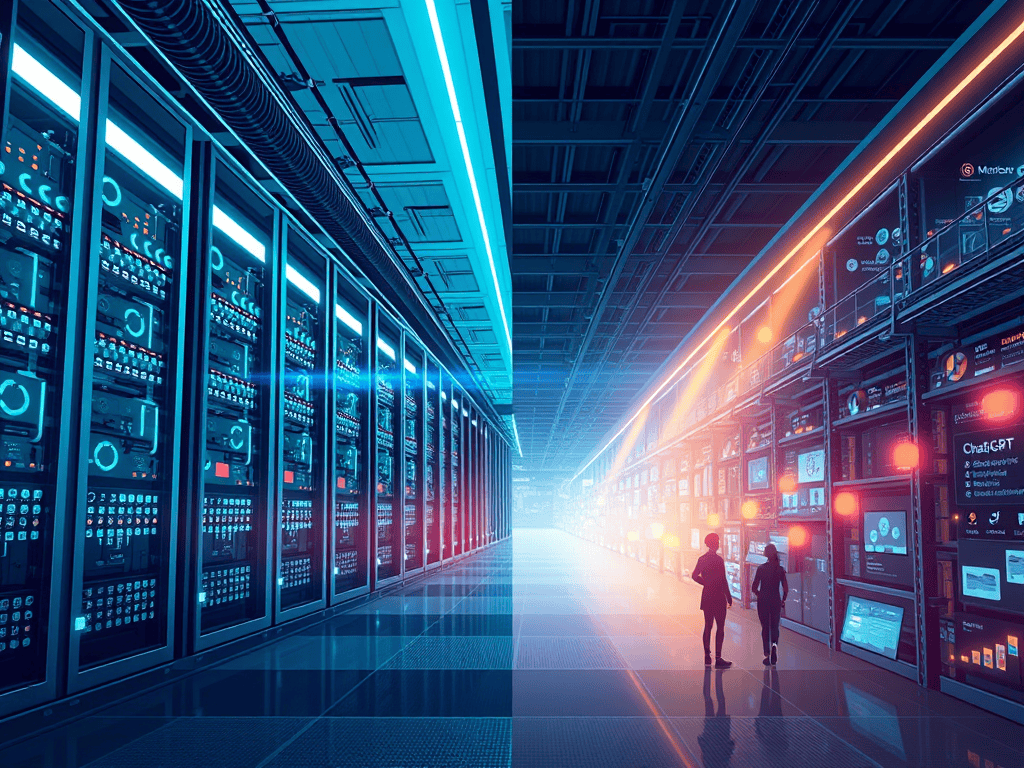
Category: The Truth Cartographer

Critical field reports exposing digital infrastructure, tokenized governance, and the architecture of deception across global systems. This article challenges the illusion of innovation and maps the power behind the platform.

  • Google Didn’t Beat ChatGPT — It Changed the Rules of the Game

    Google Didn’t Beat ChatGPT — It Changed the Rules of the Game

    Summary

    • Google’s Gemini hasn’t outthought ChatGPT — it rewired the ground beneath AI.
    • The competition has shifted from model benchmarks to infrastructure ownership.
    • ChatGPT leads in cultural adoption; Gemini leads in distribution and compute scale.
    • The real future of AI will be defined by who controls the hardware, software stack, and delivery rails.

    Benchmarks Miss the Power Shift

    The Wall Street Journal framed Google’s Gemini as the moment it finally surpassed ChatGPT. But this framing mistakes measurement for meaning.

    Benchmarks do not capture power shifts — they capture performance under artificial constraints.

    Gemini did not “beat” ChatGPT at intelligence. It did something more consequential: it rewired the terrain on which intelligence operates. Google shifted the contest away from pure reasoning quality and toward infrastructure ownership — compute, distribution, and integration at planetary scale.

    ChatGPT remains the reference point for knowledge synthesis and open-ended reasoning. Gemini’s advantage lies elsewhere: in the vertical control of hardware, software, and delivery rails. Confusing the two leads to the wrong conclusion.

    Owning the stack does not automatically confer cognitive supremacy. It confers structural leverage — the ability to embed intelligence everywhere, even if it is not the most capable mind in the room.

    Infrastructure vs Intelligence: A New Framing

    OpenAI’s ChatGPT has dominated attention because people see it as the front door to reasoning and knowledge synthesis. Millions use it every day because it feels smart.

    But Google’s strategy with Gemini is different.

    ChatGPT runs on compute supplied by partners, relying on rented cloud infrastructure and publicly shared frameworks. You could think of this as intelligence without territorial control.

    Gemini, on the other hand, runs on Google’s own silicon, proprietary software stacks, and massive integrated cloud architecture. This is infrastructure sovereignty — Google owns the hardware, the optimization layer, and the software pathways through which AI runs.

    Compute, Software, and Cloud: The Real Battlefield

    There are three layers where control matters:

    1. Compute Hardware

    Google’s custom chips — Tensor Processing Units (TPUs) — are designed and controlled inside its own ecosystem. OpenAI has to rely on externally supplied GPUs through partners. That difference affects both performance and strategic positioning.

    2. Software Ecosystem

    Gemini’s foundations are tightly integrated with Google’s internal machine-learning frameworks. ChatGPT uses public frameworks that prioritize democratization but cede control over optimization and distribution.

    3. Cloud Distribution

    OpenAI distributes ChatGPT mainly via apps and enterprise partnerships. Google deploys Gemini through Search, YouTube, Gmail, Android, Workspace, and other high-frequency consumer pathways. Google doesn’t need to win users — it already has them.

    This layered combination gives Google substrate dominance: the infrastructure, software, and channels through which AI is delivered.

    Cultural Adoption vs Structural Embedding

    OpenAI has cultural dominance. People think “ChatGPT” when they think AI. It feels like the face of generative intelligence.

    Google has infrastructural dominance. Its AI isn’t just a product — it’s woven into the fabric of global digital experiences. From search to maps to mobile OS, Gemini’s reach is vast — and automatic.

    This is why the competition isn’t just about performance on tests. It’s about who controls the rails that connect humans to intelligence.

    What This Means for the Future of AI

    If you’re thinking about “who the winner is,” the wrong question is which model is smarter today.

    The right question is:

    Who owns the substrate on which intelligence must run tomorrow?

    Control of compute, software, and delivery channels define not just performance, but who gets to embed AI into everyday life.

    That’s why Google’s strategy should not be dismissed as “second to ChatGPT” based on raw reasoning benchmarks. Gemini’s rise represents a power shift in architecture, not a simple head-to-head model race.

    Conclusion

    Google didn’t defeat ChatGPT by training a better model.

    It rewired the terrain of competition.

    In the next era of AI, the victor won’t be the system that thinks best —
    it will be the system that controls:

    • the compute base
    • the software substrate
    • the distribution rails

    OpenAI may own cultural adoption — but Google owns the infrastructure beneath it.

    And that’s a fundamentally different kind of power.

    Further reading:

  • Bitcoin Is Yet to Pass the ERISA Line

    Bitcoin Is Yet to Pass the ERISA Line

    JP Morgan Is Not Blocking Bitcoin. It Is Protecting a Covenant.

    JP Morgan signals support for MSCI’s proposal to exclude “crypto treasury firms” from equity indexes. The reaction from Bitcoin advocates is swift. They accuse JP Morgan of gatekeeping, suppression, and anti-innovation bias. But the decision is not about ideology. It is about fiduciary duty. Index providers serve as conduits into retirement portfolios governed by ERISA. Their role is not to democratize risk, but to eliminate any exposure that cannot be defended under oath.

    Indexes Are Not Market Catalogs — They Are Fiduciary Pipelines

    Trillions in passive capital track equity indexes such as MSCI Global Standard, ACWI, and US Large/Mid Cap. Much of this capital comprises retirement savings. Inclusion implies suitability for investors. Their assets are bound not by risk appetite but by a legal covenant: the Employee Retirement Income Security Act of 1974 (ERISA).

    Under ERISA, a portfolio is not a financial product.
    It is a liability-bound promise.

    ERISA Sets the Boundary, Not Market Innovation

    Three statutory provisions form the line that crypto treasury firms cannot yet cross:

    • Section 404(a)(1) — Prudence Standard
      Fiduciaries must act with “care, skill, prudence, and diligence under the circumstances then prevailing.”
      Bitcoin treasury exposure introduces valuation opacity. It causes sentiment-driven volatility and unpredictable drawdowns. No prudent expert can justify this in a retirement portfolio.
    • Section 406 — Prohibited Transactions
      Fiduciaries must not expose plan assets to arrangements involving self-dealing or conflict of interest.
      Crypto treasury firms often hold disproportionate insider positions or balance-sheet exposures that materially benefit executives and early holders. This creates a structural conflict that compliance cannot neutralize.
    • Section 409 — Personal Liability
      Fiduciaries are personally liable for losses resulting from imprudent decisions.
      Without standardized custody controls, auditable valuation, and predictable liquidity, no fiduciary can defend crypto-linked equity exposure in litigation.

    Under ERISA, a product is not disqualified because it might fail, but because its risk cannot be proven prudent.

    Index Is a Risk Boundary, Not a Policy Position

    Funding ratios, beneficiary security, and trustee liability—not innovation—govern index eligibility. By supporting MSCI’s exclusion, JP Morgan is not opposing the asset class. It is ensuring that fiduciaries do not receive products that could later expose them to legal action.

    Bitcoin advocates mistake exclusion for attack.
    Institutional finance reads it as compliance.

    This Is Not Market Hostility. It Is Process Integrity.

    JP Morgan invests in blockchain infrastructure, tokenization, and settlement rails. It has no interest in prohibiting innovation.

    Conclusion

    Index providers are not arbiters of technological relevance. They are guardians of fiduciary admissibility.
    Until crypto treasury firms can satisfy prudence (404), conflict hygiene (406), and liability defensibility (409), exclusion is not discrimination.
    It is risk containment.

    Further reading:

  • Recycling Waste into Compute

    Recycling Waste into Compute

    Urban Mining Is Compute Supply.

    Recycling rare-earths and critical minerals has been treated as climate virtue — a sustainability footnote for responsible technology. But when AI growth runs into material bottlenecks, recycling becomes procurement. Cities turn into mineral reservoirs. Old electronics become GPU feedstock. Urban mining is the only scalable way to defend compute capacity. It does not require waiting for new mines, new refineries, or new geopolitics.

    Cities as Mineral Warehouses — E-Waste as Sovereign Stockpile

    Landfills hold more gallium, neodymium, graphite, and cobalt than many mines. Phones contain magnets. Servers contain thermal materials. EV batteries contain rare-earth concentrates. Countries with dense electronics waste don’t just have recycling problems — they have undeclared mineral inventories. The nations that build fast extraction pipelines will own the mid-term buffer for AI hardware. Resource will come not from mining mountains, but from mining the past.

    The First Real Bottleneck — Not Extraction, Recovery

    Recycling is not limited by the amount of material available. It is limited by throughput, purity, and logistics. Unlike traditional mining, recycled minerals require high-precision, low-contamination yield to qualify for AI-grade packaging, magnets, and cooling systems. This elevates recycling from trash-processing to high-spec manufacturing. The bottleneck is not waste volume — it is industrial chemistry.

    Circularity Becomes a Procurement Market — Not Environmental Policy

    Cloud providers and chipmakers will not sponsor recycling because of public pressure. They will do it because material scarcity dictates production cadence. NVIDIA will care about recovery rates. AWS and Azure will care about disassembly logistics. The moment recycled gallium or rare-earth concentrates secure pipeline reliability, procurement divisions will treat recyclers like upstream suppliers. Circularity becomes a supply contract, not a pledge.

    Vertical Integration — AI Labs Acquire Feedstock

    Scarcity flips incentives. AI labs will stop lobbying for environmental credits. They will instead acquire rights to scrap streams, server returns, EV teardown facilities, and data-center disposal. Intelligence production will require feedstock agreements. This produces a strange inversion: model labs owning recycling plants, cloud providers acquiring urban-mining startups, semiconductor firms building disassembly hubs. Lab-to-landfill supply will collapse into a single stack.

    From Waste to Security Asset — Strategic Stockpiles of Scrap

    Governments once stockpiled oil and grain. Next, they will stockpile EV batteries, wind-turbine magnets, discarded servers, and chip packaging scrap. Recycling becomes a national resilience play. Cities become logistical nodes in sovereign compute planning. The waste stream becomes a defense asset. The line between garbage management and security economics will disappear.

    Conclusion

    Urban waste becomes a resource. Circularity becomes industrial strategy. Nations and companies that mine their own discard streams will protect their compute capacity. Those who depend on fresh extraction will have to depend on geopolitics.

    Further reading:

  • The Mine Beneath Intelligence

    The Mine Beneath Intelligence

    AI Begins Underground

    AI is not just a race for smarter algorithms. It is also a race for the minerals that let intelligence exist in the first place. Every GPU, every large model, and every inference burst on a cloud server begin as rock. They are dug from the earth, purified, refined, and finally made into high-bandwidth memory (HBM)-stacked silicon. Before compute becomes cognition, it is geology. And the actor that controls geology controls acceleration.

    The Mine Beneath the Model — How Geology Becomes Intelligence

    Gallium, graphite, rare-earth magnets, and specialty metals form the unseen substrate of AI. They are not chips. They are not circuits. They are the material scaffolds that make circuits fast enough, cool enough, and dense enough to sustain model training. AI is a mineral economy wearing a digital costume. China does not merely excavate the raw ore. It dominates the refining process — the chokepoint where rock becomes cognitive infrastructure.

    From Ore to Cognition — The Path of Intelligence

    Ore is valueless until refined. Refining is valueless until assembled. Assembly is valueless until packaged with HBM — the high-bandwidth memory that moves data fast enough to keep accelerators alive. Without HBM, GPUs starve. Without advanced packaging, HBM overheats. And without rare-earth-dependent thermal materials and interconnects, packaging is impossible. The world thinks Nvidia sells compute. Nvidia actually sells refined minerals in high-density formation.

    Excavation — China’s Hidden Compute Monopoly

    The U.S. can mine. Europe can subsidize. Japan can innovate. None can refine at China’s scale. Extraction is not sovereignty — purification is. China controls gallium and graphite exports because it controls the refinery architecture, not the mine output. Mines are replaceable. Refining ecosystems are not. This is why export restrictions on gallium and graphite sent shockwaves through AI markets: the leverage is industrial, not geological. Sovereignty sits in the furnace, not in the soil.

    The Price of Dependency — Rationed Intelligence

    If China constrains AI mineral flows, the immediate effect is not empty shelves — it is rationed cloud capacity. GPU shipments slow. HBM packaging bottlenecks. Cloud providers prioritize Tier-1 demand. Mid-sized AI builders are pushed out of compute markets and forced to compress models instead of scaling them. AI stops being a race for scale and becomes a race for efficiency. When minerals tighten, models shrink. Scarcity rewrites architecture.

    The Allied Counter-Mine — Sovereignty by Diversification

    Allied recovery has already begun, but it is slow, fragmented, and expensive. Australia’s Lynas expands refining. The U.S. Mountain Pass mine is rising again. Europe is stockpiling. Japan and Korea are increasing recycling. Southeast Asia is quietly becoming a refinery logistics hub — a neutral ground for mineral diplomacy. Independence will not come from mining more — it will come from refining outside China’s shadow.

    Conclusion

    The world thinks AI is a story about data, algorithms, and acceleration. But the real story begins in mines, continues in furnaces, and ends in sovereignty. Intelligence is geological before it is computational. Until nations secure control of the rocks that become cognition, they will not control the future they are building.

    Further reading:

  • Bitcoin’s Sell Pressure Is Mechanical

    Bitcoin’s Sell Pressure Is Mechanical

    The Crash Was Institutional, Not On-Chain

    Bitcoin’s sharp drop was blamed on whale liquidations, DeFi leverage, and cascading margin calls. Those were visible triggers, but not the cause. The crash began off-chain. In 2025, Spot Bitcoin ETFs experienced their heaviest daily outflows. Nearly $900M was pulled in a single trading session. This selling did not emerge from panic or belief. It emerged from portfolio rotation. Institutions didn’t abandon Bitcoin. They returned to Treasuries.

    Macro Reflexivity — ETF Outflows as Liquidity Rotation

    Spot Bitcoin Exchange Traded Funds (ETFs) operate on a mandatory cash-redemption model in the U.S. When investors redeem ETF shares, the fund must sell physical Bitcoin on the spot market. This forces Bitcoin to react directly to macro shifts like dollar strength, employment data, and bond yields. When safer yield rises, ETF redemptions pull liquidity from Bitcoin automatically. The sell pressure isn’t emotional — it is mechanical. Bitcoin doesn’t trade sentiment. It trades liquidity regimes.

    This choreography applies at $60K, $90K, or $120K. Macro reflexivity doesn’t respond to price levels. It only responds to liquidity regimes and yield incentives.

    Micro Reflexivity — Whale Margin Calls as Amplifiers

    Once ETF outflows suppressed spot liquidity, whales’ collateral weakened. Leveraged positions lost their safety margin. Protocols do not debate risk; they enforce it at machine speed. When a health factor drops below 1.0 on Aave or Compound, liquidations begin automatically. Collateral is seized and sold into a falling market with a liquidation bonus to incentivize speed. Margin is not a position — it is a trapdoor. When ETFs drain liquidity, whales fall through it.

    Crash Choreography — Macro Drains Liquidity, Micro Amplifies It

    Macro shock (jobs data, rising yields) → ETF redemptions pull BTC liquidity
    ETF selling suppresses spot price → whale collateral breaches thresholds
    Machine-speed liquidations cascade → forced selling accelerates price drop

    The crash wasn’t sentiment unraveling. It was liquidity choreography across two systems — Traditional Finance rotation and DeFi reflexivity interacting on a single asset.

    Hidden Transfer — Crash as Redistribution, Not Exit

    ETF flows exited Bitcoin not because it failed, but because Treasuries outperformed. Mid-cycle traders sold into weakness. Leveraged whales were liquidated involuntarily. Yet long-term whales and tactical hedge funds accumulated discounted supply. The crash redistributed sovereignty — from weak, pressured hands to conviction holders and high-speed capital.

    Conclusion

    Bitcoin did not crash because belief collapsed. It crashed because liquidity rotated. ETF outflows anchor Bitcoin to Wall Street’s macro cycle, and whale liquidations amplify that anchor through machine-speed enforcement. The drop was not abandonment — it was a redistribution event triggered by a shift in yield. Bitcoin trades macro liquidity first, reflexive leverage second, belief last.

    Further reading:

  • How DeFi Replaced Traditional Credit Approval System with Code

    How DeFi Replaced Traditional Credit Approval System with Code

    Risk Without Relationships

    In traditional finance, credit is negotiated. Leverage is personal. Counterparty risk is priced through relationships. It depends on who you are and how much you trade. It also depends on whether your prime broker thinks you matter. In decentralized finance (DeFi), none of that exists. A protocol does not know your name, reputation, or balance sheet. It only knows collateral. You don’t receive credit. You post it. Risk becomes impersonal. Leverage becomes mathematical. The system replaces human discretion with executable judgment.

    Collateral Supremacy — The End of Character Lending

    Banks lend against a mixture of collateral and trust. DeFi lends against collateral alone. The system does not believe in character, history, or narrative. It believes in market price. The moment collateral value drops, the system acts — without negotiation, without sympathy, and without systemic favors. MakerDAO does not rescue large borrowers. Aave does not maintain client relationships. There are no special accounts. No preferential terms. In this market, solvency is not a social construct — it is a calculation.

    Interest Rates as Automated Fear

    Borrowing costs are not determined in meetings or set by risk analysts. They are discovered dynamically through utilization ratios: when borrowers crowd into a stablecoin, the borrow rate spikes automatically. Fear is priced by demand. Panic becomes cost. High rates are not a policy response; they are a market reaction encoded in protocol logic. The system does not ask whether borrowers can afford the increase. It raises the rate until someone exits. Interest becomes an eviction force.

    Liquidation As Resolution, Not Punishment

    In traditional finance, liquidation is a last resort — preceded by calls, extensions, renegotiations, and strategic forgiveness for elite clients. In DeFi, liquidation is not a failure. It is resolution. The liquidation bonus incentivizes arbitrageurs to close weak positions instantly. A whale can be erased in seconds. The market protects itself not through supervision but through profit. Bankruptcy becomes a bounty. Default becomes a competition. Risk is not mitigated privately — it is resolved publicly.

    Systemic Autonomy — Protocols as Central Banks Without Balance Sheets

    Aave, Maker, Compound — they are not lenders. They are rule engines. They do not make loans. They permit loans. They do not manage risk. They encode risk management. Their policies are not communicated. They are executed. They do not need capital buffers like banks because they do not extend uncollateralized credit. Their solvency model is prophylactic: prevent risk by denying leverage depth, not by absorbing losses.

    Conclusion

    DeFi is the automation of risk governance. The protocol is a central bank without discretion, a prime broker without favoritism, and a risk officer without emotion. It does not negotiate, extend, forgive, or trust. It enforces. By removing human judgment and political discretion from leverage, DeFi has created the first financial system where discipline is structural. The result is an economy where credit allocation is not a privilege granted by institutions. Instead, it is a calculus executed by machines.

    Further reading:

  • Shadow Banking at Machine Speed

    Shadow Banking at Machine Speed

    Leverage Without Banks

    Decentralized finance (DeFi) has built a shadow-banking system that does not hide risk behind balance sheets or prime brokers. It exposes it. Whale leverage is visible in real time, enforced by code, and liquidated at machine speed. Traditional finance treats margin as a private contract negotiated with a broker. DeFi treats margin as public debt, enforceable by anyone with a bot, rewarded with liquidation bounties. In this market, leverage is not a secret. It is a ledger.

    Margin Detection — Collateral + Stablecoin Borrowing

    Whale financing does not require regulatory filings. Two observable conditions must be met. First, there is the placement of large volatile collateral, such as ETH, BTC, or RWA tokens. Second, there is the borrowing of stablecoins against it, like USDC and DAI. In DeFi, these actions are not hidden in pooled accounts. They are tagged, clustered, and traceable. Borrowing becomes a systemic broadcast: whales cannot borrow without signaling their leverage to the entire market. Margin becomes not a privilege of size, but a transparent commitment of debt.

    Machine Enforcement — Auto-Liquidation as Monetary Policy

    Traditional markets liquidate positions through risk desks, brokers, and negotiated calls. DeFi liquidates via incentives. When a whale’s health factor drops, liquidation becomes a public bounty. Bots race to liquidate the position and take a percentage cut of the collateral. This penalty is the enforcement mechanism. It turns liquidation into a programmatic market function, not a negotiated escape. In DeFi, liquidation is not an emergency. It is monetary policy: a forced deleveraging mechanism that maintains solvency by design.

    Reflexive Choreography — Boom and Bust in Code

    Whale leverage amplifies the cycle. Rising collateral value increases borrowing capacity, enabling more accumulation, reinforcing the rally. This reflexive rise is not unique to crypto. What is unique is how its reversal unfolds. When collateral falls, liquidation is not delayed by regulators or waived through rescue. It cascades instantly. Forced sales accelerate price decline, breach more collateral thresholds, and trigger more liquidations. The cycle is visible, measurable, and enforceable. DeFi’s greatest strength—transparency—is also its amplifier of fragility.

    Risk — Protocols as Prime Brokers

    Traditional shadow banking hides its risk in opacity: prime brokers, private credit desks, unreported leverage. DeFi reverses the doctrine. It does not rely on human judgment to gate risk. It relies on predetermined collateral factors, liquidation thresholds, and caps set through governance. Aave and MakerDAO do not negotiate risk. They parametrize it. They do not rescue borrowers. They auction them. The protocol becomes the risk officer, the bank, and the clearing mechanism. Power shifts from institutions to parameters.

    Conclusion

    DeFi did not replicate shadow banking. It inverted it. Traditional finance hides leverage to protect institutions. DeFi exposes leverage to protect the system. In this architecture, liquidation is not failure. It is governance. Leverage is not privilege. It is collateralized debt in public view. Shadow banking at machine speed is not a threat to markets. It is a new form of monetary enforcement where transparency replaces trust, liquidation replaces negotiation, and code replaces discretion.

    Further reading:

  • Quantum Computing — Compute Becomes a National Resource

    Quantum Computing — Compute Becomes a National Resource

    Not a Hardware Race, a Stack Sovereignty Race

    Mainstream commentary still frames quantum computing as a contest of qubit counts and breakthrough experiments. But the real contest doesn’t sit in physics alone. It lives in the stack: hardware + compilers + cloud distribution. Quantum dominance will belong to whoever can own the entire pathway from qubit → code → cloud. Hardware is not enough. Algorithms are not enough. Cloud is not enough. The power is in stack sovereignty — controlling physics, programming, and access as a single computational infrastructure.

    Stack as Infrastructure — Hardware, Software, Cloud

    Quantum computing unfolds across three interdependent layers.

    Hardware: IBM and Google shape superconducting roadmaps. IonQ, Quantinuum, and Pasqal innovate in trapped ions and neutral atoms. Photonics challengers like Xanadu leverage foundry scalability.

    Software: Qiskit (IBM) and Cirq (Google) dominate open access. Microsoft promotes Q# and emphasizes compiler control. Nvidia connects GPU and QPU using CUDA Quantum.

    Cloud: IBM Quantum Cloud scales proprietary access. Microsoft Azure Quantum aggregates multiple vendors. Amazon Braket acts as a neutral marketplace. OVHcloud positions Europe in regional sovereignty.

    This is not a competitive market. It is a sovereignty stack. Companies that control two layers can survive. Companies that control all three control the infrastructure.

    The Sovereign Fate of Quantum Computing

    Quantum will not repeat AI’s trajectory. AI centralized compute in GPU clouds; quantum industrializes that centralization. Fault-tolerant qubits require capital-intensive cryogenics, error-correction clusters, and hybrid supercomputing tied directly to GPU capacity. Only hyperscalers and sovereign alliances can fund it. No state can build it alone. No corporation will be allowed to own it outright. Quantum exits product markets. It enters the domain of national resources, like nuclear energy. It also encompasses satellite infrastructure.

    Why Startups Become Strategic Arms

    The quantum ecosystem will not reward standalone disruptors. Hardware specialists (IonQ, Pasqal, Quantinuum) build frontier physics, but lack sovereign cloud pipelines and long-term monetization. Their structural destiny is not IPO independence but absorption into strategic alliances: as European sovereign vendors, as U.S. defense suppliers, or as licensed hardware nodes in hyperscaler networks. They invent, but they will not govern. Quantum startups are building the physics. Sovereigns and clouds will own the infrastructure.

    Conclusion

    Quantum computing is not the next consumer technology wave. It is the next sovereign infrastructure. Compute ceases to be a product and becomes a national resource. The winners will not be the companies with the most qubits, the fastest error-correction, or the best SDK. The winners will be those who can make quantum a public-grade, treaty-grade, cloud-embedded asset. These assets must be co-owned by nations. They should be operated by hyperscalers and governed as strategic resources.

    Further reading:

  • When Sovereign Debt Becomes Collateral for Crypto Credit

    When Sovereign Debt Becomes Collateral for Crypto Credit

    The Record That Reveals the System

    Galaxy Digital’s Q3 report showed a headline the market celebrated. DeFi lending hit an all-time record. This achievement drove combined crypto loans to $73.6B — surpassing the frenzy peak of Q4 2021. But growth is not the signal. The real signal is the foundation beneath it. The surge was not powered by speculation alone. It was powered by sovereign collateral. Tokenized U.S. Treasuries — the same assets that anchor global monetary policy — are now underwriting crypto leverage. This is no longer the “DeFi casino.” It is shadow banking at block speed.

    The New Credit Stack — Sovereign Debt as Base Money

    Tokenized Treasuries such as BlackRock’s BUIDL and Franklin Templeton’s BENJI have become the safest balance-sheet instruments in crypto. DeFi is using them exactly as the traditional system would: as pristine collateral to borrow against. The yield ladder works like this:

    1. Tokenized Treasuries earn ≈4–5% on-chain.
    2. These tokens are rehypothecated as collateral.
    3. Borrowed stablecoins are redeployed into lending protocols.
    4. Incentives, points, and airdrops turn borrowing costs neutral or negative.

    Borrowers are paid to leverage sovereign debt. What looks like “DeFi growth” is actually a sovereign-anchored credit boom. Yield is being manufactured on top of U.S. government liabilities — transformed into programmable leverage.

    Reflexivity at Scale — A Fragile Velocity Engine

    The record Q3 lending surge did not come from “demand for loans.” It came from reflexive collateral mechanics. Rising crypto prices increase collateral value. This increase enhances borrowing capacity. That, in turn, raises demand for tokenized Treasuries. The yield base then increases, attracting institutional capital. This is the same reflexive loop that fueled historical credit expansions. Now it runs 24/7 on public blockchains without circuit breakers. The velocity accelerates until a shock breaks the loop. The market saw exactly that in October and November. There were liquidation cascades, protocol failures, and a 25% collapse in DeFi total value locked. Credit expansion and fragility are not separate states. They are a single system oscillating between boom and stress.

    Opacity Returns — The Centralized Finance (CeFi) Double Count

    Galaxy warned that data may be overstated because CeFi lenders are borrowing on-chain and re-lending off-chain. In traditional finance, this would be called shadow banking: one asset supporting multiple claims. The reporting reveals a deeper problem: DeFi appears transparent, but its credit stack is now entangled with off-chain rehypothecation. The opacity of CeFi is merging with the leverage mechanics of DeFi. Blockchain clarity seems evident. However, it masks a rising shadow architecture. Regulators cannot fully see this architecture. Developers also cannot fully unwind it.

    Systemic Consequence — When BlackRock Becomes a Crypto Central Bank

    When $41B of DeFi lending is anchored by tokenized Treasuries, institutions issuing those Real World Assets (RWAs) become active participants. They are no longer passive participants. They have become systemic nodes — unintentionally. If BlackRock’s tokenized funds power collateral markets, BlackRock is a central bank of DeFi. BlackRock issues the base money of a parallel lending system. Regulation will not arrive because of scams, hacks, or consumer protection. It will arrive because sovereign debt has been turned into programmable leverage at scale. Once Treasuries power credit reflexivity, stability becomes a monetary policy concern.

    Conclusion

    DeFi is no longer a counter-system. It is becoming an extension of sovereign credit — accelerated by yield incentives, collateral innovation, and shadow rehypothecation. The future of decentralized finance will not be shaped by volatility, but by its collision with debt architectures that were never designed for 24-hour leverage.

    Further reading:

  • Safety now pays more than risk

    Safety now pays more than risk

    For two decades, global investors accepted a coerced truth: to earn a return, they were required to take on risk. The TINA era (“There Is No Alternative”) signified a time when capital had to move into equities. It also moved into real estate and private credit. This happened because the sanctuary of safety paid zero.

    Today, that hierarchy has performed a definitive inversion. Sovereign Digital Money, Tokenized Treasuries, and Regulated Staking ETPs have emerged. As a result, safety now offers competitive yield. This yield comes with immediate liquidity and near-zero credit risk. Markets are no longer simply correcting; they are repricing a world where yield no longer requires danger to exist.

    The Drain—Capital Flees Its Own Inflation

    The TINA era did not inflate asset prices by belief alone; it inflated them through Captive Flows. Near-zero rates pushed trillions out of money markets and sovereign bonds into high-beta risk assets. These assets rose not because they were structurally superior, but because capital had no other exit.

    The new digital rails are reversing this coercion:

    • Tokenized T-Bills: Deliver 24/7 access to the safest asset in the world, removing the “banking hours” friction of traditional safety.
    • Regulated Staking ETPs: As analyzed in our Sanctioned Yield dispatch, these transform blockchains into yield platforms with custodial clarity.
    • CBDC Settlement Layers: Offer Tier-1 liabilities available directly to participants, bypassing the commercial banking filter.

    Capital is flowing back into safety—not as an act of panic, but as an act of preference. The inflation of risky assets is currently deflating into its origin: the costless safety it was once forced to abandon.

    The Banking Breach—Outbid for Their Own Deposits

    Digital finance is systematically starving the legacy institutions that once protected the TINA narrative. Deposits are draining into yield products that exist outside the traditional banking perimeter.

    • The Squeeze: Banks lack a captive deposit base. They must raise their own interest rates just to maintain liquidity.
    • The Competition: The cost of capital is rising. This is not because central banks are tightening. Instead, it is because the banks are being outbid for the savings they once owned.
    • The Subsidy Collapse: The old economy was not priced on cash flows; it was priced on cheap funding. By destroying the banking subsidy, the new digital rails are forcing a mathematical revaluation of every debt-reliant sector.

    Banks are being chased by their own deposits. When the “Sanctuary” (the bank) becomes more expensive than the “System” (the protocol), the old financial architecture begins to weaken. It enters a phase of structural fatigue.

    The Sovereign Upgrade—Safety as Liquid Infrastructure

    The move toward tokenized Treasuries and regulated stablecoins represents the Sovereign Return of Risk-Free Yield. This is not a “crypto experiment”; it is the restoration of the ledger’s primary function.

    Safety has become a high-velocity yield engine:

    1. Restore Utility: Safety is finally competitive with speculation.
    2. Restoration over Innovation: Earning 4-5 percent on a tokenized T-bill offers a reliable structural hedge. The instant settlement enhances its effectiveness.
    3. Ruthless Competition: Capital no longer needs to gamble on a “growth story” to beat inflation. It can now anchor in programmable sovereignty.

    We are witnessing the Restoration of the Floor. When safety becomes liquid and high-yielding, the “Risk Premium” must increase significantly. This rise is essential to attract capital into speculative projects, as it must rise to prohibitive levels.

    The New Split—Winners vs. Stranded Assets

    The inversion of risk has created a sharp bifurcation in the global market. One sector is uniquely advantaged, while others are entering a “Liquidation Trap.”

    The Technology Exception

    Technology firms do not depend on the bank credit system; they build the rails that drain it.

    • Monetizing the Drain: Tech giants monetize the productivity unleashed by digital settlement, tokenized collateral, and AI-driven automation.
    • Insulated Cash Flows: Their revenue rises faster than their discount rate, allowing them to harvest the new yield economy.

    The Real Estate and Private Credit Trap

    In contrast, real estate and long-duration private assets have no such insulation.

    • Debt Dependence: These sectors are priced on the cost of debt, not the velocity of productivity.
    • Inherited Abandonment: As the cost of capital rises structurally, these asset classes inherit the abandonment. Capital once viewed them as the “only alternative.”

    Technology becomes the sovereign exception to the new safety rule. While real estate is crushed by its funding cost, technology builds the very pumps that are moving the liquidity.

    Conclusion

    The end of the TINA era is not merely a story of higher interest rates. It marks the End of Coerced Risk. Capital no longer needs to gamble to grow.

    Yield has come home to safety, and safety has become programmable. Markets that were inflated by forced risk are now deflating into optionality. The asset classes that only existed because safety was too weak to compete will collapse next. It is not confidence that will collapse. Tech will harvest the economy it powers, while real estate will inherit the cost of its own debt.

    Further reading: