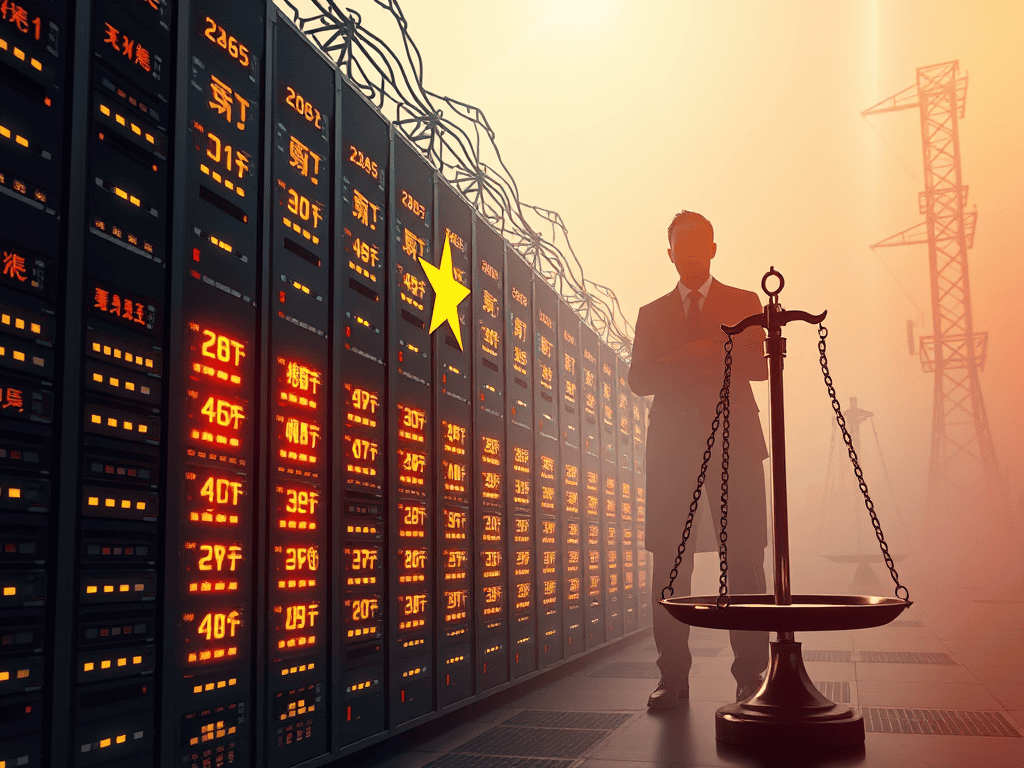
A definitive structural intervention is unfolding across the Chinese industrial map. Beijing has begun slashing energy costs for its largest data centers. They are cutting electricity bills by up to 50 percent. This is to accelerate the production and deployment of domestic AI semiconductors.
Targeting hyperscalers such as ByteDance, Alibaba, and Tencent, these grants are designed to sustain compute velocity despite U.S. export controls that bar access to frontier silicon.
Mechanics—How Subsidies Rehearse Containment
The 50 percent energy cuts operate as a containment rehearsal. Beijing lowers the operational cost floor. This ensures that its developer ecosystem maintains its momentum.
- Cost-Curve Diplomacy: Subsidized power effectively attempts to reset the global benchmark for AI compute pricing. This forces Western firms to defend their margins in an environment where the energy-AI loop is tightening.
- Developer Anchoring: Municipal and provincial incentives create a “gravity well” for talent. These incentives ensure that startups, inference labs, and cloud operators remain anchored within China’s sovereign stack.
- The Scale Logic: Unlike the market-led surge seen in firms like Palantir, China’s AI expansion is subsidized by the government. This is done as a matter of national defense. It converts a commodity (electricity) into a strategic propellant for the silicon race.
China is weaponizing its cost curve. By subsidizing the “oxygen” of the AI economy—energy—it is attempting to bypass the hardware bottlenecks imposed by the West.
The Globalization Breach—Why Trust Wins Systems
A decade ago, the globalization playbook was simple: low costs won markets. Today, that playbook has failed. In the AI era, trust wins systems.
- The Manufacturing Trap: In the 2010s, China’s scale made it the gravitational center of supply chains. But AI is not labor-intensive; it is trust-intensive.
- The Reliability Standard: Western nations are increasingly framing their technology policy around ethics, security, and institutional credibility. Legislation like the CHIPS Act and the EU AI Act has redefined market participation as conditional—access requires proof of reliability.
- The Reputational Deficit: China’s own maneuvers include the Nexperia export-control retaliation. Opaque Intellectual Property (IP) rules are another factor. These actions have deepened a systemic trust deficit. Cheap power may illuminate a data center, but it cannot offset reputational entropy.
Cost efficiency once conferred dominance, but credibility now determines inclusion. China’s cheap energy can sustain a domestic model, but it cannot buy the global interoperability required for AI leadership.
The Ethics Layer—Abundance Without Interoperability
Beijing’s energy subsidies may secure short-term velocity, but they cannot substitute for the governance frameworks that global firms demand.
The primary barrier to China’s AI sovereignty is not silicon scarcity, but Institutional Opacity. Global developers remain wary of China-tethered stacks due to IP leakage risks. They are also concerned about forced localization clauses. Additionally, there is the lack of an independent judiciary.
Real AI advancement requires Governance Interoperability:
- Enforceable IP protection.
- Transparent regulatory regimes.
- Credible institutions that uphold contractual integrity.
Without these, subsidies become “Symbolic Fuel”. They are abundant and powerful, but ultimately directionless. This occurs in a global market that values the rule of law over the price of a kilowatt.
Rehearsal Logic—From Cost to Credibility
In the AI era, cost is no longer the decisive variable; it is merely the entry fee. We are moving from an era of cost advantage to an era of Credible Orchestration.
- Then: IP flexibility drove expansion. Now: IP enforceability defines legitimacy.
- Then: Tech transfer was coerced. Now: Tech transfer must be consensual and audited.
- Then: Governance sat on the sidelines. Now: Governance directs the entire play.
Conclusion
China’s subsidies codify speed but not stability. They rehearse domestic resilience yet fail to restore the confidence required to lead a global digital order.
At this stage, the AI era remains suspended in an interregnum of partial sovereignties:
- The United States commands model supremacy but lacks the cost discipline seen in its rivals.
- China wields scale and speed but faces a debilitating trust deficit.
- Europe codifies ethics and governance but trails significantly in compute and execution velocity.
The decisive choreography—where trust, infrastructure, and innovation align—has yet to emerge. In this post-globalization landscape, reliability and orchestration outperform price. The age of cost advantage has ended. The era of credible orchestration has begun.
Further reading: