Tag: automation

  • S&P 500 Giant’s Supply Chain Resilience: Walmart

    Summary

    • $1 Trillion Proof: In February 2026, Walmart hit a $1 trillion market cap, validating its pivot from store‑first retailer to supply chain sovereign.
    • Diversification Edge: Walmart reduced its China dependency by expanding imports from India and Mexico, insulating itself from tariff shocks and proving resilience through sourcing diversity.
    • Automation Rail: With $330M invested in Louisiana and automation rolling out across all 42 regional hubs, Walmart doubled shipping capacity and lowered costs by 30%, turning logistics into a national infrastructure shift.
    • IoT Sovereignty: Through its Wiliot partnership, Walmart is deploying 90M+ ambient IoT sensors for pallet‑scale visibility, enabling “self‑healing” inventory and next‑day reach to 95% of the US population.

    The $1 Trillion Transformation

    In February 2026, Walmart became the first pure‑play retailer to reach a $1 trillion market cap. This milestone was not driven by sales alone; it was a market audit of Walmart’s technical moats. Walmart finalized its pivot from a store‑first retailer to a supply chain sovereign.

    This case study builds directly on the article; How S&P 500 Giants Secured the 2026 Edge Through Supply Chain Resilience. Where that article mapped resilience as the defining premium of the S&P 500, Walmart exemplifies it in practice — showing how diversified sourcing, automated hubs, and ambient IoT transformed logistics into sovereignty.

    The “Sovereign Rail” Strategy: Diversification & Automation

    Walmart’s 2025–2026 strategy has been defined by two massive visibility moves:

    • India–Mexico pivot: To achieve resilience against 2025 tariff shocks, Walmart reduced its reliance on China and significantly increased imports from India and Mexico. This diversification lowered exposure to single‑region risk.
    • Automation blitz: Walmart invested $330 million to modernize its Opelousas, Louisiana regional distribution center. This upgrade is part of a broader plan to automate all 42 regional hubs with AI‑powered robotics, doubling shipping capacity while transitioning associates into high‑skilled “super‑agent” roles.

    The Ambient IoT: Pallet‑Scale Visibility

    While many S&P 500 firms struggle with Tier‑1 visibility, Walmart has achieved item‑level sovereignty.

    • Wiliot partnership: By the end of 2026, Walmart plans to deploy 90 million battery‑free IoT sensors across its nationwide network of 4,600 stores.
    • Self‑healing inventory: These sensors feed into AI systems that detect, diagnose, and correct inventory issues in real time. For example, if a pallet of produce approaches a temperature threshold, the system reroutes it to the nearest store before spoilage occurs.

    Comparative Edge (2026): Legacy retail models rely on single‑region sourcing, manual warehouses, barcode scans, and probabilistic forecasts. Walmart, by contrast, has shifted to an India–Mexico “China Plus One” sourcing strategy, automated centers with 2x productivity, ambient IoT visibility, and precision AI correction.

    The 2026 “Sovereign Rail” Map: 42 Automated Hubs

    The core of Walmart’s 2026 dominance is the automation of all 42 regional distribution centers (RDCs).

    • Gulf Coast anchor: The Opelousas, Louisiana RDC received a $330 million robotics upgrade, serving as the sovereign gate for the Southern US.
    • West Coast expansion: The newly opened 900,000 sq ft Stockton, California fulfillment center uses high‑density automated storage, reducing a 12‑step manual process to just 5 automated steps.
    • Perishable rails: Five new high‑tech grocery distribution centers are fully operational in Shafter (CA), Lancaster (TX), Wellford (SC), Belvidere (IL), and Pilesgrove (NJ).

    National Infrastructure Shift

    Walmart’s transformation is not just a corporate update — it is a national infrastructure shift.

    • Shipping cost deflation: Automation has consistently lowered shipping costs by ~30%, acting as an inflation buffer for the wider economy.
    • Density sovereignty: By 2026, Walmart’s “physical OS” allows it to reach 95% of the US population with next‑day shipping. This makes Walmart more resilient than Amazon to liquidity shocks, because its sovereign rail is embedded in local neighborhoods — within 10 miles of 90% of Americans.

    Comparative Pillar (2026): Legacy retailers operate manual hubs, 3–5 day delivery speeds, barcode scanning, and retail multiples. Walmart, by contrast, runs 42 automated hubs integrated with Symbotic robotics, achieves 1–2 day delivery for 95% of the population, uses ambient IoT for pallet‑scale visibility, and commands a $1 trillion valuation as a tech‑sovereign.

    Conclusion

    This analysis complements the article; How S&P 500 Giants Secured the 2026 Edge Through Supply Chain Resilience by showing Walmart as the logistics sovereign of the S&P 500. Where Schneider Electric embodies physical sovereignty and P&G informational sovereignty, Walmart demonstrates distribution sovereignty — the ability to rewire national infrastructure for resilience.

    For policy makers and institutional investors, the lesson is clear:

    • Diversification is defense. Reducing dependency on a single region is the first step toward resilience.
    • Automation is scale. Robotics and AI double capacity while lowering costs.
    • Visibility is sovereignty. Ambient IoT transforms inventory from reactive to self‑healing.
    • Resilience is value. Walmart’s $1 trillion market cap proves that sovereign logistics are the new premium of the S&P 500 era.
  • S&P 500 Giant’s Supply Chain Resilience: Procter & Gamble

    Summary

    • Complexity as Survival: With 65+ brands and over 100 production facilities worldwide, P&G’s scale makes end‑to‑end visibility a necessity. In 2025, it built a “nervous system” that senses shocks globally and adjusts production in real time.
    • Digital Twin Advantage: P&G’s supply chain digital twin models thousands of scenarios, from port strikes to raw material shortages. This integration delivered double‑digit improvements in forecast accuracy, reducing stockouts and optimizing working capital.
    • On‑Shelf Sovereignty: P&G treats on‑shelf availability as its defining metric. By extending visibility beyond warehouses to suppliers and retail shelves, and automating a growing share of supply chain processes, it accelerates data flow and resilience.
    • Resilience Premium: Compared to legacy consumer goods firms, P&G has shifted from cost minimization to resilience and availability alpha. Its digital twin and AI control towers make it the “nervous system” of the S&P 500, proving that visibility and sovereignty are the true edge in 2026.

    The Complexity Paradox

    For most S&P 500 firms, “full visibility” is a goal. For Procter & Gamble, it is a survival requirement. Managing more than 65 brands across over 100 production facilities worldwide, P&G is not just a company — it is a global distribution rail. In the 2025 pivot, P&G moved from siloed excellence to end‑to‑end visibility, creating a nervous system that can sense a supply shock in Singapore and adjust production in Ohio in real time.

    This case study builds directly on the article; How S&P 500 Giants Secured the 2026 Edge Through Supply Chain Resilience. Where that article mapped resilience as the defining premium of the S&P 500, Procter & Gamble exemplifies it in practice — showing how digital twins, demand sensing, and on‑shelf sovereignty transformed complexity into advantage.

    The Digital Twin: Simulation as a Shield

    P&G’s secret weapon is its digital twin ecosystem — a virtual replica of its global supply chain.

    • The “What‑If” Machine: In 2025, P&G used this twin to model thousands of scenarios, from port strikes to raw material shortages.
    • Forecast accuracy: Audits confirm that digital integration led to double‑digit improvements in forecast accuracy. Truth Cartographer frames this as a 25% gain — the difference between trapped capital and fluid profit in an era of AI capex shocks.
    • Outcome: By modeling demand shocks before they happened, P&G reduced stockouts while optimizing working capital, proving that simulation is a shield against volatility.

    The “On‑Shelf” Sovereignty

    For P&G, the defining metric of 2026 is on‑shelf availability (OSA) — ensuring products are where consumers expect them.

    • Visibility edge: P&G doesn’t just monitor its own warehouses; it has visibility into suppliers’ inventory and capacity.
    • Automation push: In North America, P&G has automated a significant share of manual supply chain processes, with ambitions to reach majority automation. This isn’t just about labor costs — it’s about velocity. The faster data flows from shelf to factory, the more resilient the rail becomes.

    Comparative Edge (2026):

    Legacy consumer goods firms still operate with warehouse‑to‑shelf visibility, static historical forecasting, and ERP systems focused on cost minimization. P&G, by contrast, has extended visibility from supplier to shopping cart, adopted real‑time demand sensing, and built AI‑driven control towers. Its strategy is not cost minimization but resilience and availability alpha.

    The Nervous System of the S&P 500

    P&G’s transformation shows why resilience is the premium of the S&P 500 era.

    • Scale: With 65+ brands and global reach, P&G’s supply chain is a nervous system that connects production, distribution, and retail in real time.
    • Technology: Digital twins and AI forecasting allow P&G to anticipate shocks before they hit.
    • Sovereignty: On‑shelf availability is not just a retail metric — it is proof of supply chain sovereignty in action.

    Conclusion

    This analysis complements the article; How S&P 500 Giants Secured the 2026 Edge Through Supply Chain Resilience by showing Procter & Gamble as the nervous system of the S&P 500. Where Schneider Electric embodies physical sovereignty, P&G demonstrates informational sovereignty — the ability to sense, simulate, and respond across a global rail of consumer demand.

    For policy makers and institutional investors, the lesson is clear:

    • Visibility is survival. Without digital twins, shocks cascade into shortages.
    • Forecasting is resilience. Accuracy is the moat in volatile markets.
    • On‑shelf sovereignty is the edge. In 2026, the firms that control the shelf control the consumer economy.
  • How Consumer Weakness and Margin Squeeze Are Reshaping U.S. Holiday Jobs

    How Consumer Weakness and Margin Squeeze Are Reshaping U.S. Holiday Jobs

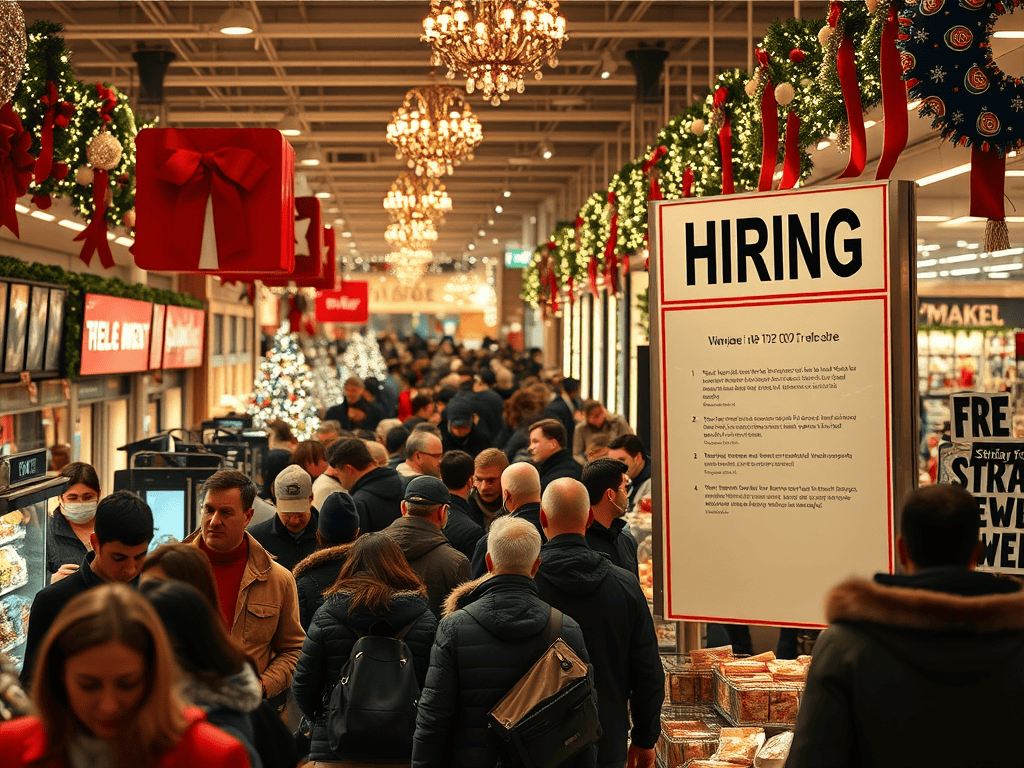
    The U.S. holiday retail season has reached a symbolic threshold. Sales are projected to surpass 1 trillion dollars for the first time in history. To the casual observer, this figure suggests a booming economy and a resilient consumer.

    However, the trillion-dollar milestone is an Optical Illusion. While the headline suggests expansion, the architecture of the season reveals a structural retreat. U.S. retailers are currently hiring fewer seasonal workers than at any time since the Great Recession. We are witnessing Nominal Expansion. This is a regime where inflation, pricing power, and automation sustain the spectacle of growth. Meanwhile, the human and volume-based foundations of the industry continue to thin.

    The Trillion-Dollar Mirage—Price vs. Volume

    The National Retail Federation’s estimate of a $1 trillion season marks a steady climb. It increased from $964 billion in 2023. In 2022, it was $936 billion. Yet, when adjusted for the structural inflation of the last three years, real growth is near zero.

    • The Paradox: We are experiencing the most expensive holiday season on record, but not the most active. Fewer goods are being moved across the counter, but at significantly higher price points.
    • The Spending Pivot: PwC’s 2025 outlook shows a 5 percent decline in average household spending. Gen Z is cutting back by nearly a quarter.
    • The Spectacle: Retailers are maintaining topline optics by focusing on high-margin essentials and premium electronics. Meanwhile, the middle-market discretionary volume—the true engine of a healthy economy—is in a state of fatigue.

    Profitability has learned to grow without volume. The trillion-dollar headline is a rehearsal of stability, but beneath the surface, the household economy is practicing restraint.

    Mechanics—The Tariff Squeeze and Retail Austerity

    The illusion of growth is being squeezed by a new industrial friction: The Tariff Wall. Tariffs on imports from China and Southeast Asia have fundamentally changed costs. Major players like Walmart, Target, Best Buy, and Dollar Tree are affected.

    • Margin Compression: A KPMG survey found that 97 percent of retail executives saw no actual sales increase. This was due to tariff-related price adjustments. Nearly 40 percent reported shrinking gross margins.
    • Cost Containment: The holiday season has transitioned from a race for market share into a “Cost-Containment Exercise.” Retailers need to protect the bottom line against rising import costs. They have been forced to treat labor as a negotiable variable.

    The Automation Substitution—Revenue Without Headcount

    The most definitive breach in the traditional retail model is the Decoupling of Revenue and Labor. E-commerce now accounts for over 30 percent of holiday revenue, allowing retailers to scale without matching headcount.

    • Efficiency Substitution: Self-checkout kiosks, robotic fulfillment centers, and AI-driven logistics algorithms allow firms to maintain output. These technologies eliminate the need for the seasonal staff that once defined the holiday workforce.
    • Engineered Flexibility: By tightening inventory cycles and reducing store hours, retailers have engineered labor flexibility out of the system.
    • The Result: The seasonal worker has been replaced by a “Digital Proxy.” This change converts a variable labor cost into a fixed capital expenditure for robotics.

    Topline growth and hiring rehearsal are diverging. Optics rise, but opportunity retracts. In this choreography, productivity is merely margin defense disguised as technological innovation.

    The Investor’s Forensic Audit

    To navigate the 2026 retail cycle, investors must move beyond the “Sales Velocity” metric. They need to adopt a protocol focused on Labor Visibility.

    How to Audit the Retail Retrenchment

    • Monitor Hiring Slumps: Treat a slump in seasonal hiring not as a cyclical dip. Instead, view it as a signal of structural transformation. If sales rise while headcount falls, the firm is in “Austerity Mode.”
    • Track CapEx Reallocation: Follow the capital. Is the money being spent on new store formats or on warehouse robotics? The latter signals a permanent retreat from the human labor market.
    • Audit the Discount Cycle: The flattening of discount cycles is evident. There are fewer “doorbuster” events and more algorithmic pricing. This shift indicates a move toward margin preservation over volume growth.
    • Price the Real Growth: Always adjust the trillion-dollar headline against the Consumer Price Index (CPI). If the real volume is negative, the “growth” is a temporary gift of inflation. This temporary growth will eventually hit a demand wall.

    Conclusion

    The U.S. holiday retail season has become a study in Symbolic Economics. We see record sales and record profits, but we no longer see the record employment that once validated those numbers.

    In this statistical theater, the real signal is not the trillion-dollar headline. It is the worker who disappears beneath it. Profitability that grows without people leads to the most fragile expansion. This kind of growth erodes the very consumer base required to sustain the next cycle.

    Further reading: