Tag: Cash Conversion Gap

  • Understanding the $250B Semiconductor Allocation in AI

    The Brief

    • The Sector: Semiconductors & Hardware (GPUs, CPUs, HBM, and Networking).
    • The Capital Allocation: $250 Billion (25% of the total Data Cathedral build-out).
    • The U.S. Share: Like Real Estate, the U.S. is the destination for roughly 45% of this hardware. However, 0% of the leading-edge AI chips (Blackwell/H200) are currently forged on U.S. soil.
    • The Forensic Signal: A widening Cash Conversion Gap at Nvidia. While revenue is projected to hit record highs, the actual “liquidity” of that growth is being stifled by longer payment cycles and geopolitical “gray markets.”

    Investor Takeaways

    Structural Signal: $250B (25% of the Data Cathedral) is flowing into semiconductors — the computational oxygen of AI.

    Systemic Exposure: The entire layer depends on TSMC; any Taiwan Strait disruption collapses the $1T AI projection.

    Narrative Risk: Nvidia’s record revenues mask a widening Cash Conversion Gap. Sentiment could flip if liquidity strains surface.

    Portfolio Implication:

    • Nvidia (NVDA): Monitor Accounts Receivable growth vs. cash flow.
    • TSMC (TSM): Geopolitical single‑point‑of‑failure risk.
    • ASML (ASML): EUV tooling advantage, but vulnerable to export restrictions.
    • SMIC (China): Closing the gap with DUV multi‑patterning — potential shadow competitor.

    Macro Link: U.S. export controls remain porous; gray‑market flows undermine sovereign leverage. Elevated geopolitical risk should be priced into semiconductor ETFs.

    Full article

    In our earlier analysis, we ventured into the Data Cathedral
    —mapping the systemic shift as Artificial Intelligence transitions from a software story into a $1 trillion physical monument by 2027. Following our audit of the $350 Billion Land Grab, we now move from the “Dirt” to the “Silicon.”

    This report marks the second in our forensic series detailing the global allocation of capital. We are now auditing the $250 Billion Semiconductor and Hardware layer—the computational “oxygen” of the AI era. While the U.S. remains the primary theatre for hardware deployment, the substrate of that power remains dangerously tethered to Eastern foundries and a resurgent Chinese domestic supply chain.

    The Foundries of the Cathedral: The TSMC Choke Point

    The $250 billion spend is entirely dependent on a single island. Whether the designer is Nvidia, AMD, or Broadcom, the path to the Cathedral leads through TSMC.

    As we noted in our analysis of the global capital shift, any disruption in the Taiwan Strait doesn’t just slow down AI; it collapses the $1 trillion projection entirely. The “Cathedral” is not just built on silicon; it is built on a geopolitical single-point-of-failure.

    The Sovereign Silicon Tracker: 2026 Leverage Audit

    To understand the current state of play, we must audit the “Sovereign Silicon Gap”—comparing U.S. design dominance against China’s domestic engineering workarounds across four critical pillars:

    • The Leading Edge (Manufacturing): While the Western Alliance is pushing toward 3nm and 2nm (GAAFET) architectures via TSMC, China is achieving surprising parity. Using repurposed DUV (Deep Ultraviolet) lithography, SMIC is successfully scaling 7nm and even 5nm chips for AI inference. The forensic reality is that the gap is eroding; China is performing “High-End” AI tasks with “Obsolete” tech.
    • Export Leverage (The Firewall): Despite high-profile Blackwell and H200 restrictions, the U.S. “Firewall” remains leaky. Gray market bypassing via the Middle East and Southeast Asia ensures that top-tier silicon is still reaching Chinese labs. The “Sovereign Premium” on Western chips is under threat as supply-chain control weakens.
    • The Tooling War: The West relies on the next generation of ASML’s EUV (Extreme Ultraviolet) machines. Meanwhile, China has pivoted to maximizing DUV “multi-patterning” to hit higher densities. By mastering the tools they already have, China is neutralizing the Western advantage in the short term.
    • The Capital Conflict (Cash Conversion): This is the ultimate structural risk. U.S. firms like Nvidia must answer to shareholders and are currently facing a declining Cash Conversion Ratio (OCF Lag). Conversely, China’s “Shadow” supply is state-funded with effectively infinite liquidity, allowing them to build their Cathedral without the pressure of quarterly market cycles.

    The Forensic Ledger: Nvidia and the Cash Conversion Conflict

    We must reconcile the $250B demand with the Cash Conversion Gap Crisis we have tracked throughout 2025.

    1. The High-Velocity Mirage: Nvidia’s revenue is at record highs, but as we’ve audited, their Operating Cash Flow (OCF) is falling behind revenue recognition.
    2. The China Gamble: As highlighted in our report on Nvidia’s H200 and China’s Semiconductor Gamble, U.S. export leverage is being undermined by a domestic Chinese supply chain repurposing DUV lithography systems.
    3. The Normalization Trap: As we learned from the Cisco lessons of the Dot-Com era, peak infrastructure spend is often followed by a violent “Demand Normalization.” The Cash Conversion Gap is the first forensic signal that the “Data Cathedral” build-out is entering its high-risk phase.

    The Investor’s Forensic Audit

    To navigate the $250B silicon layer, investors must look past the “Units Shipped” and audit the Quality of Capital:

    • Monitor Accounts Receivable: If Nvidia is shipping chips to startups that can’t turn a profit, the revenue is an IOU, not an asset.
    • Track DUV Yields: If SMIC successfully scales 5nm yields using DUV, the “Sovereign Premium” on Western chips will evaporate.
    • Price the Liquidity: In a capital-heavy era, the player with the cleanest cash conversion wins the long game.

    Conclusion

    The Silicon Layer of the Cathedral is a race against time and liquidity. While $250 billion is flowing into hardware, the “Cash Conversion Gap” we’ve tracked at Nvidia suggests the quality of this capital is thinning.

    This is Part 2 of 7. Over the coming days, we will audit the remaining $400 Billion in capital flow—starting with the “Power Rail”: Energy & Utilities ($150B).
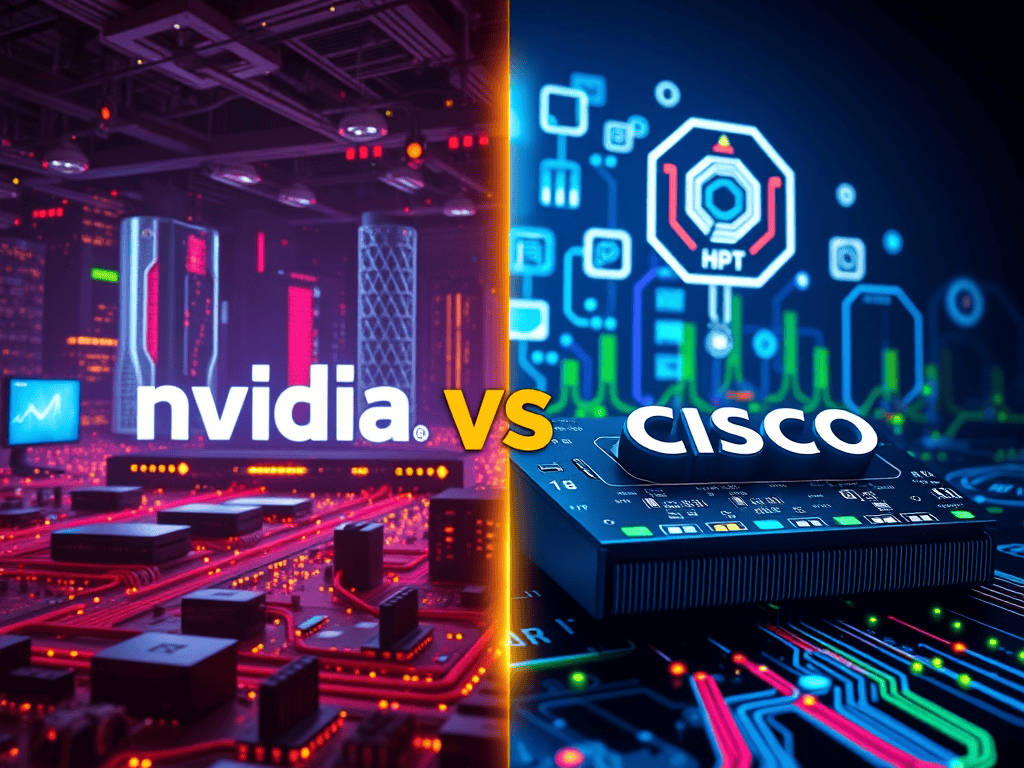
  • Nvidia vs Cisco: Lessons from the Dot-Com Era

    Nvidia vs Cisco: Lessons from the Dot-Com Era

    The comparison of Nvidia today to Cisco at the peak of the dot-com bubble in 2000 is a key analogy. It defines the AI era.

    At its peak, Cisco briefly became the world’s most valuable company. It traded at a Price-to-Earnings (P/E) ratio of 100 to 120. This was based on the assumption of perpetual hypergrowth. This valuation detached from reality. It showed that the most indispensable companies in a tech revolution can still be priced for impossible success.

    Nvidia’s P/E multiple is lower than Cisco’s peak. However, the analogy holds. Both companies are the indispensable, profitable, and structurally sound infrastructure backbone of a technological revolution. But the key divergence lies in margin dynamics and structural fragility.

    Valuation and Narrative Parallels

    The parallel is anchored by the shared role of dominating critical infrastructure during periods of market exuberance.

    Comparative Valuation Overview

    • Market Capitalization:
      • Cisco (2000 Peak): $550 Billion (World’s largest at the time).
      • Nvidia (2025): $4.2 Trillion.
    • Price-to-Earnings (P/E) Ratio:
      • Cisco (2000 Peak): ~100–120
      • Nvidia (2025): ~43 Trailing Twelve Months (TTM), ~25 Forward.
    • Narrative Driver:
      • Cisco (2000): Internet infrastructure boom.
      • Nvidia (2025): AI infrastructure boom.

    Cisco’s 100+ P/E in 2000 shows how investor enthusiasm can detach valuations from reality. Nvidia’s current multiples are lower. However, the analogy holds. Both are real companies at the center of tech revolutions. They are priced as if their growth will never slow.

    The Critical Divergence—Monopoly Margins

    The most striking difference is in profitability. Cisco’s margins were capped by the economics of hardware and competition; Nvidia’s are amplified by monopoly pricing power.

    Net Margin Dynamics

    • Cisco (2000 Peak): ~15%
      • Industry Structure: Networking hardware is capital-intensive and competitive.
      • Economics: Selling routers and switches meant manufacturing, distribution, and service costs capped profitability, even at peak demand.
    • Nvidia (2025): ~53%
      • Industry Structure: AI Graphics Processing Unit (GPU) dominance, fabless model, and software ecosystem.
      • Economics: Nvidia enjoys near-monopoly pricing power in high-end AI chips. The fabless model (outsourcing manufacturing to TSMC) keeps capital expenditure (capex) lower, and the high-margin CUDA ecosystem adds software leverage.

    The 53% net margin indicates Nvidia’s unique market power in the AI cycle. It is not a permanent structural truth. Cisco’s margins were capped by hardware economics; Nvidia’s are inflated by monopoly-like demand and software leverage.

    Structural Threats and Fragility

    The analogy warns that both companies face existential threats tied to their dominance. Cisco’s threat was commoditization; Nvidia’s is a complex combination of vertical integration and geopolitics.

    Key Structural Risks for Nvidia

    • Internal Vertical Integration: Hyperscalers, such as Alphabet and Meta, are aggressively building custom AI stacks. They are also developing in-house chips like Tensor Processing Units (TPU) and Custom Application-Specific Integrated Circuits (ASIC). The aim is to reduce dependency on Nvidia GPUs. This is a direct structural threat to Nvidia’s long-term margins and market share.
    • Cash Conversion Gap: Unlike Cisco in 2000. Cisco’s fragility was valuation, not cash conversion. Nvidia shows a widening gap between reported revenue and operating cash flow (OCF). This gap is driven by receivables, stock-based compensation (SBC), and depreciation timing. This structural financial fragility is detailed in our analysis, Exploring NVIDIA’s Cash Conversion Gap Crisis. Its valuation depends on the timing of cash receipts.
    • Geopolitical Competition: Cisco faced commercial competition (Huawei). Nvidia faces state-backed efforts from China to replicate the CUDA ecosystem and domestic chip production, amplified by U.S. export controls.

    Conclusion

    The Cisco vs. Nvidia analogy works because both are infrastructure monopolies of their respective tech cycles. Cisco demonstrates the result of exuberance meeting hardware economics, which leads to capped margins. Nvidia illustrates the result of exuberance meeting monopoly pricing power, resulting in amplified margins. The risk for Nvidia is that if growth normalizes, its 53% margin could rapidly collapse. If hyperscalers succeed in vertical integration, this could also collapse the margin toward traditional semiconductor economics. This situation would expose the valuation fragility.

  • Exploring NVIDIA’s Cash Conversion Gap Crisis

    Billions in Potential Revenue

    The Trump administration reportedly decided to authorize the conditional sale of NVIDIA’s H200 AI chips to approved customers in China. This decision has been framed as a win for the company. The deal secures billions in potential revenue. Nonetheless, it does not solve NVIDIA’s core structural fragility. This fragility is the widening Cash Conversion Gap (as explained in our analysis, Decoding Nvidia’s Structural Fragility).

    This geopolitical maneuver highlights a systemic tension: U.S. foreign policy is no longer just geopolitical; it is a direct lever on corporate balance sheets. The H200 concession is a short-term optic that masks a long-term structural risk.

    The Political Optic (The H200 Concession)

    The sale of H200 chips was a crucial lobbying victory for Nvidia CEO Jensen Huang. It excluded the frontier Blackwell and Rubin variants.

    • The Immediate Win: Nvidia gains immediate revenue and market access in China. This preserves headline sales figures. It also alleviates immediate investor panic over a total market lock-out.
    • The Geopolitical Exchange: The U.S. policy benefits financially. This occurs reportedly via a revenue clawback. Meanwhile, China gains access to powerful AI compute. This reduces its reliance on domestic accelerators in the short term.

    Yet, this concession is not a rescue. It is a downgrade that preserves the revenue headline but fails to tackle the underlying financial liquidity of the business.

    The Structural Wound (The Cash Conversion Gap)

    Nvidia’s core structural fragility is rooted in the Cash Conversion Gap. This is the widening divergence between reported revenue and actual Operating Cash Flow (OCF).

    • The Lag: Nvidia has historically experienced a lag in converting reported sales into liquid cash. This lag was already quantified. Nvidia’s OCF conversion ratio fell sharply in Q3 ext FY2026. This left billions of reported revenue as “non-cash” commitments.
    • The China Anchor: Historically, cash-rich Chinese hyperscalers provided large, upfront prepayments. These payments were crucial for anchoring and stabilizing Nvidia’s operating cash flow (OCF) ratio.
    • The Amplification: By restricting frontier chips and only allowing the H200 downgrade, U.S. policy removes this crucial, liquid demand cushion. Nvidia is forced to rely heavily on debt-laden AI startups outside China, whose payments are slower and more fragile.

    The H200 concession fails to stabilize OCF. It preserves the fragile revenue stream. But, it removes the liquid cash anchor that China’s frontier demand provided. The structural crisis remains.

    China’s Strategic Inversion: The Hunter Becomes the Hunted

    The H200 concession is a temporary measure that accelerates China’s long-term goal of compute sovereignty.

    The risk is compounded by China’s strategic response. They are rejecting even “degraded” Nvidia chips. This signals a pivot to homegrown alternatives. This accelerates the “hunter becomes hunted” dynamic:

    • The Erosion: U.S. policy compels China to localize, accelerating the erosion of Nvidia’s market share in segments like inference and sovereign workloads. Chinese domestic chipmakers (Huawei Ascend and Biren) are scaling their own AI accelerators.
    • The Capitalization: The reported 470% IPO surge of a Chinese GPU rival indicates strong investor validation for domestic alternatives. These alternatives are now recognized and capitalized as credible, state-backed options.

    The H200 concession buys Nvidia optics, but it can’t reverse the strategic inversion underway. China’s long-term play is to remove dependency entirely.

    The Investor Imperative

    The uncertainty created by this geopolitical lever demands that institutional investors reprice Nvidia based on financial reality, not revenue headlines. This creates a binary, “Make-or-Break” trajectory:

    • Break Path (Normalization): If China rejection of downgraded SKUs persists and the Cash Conversion Gap widens, Nvidia’s valuation normalizes downward. Investors reprice the company based on lower cash flow multiples, regardless of the strong revenue headlines.
    • Make Path (Financial Engineering): Nvidia must shift its mix toward high-margin systems for allies. It should tighten payment terms with AI startups. Nvidia also needs to secure prepayments to stabilize OCF. This requires financial discipline to sustain its liquidity.

    Nvidia’s future hinges on answering the Cash Conversion Gap. Lobbying victories and export concessions are cosmetic; investors demand structural proof that Nvidia can translate AI demand into sustainable liquidity. The question is not whether Nvidia can sell chips. The real question is whether it can uphold the cash discipline needed to sustain its valuation. This is crucial when its most liquid customer is sovereignly deleted from the map.

    To understand how this accounting reality translates into market volatility, read our analysis on why short sellers are monitoring this structural fragility.

  • Nvidia’s Make-or-Break Moment

    The Policy Shock Hits the Balance Sheet

    Today’s news confirms the political pressure: a bipartisan group of U.S. senators is pressing the administration to expand restrictions on NVIDIA’s most advanced AI GPUs. This policy action directly intersects with NVIDIA’s core structural fragility: the Cash Conversion Gap—the widening divergence between reported revenue and operating cash flow (a concept detailed in our previous structural analysis on NVIDIA’s filings, Decoding Nvidia’s Structural Fragility).

    • China as Cash Anchor: Historically, cash-rich Chinese hyperscalers provided large, upfront orders that helped stabilize NVIDIA’s operating cash flow (OCF) ratio.
    • The Policy Trap: By cutting off this crucial, liquid demand, U.S. policy removes the cushion and forces NVIDIA to rely heavily on debt-laden AI startups outside China, whose payments are slower and more fragile.

    U.S. foreign policy is not just geopolitical—it is a direct balance-sheet risk, stripping out cash-rich buyers and exposing NVIDIA to liquidity-fragile customers.

    The Widening Cash Conversion Gap

    The divergence between NVIDIA’s revenue optics and cash reality is the hinge of this moment. Losing China risk turns the existing cash conversion lag into a structural crisis.

    • The Quantified Lag: NVIDIA’s OCF conversion ratio already fell sharply from 30% to 23% in Q3 FY2026. This left approximately $44 billion of reported revenue as “non-cash.”
    • The Worsening Trajectory: Without China’s cash-rich demand, this divergence widens sharply. NVIDIA can maintain strong headline sales, but the share of revenue converting to cash declines—the precise breach flagged by short sellers.

    Removing China sales could weaken NVIDIA’s cash conversion ratio, exposing the structural fragility. Lawmakers’ move is an inflection point that could define NVIDIA’s future.

    The Hunter Becomes the Hunted

    The risk is compounded by China’s response: they are rejecting even “degraded” NVIDIA chips, signaling a pivot to homegrown alternatives. This accelerates a “hunter becomes hunted” dynamic similar to the one that eroded BYD’s margins in the EV sector (The Hunter Becomes the Hunted).

    The Financial Times reports that a Chinese GPU rival surged 470% in its market debut, confirming the structural inversion:

    • The Erosion: NVIDIA’s GPU leadership is being mirrored. Chinese domestic chipmakers (Huawei Ascend) are scaling AI accelerators, forcing adoption of local silicon rather than waiting for compromised NVIDIA variants.
    • The Reversal & Capitalization: U.S. policy compels China to localize, accelerating the erosion of NVIDIA’s market share in segments like inference and sovereign workloads. The 470% IPO surge proves these rivals are now investor-validated and capitalized as a credible, state-backed alternative.

    The Make-or-Break Trajectory

    The lawmakers’ push creates a binary signal for institutional investors:

    Break Path (Total Ban)

    • Description: China rejection of downgraded SKUs persists; U.S. clamps the high end.
    • Outcome: Cash conversion weakens; valuation normalizes downward as investors reprice on cash flow multiples, validating the short sellers’ thesis.

    Make Path (Financial Engineering)

    • Description: NVIDIA shifts mix toward high-margin systems for allies; tightens payment terms; and secures prepayments to stabilize OCF.
    • Outcome: Cash conversion stabilizes; NVIDIA maintains its position as the liquidity barometer of AI growth, overcoming the structural hurdle.

    NVIDIA is at risk of normalization. If the cash conversion gap persists, the market will reprice NVIDIA’s earnings based on lower cash flow multiples, regardless of the revenue headline.

    Conclusion

    This moment proves that U.S. foreign policy and technological containment strategy are now direct levers on corporate balance sheets. The question is not whether NVIDIA can sell chips, but whether it can maintain the cash discipline required to sustain its valuation when its most liquid customer is sovereignly deleted from the map.

    Disclaimer

    This article is for informational and educational purposes only and reflects analysis of publicly available information at the time of publication. It does not constitute financial, investment, or legal advice. Markets, policies, and geopolitical conditions shift rapidly; Truth Cartographer maps signals as they appear but cannot guarantee future outcomes. Readers should conduct their own due diligence and consult qualified professionals before making financial decisions.