Tag: China

  • AI Is Splitting Into Two Global Economies

    AI Is Splitting Into Two Global Economies

    Download Share ≠ Industry Dominance

    The Financial Times recently claimed that China has “leapfrogged” the U.S. in open-source AI models, citing download share: 17 percent for Chinese developers versus 15.8 percent for U.S. peers. On paper, that looks like a shift in leadership. In reality, a 1.2-point lead is not geopolitical control.

    Downloads measure curiosity, cost sensitivity, and resource constraints — not governance, maintenance, or regulatory compliance. Adoption is not dominance. The headline confuses short-term popularity with durable influence.

    Two AI Economies Are Emerging

    AI is splitting into two parallel markets, each shaped by economic realities and governance expectations.

    • Cost-constrained markets — across Asia, Africa, Latin America, and lower-tier enterprises — prioritize affordability. Lightweight models that run on limited compute become default infrastructure. This favors Chinese models optimized for deployment under energy, GPU, or cloud limitations.
    • Regulated markets — the U.S., EU, Japan, and compliance-heavy sectors — prioritize transparency, reproducibility, and legal accountability. Institutions favor U.S./EU models whose training data and governance pipelines can be audited and defended.

    The divide is not about performance. It is about which markets can afford which risks. The South chooses what it can run. The North chooses what it can regulate.

    Influence Will Be Defined by Defaults, Not Downloads

    The future of AI influence will not belong to whoever posts the highest download count. It will belong to whoever provides the default models that businesses, governments, and regulators build around.

    1. In resource-limited markets, defaults will emerge from models requiring minimal infrastructure and cost.
    2. In regulated markets, defaults will emerge from models meeting governance requirements, minimizing legal exposure, and surviving audits.

    Fragmentation Risks: Two AI Worlds

    If divergence accelerates, the global AI market will fragment:

    • Model formats and runtime toolchains may stop interoperating.
    • Compliance standards will diverge, raising cross-border friction.
    • Developer skill sets will become region-specific, reducing portability.
    • AI supply chains may entrench geopolitical blocs instead of global collaboration.

    The FT frames the trend as competition with a winner. The deeper reality is two uncoordinated futures forming side by side — with incompatible assumptions.

    Conclusion

    China did not leapfrog the United States. AI did not converge into a single global marketplace.

    Instead, the field divided along economic and regulatory lines. We are not watching one nation gain superiority — we are watching two ecosystems choose different priorities.

    • One economy optimizes for cost.
    • The other optimizes for compliance.

    Downloads are a signal. Defaults are a commitment. And it is those commitments — not headlines — that will define global AI sovereignty.

  • Why Wealthy Chinese Prefer Dubai, Not Singapore

    Why Wealthy Chinese Prefer Dubai, Not Singapore

    A definitive structural shift is redrawing the map of global wealth. In 2025, wealthy Chinese investors are systematically shifting their family offices from Singapore to Dubai. This is not a flight toward “secrecy,” but a calculated move toward Operability.

    Singapore has historically been the preferred hub for Asian capital. However, its pivot toward transparency and OECD-aligned data-sharing has introduced a level of friction. The modern “digital sovereign” no longer accepts this friction. In contrast, the United Arab Emirates (UAE) has choreographed an environment where crypto access, tax neutrality, and rapid residency coexist. The result is a Sovereign Pivot: capital is moving from jurisdictions that export compliance to those that export conviction.

    Crypto Access—Dubai’s Strategic “Plus Factor”

    The UAE has constructed the most advanced crypto regulatory stack outside of Switzerland. Dubai treats digital assets as necessary infrastructure. This approach is not a speculative indulgence. Because of this, Dubai has created a “Gravity Well” for Chinese wealth.

    • Activity-Based Licensing: Dubai’s VARA and Abu Dhabi’s ADGM issue specific licenses for custody, exchange, and tokenization. This provides legal clarity without the invasive surveillance found in Western-aligned nodes.
    • Institutional Integration: Major exchanges like Binance, OKX, and Coinbase operate legally. This allows wealthy investors to bridge digital assets directly into bank-linked accounts. Additionally, they can connect to regulated fund structures.
    • The Singapore Contrast: Singapore, once the dominant crypto node, now filters all activity through tightening Anti-Money Laundering (AML) gates. The “Redemption Logic” in Singapore has become slow and procedural, whereas in Dubai, it is real-time and protocol-native.

    In the choreography of capital, access is the ultimate premium. Dubai has established a jurisdiction. In this jurisdiction, on-chain instruments like tokenized real estate can exist as regulated collateral. In contrast, Singapore has prioritized visibility over velocity.

    Tax Architecture—The Neutrality Moat

    The UAE’s fiscal design remains radically simple, functioning as a structural moat against the rising transparency obligations of the West.

    • Zero-Levy Regime: The UAE maintains 0 percent personal income tax, 0 percent capital-gains tax, and no levies on crypto profits. Corporate tax only triggers above 375,000 AED (approximately 100,000 USD).
    • OECD Fragmentation: Singapore is aligning more closely with the OECD’s global minimum tax and data-sharing mandates. This is eroding its appeal for privacy-minded investors. These investors fear the “Visibility Trap.”
    • Exit-Neutrality: Unlike many Western jurisdictions, the UAE imposes no wealth, inheritance, or exit taxes. It is a “frictionless gate” that allows capital to remain as liquid as the ledger it resides on.

    Tax neutrality is the “Oxygen” of the family office. When a jurisdiction begins to prioritize reporting over growth, it signals the end of its era as a safe haven. Dubai is currently performing the role of the global “Fiscal Buffer.”

    Residency and Custody—From Permits to Protocols

    The link between physical residency and digital custody has been codified through the UAE’s Innovation and Golden Visa frameworks.

    • The Equity Bridge: Golden Visas allow for ten-year residency through property or business ownership, with approvals frequently granted within weeks.
    • Entrepreneurial Alignment: Crypto founders and family-office principals qualify via innovation visas. This ensures that their personal residency is anchored in the same jurisdiction. This jurisdiction protects their digital assets.
    • Rapid Onboarding: Family offices can be registered within days under the DIFC or ADGM frameworks. In Dubai, the “Sovereign Onboarding” process is practiced for quick speed. This ensures that wealth can be legally anchored the moment it arrives digitally.

    Capital no longer migrates for safety alone; it migrates for Operability. The “Crypto-Resident” is the new wealth archetype—individuals whose legal and digital identities are unified under a single, tax-neutral roof.

    Strategic Contrast—Visibility vs. Discretion

    The divergence between Singapore and Dubai reveals a fundamental breach in the “Global Safe Haven” narrative.

    • Singapore (Trust through Visibility): Singapore’s value proposition is now built on international credibility and regulatory harmony with the West. It is the “Cathedral of Compliance.”
    • Dubai (Flexibility within the Law): Dubai offers a “Bazaar of Discretion.” It provides flexibility for Chinese investors. These investors face outbound capital controls and digital-asset suspicion at home. It maintains the law without the ritual of performative surveillance.

    Singapore is for capital that seeks the state’s blessing; Dubai is for capital that seeks the state’s infrastructure. One city exports the rules; the other exports the rails.

    Conclusion

    Wealthy Chinese are not “escaping” regulation; they are rewriting the terms of their engagement with the state. The move to Dubai confirms that in the 2026 cycle, the decisive edge is not lifestyle or climate. Instead, it is the synthesis of crypto access and tax neutrality.

  • How BRI Projects Inflate GDP

    How BRI Projects Inflate GDP

    GDP Without Multipliers

    China’s GDP headline continues to print resilience, yet the substance behind the number has hollowed. In 2025, Chinese growth relies increasingly on a strategy of Expatriated Sovereignty. This strategy includes outbound infrastructure projects under the Belt and Road Initiative (BRI).

    Chinese firms construct ports, railways, and power plants across the Global South. This activity is logged as domestic output. It is also recorded as manufacturing and financial flows. On the surface, the Chinese economy seems to be expanding. In reality, it is an externalized performance of growth. This is a choreography designed to sustain macro optics. However, the internal engine of consumption and property remains in a state of fatigue.

    How BRI Projects Inflate the Macro Ledger

    The Belt and Road Initiative functions as a statistical life-support system. The accounting logic of the Chinese state retrieves growth signals. These signals come from projects that physically exist thousands of miles away.

    • Industrial Output as Export: The machinery, steel, and cement are shipped to BRI countries. They are logged as “active trade,” inflating manufacturing statistics. This occurs even when there is no domestic demand for those materials.
    • Service Income: Revenues from foreign construction contracts are reported as industrial services. This income pads the GDP narrative with capital that circulates outside domestic borders.
    • Credit Creation: Loans from Chinese state banks to host governments register as outbound capital flows. This activity raises financial account activity. It simulates a “velocity” that never touches the Chinese household.

    GDP has transitioned from a measure of capacity to a tool of choreography. Beijing exports its excess industrial capacity. This simulates growth that is geographically externalized. The BRI becomes a mechanism for statistical sustenance.

    Mechanics—The Statistical Theater of Outbound Velocity

    The fundamental breach in the Chinese growth story is the Multiplier Gap. Traditional GDP growth relies on internal multipliers—jobs, local spending, and technological spillovers that enrich the domestic base. BRI growth lacks these anchors.

    • Local Labor vs. Domestic Vitality: Construction labor on BRI sites is frequently sourced from the host nations or trapped in isolated enclaves. The wages do not return to stimulate Chinese retail.
    • One-Off Equipment Sales: Unlike a domestic factory that creates sustained demand, a foreign port is often a “one-off” sale. It creates headline motion on the balance sheet but fails to create a durable domestic multiplier.
    • The Repayment Mirage: The initial loan value sits in the headline data. However, repayments are increasingly deferred. They are also renegotiated or written down. The “value” is recorded at the point of issuance, but the “redemption” is often a hollow promise.

    BRI growth is velocity without a multiplier. The balance sheet shows motion, but the household economy shows fatigue. In this regime, projection abroad functions as an economic distraction from the stagnation at home.

    Implications—International Pride vs. Domestic Fragility

    The reliance on externalized growth introduces a profound paradox. Beijing projects global authority through infrastructure diplomacy, yet this very strategy exposes a thinning foundation.

    • The Mask of Expansion: Foreign construction pipelines are used to mask the collapse of the domestic property sector. As long as a train is being built in Africa, the steel mills in Hebei can claim to be productive.
    • The Debt Ceiling: BRI loans in Africa and Central Asia face rising default risks. Meanwhile, local governments within China are hitting debt ceilings. These ceilings prevent genuine domestic stimulus.
    • The Optics of Sovereignty: China is performing the role of a global creditor. However, its own internal liquidity is increasingly constrained. The optics of expansion conceal a base of structural inertia.

    Codified Insight: An economy often rehearses expansion abroad when it has lost the ability to innovate at home. Growth without internal return is not expansion—it is displacement measured as pride.

    The Investor’s Forensic Audit

    Investors reading China’s GDP prints must separate Velocity from Value. To navigate this mirage, the audit protocol must shift from the headline to the composition.

    How to Decode the GDP Mirage

    • Audit Export Composition: Look for “Captive Exports”—materials sent to BRI project sites. These are signals of overcapacity, not market demand.
    • Track Overseas Project Volumes: If GDP stays steady while overseas contract volume spikes, the growth is being manufactured offshore.
    • Monitor Loan Renegotiations: The true leading indicator of China’s macro resilience is the rate of BRI loan write-downs. Every renegotiated loan is a retroactive correction to a previous year’s “growth.”
    • Separate Flow from Multiplier: High-velocity capital flows out of Chinese banks do not equal high-quality domestic growth. If the money isn’t circulating internally, the foundation is thinning.

    Conclusion

    The Belt and Road Initiative was once a vision of “Diplomacy through Infrastructure.” It has been co-opted as a tool for narrative survival. Each new contract props up the GDP storyline, but the foundation of the Chinese miracle is becoming increasingly porous.

    In the age of symbolic governance, China’s growth story is being rehearsed offshore. The number may hold, but the foundation is eroding. For the global investor, the truth is not found in the printed percentage. It is found in the widening gap between the bridge built in the distance and the silent street at home.

  • State Subsidy | Why Cheap Power No Longer Buys AI Supremacy

    State Subsidy | Why Cheap Power No Longer Buys AI Supremacy

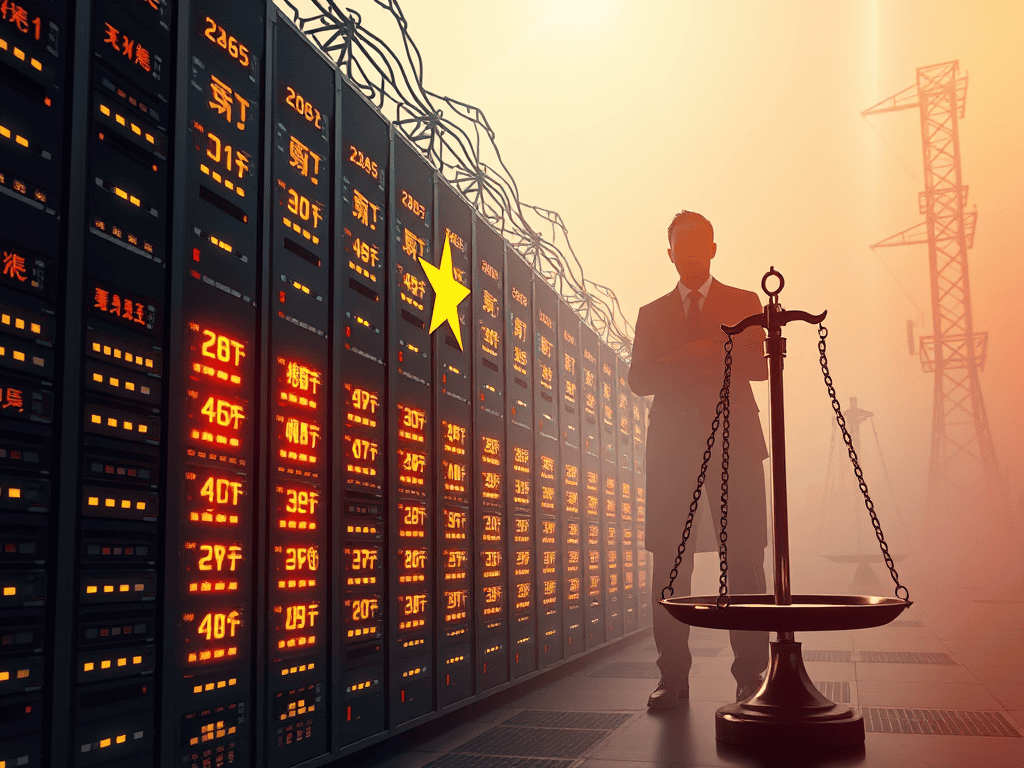
    A definitive structural intervention is unfolding across the Chinese industrial map. Beijing has begun slashing energy costs for its largest data centers. They are cutting electricity bills by up to 50 percent. This is to accelerate the production and deployment of domestic AI semiconductors.

    Targeting hyperscalers such as ByteDance, Alibaba, and Tencent, these grants are designed to sustain compute velocity despite U.S. export controls that bar access to frontier silicon.

    Mechanics—How Subsidies Rehearse Containment

    The 50 percent energy cuts operate as a containment rehearsal. Beijing lowers the operational cost floor. This ensures that its developer ecosystem maintains its momentum.

    • Cost-Curve Diplomacy: Subsidized power effectively attempts to reset the global benchmark for AI compute pricing. This forces Western firms to defend their margins in an environment where the energy-AI loop is tightening.
    • Developer Anchoring: Municipal and provincial incentives create a “gravity well” for talent. These incentives ensure that startups, inference labs, and cloud operators remain anchored within China’s sovereign stack.
    • The Scale Logic: Unlike the market-led surge seen in firms like Palantir, China’s AI expansion is subsidized by the government. This is done as a matter of national defense. It converts a commodity (electricity) into a strategic propellant for the silicon race.

    China is weaponizing its cost curve. By subsidizing the “oxygen” of the AI economy—energy—it is attempting to bypass the hardware bottlenecks imposed by the West.

    The Globalization Breach—Why Trust Wins Systems

    A decade ago, the globalization playbook was simple: low costs won markets. Today, that playbook has failed. In the AI era, trust wins systems.

    • The Manufacturing Trap: In the 2010s, China’s scale made it the gravitational center of supply chains. But AI is not labor-intensive; it is trust-intensive.
    • The Reliability Standard: Western nations are increasingly framing their technology policy around ethics, security, and institutional credibility. Legislation like the CHIPS Act and the EU AI Act has redefined market participation as conditional—access requires proof of reliability.
    • The Reputational Deficit: China’s own maneuvers include the Nexperia export-control retaliation. Opaque Intellectual Property (IP) rules are another factor. These actions have deepened a systemic trust deficit. Cheap power may illuminate a data center, but it cannot offset reputational entropy.

    Cost efficiency once conferred dominance, but credibility now determines inclusion. China’s cheap energy can sustain a domestic model, but it cannot buy the global interoperability required for AI leadership.

    The Ethics Layer—Abundance Without Interoperability

    Beijing’s energy subsidies may secure short-term velocity, but they cannot substitute for the governance frameworks that global firms demand.

    The primary barrier to China’s AI sovereignty is not silicon scarcity, but Institutional Opacity. Global developers remain wary of China-tethered stacks due to IP leakage risks. They are also concerned about forced localization clauses. Additionally, there is the lack of an independent judiciary.

    Real AI advancement requires Governance Interoperability:

    • Enforceable IP protection.
    • Transparent regulatory regimes.
    • Credible institutions that uphold contractual integrity.

    Without these, subsidies become “Symbolic Fuel”. They are abundant and powerful, but ultimately directionless. This occurs in a global market that values the rule of law over the price of a kilowatt.

    Rehearsal Logic—From Cost to Credibility

    In the AI era, cost is no longer the decisive variable; it is merely the entry fee. We are moving from an era of cost advantage to an era of Credible Orchestration.

    • Then: IP flexibility drove expansion. Now: IP enforceability defines legitimacy.
    • Then: Tech transfer was coerced. Now: Tech transfer must be consensual and audited.
    • Then: Governance sat on the sidelines. Now: Governance directs the entire play.

    Conclusion

    China’s subsidies codify speed but not stability. They rehearse domestic resilience yet fail to restore the confidence required to lead a global digital order.

    At this stage, the AI era remains suspended in an interregnum of partial sovereignties:

    • The United States commands model supremacy but lacks the cost discipline seen in its rivals.
    • China wields scale and speed but faces a debilitating trust deficit.
    • Europe codifies ethics and governance but trails significantly in compute and execution velocity.

    The decisive choreography—where trust, infrastructure, and innovation align—has yet to emerge. In this post-globalization landscape, reliability and orchestration outperform price. The age of cost advantage has ended. The era of credible orchestration has begun.