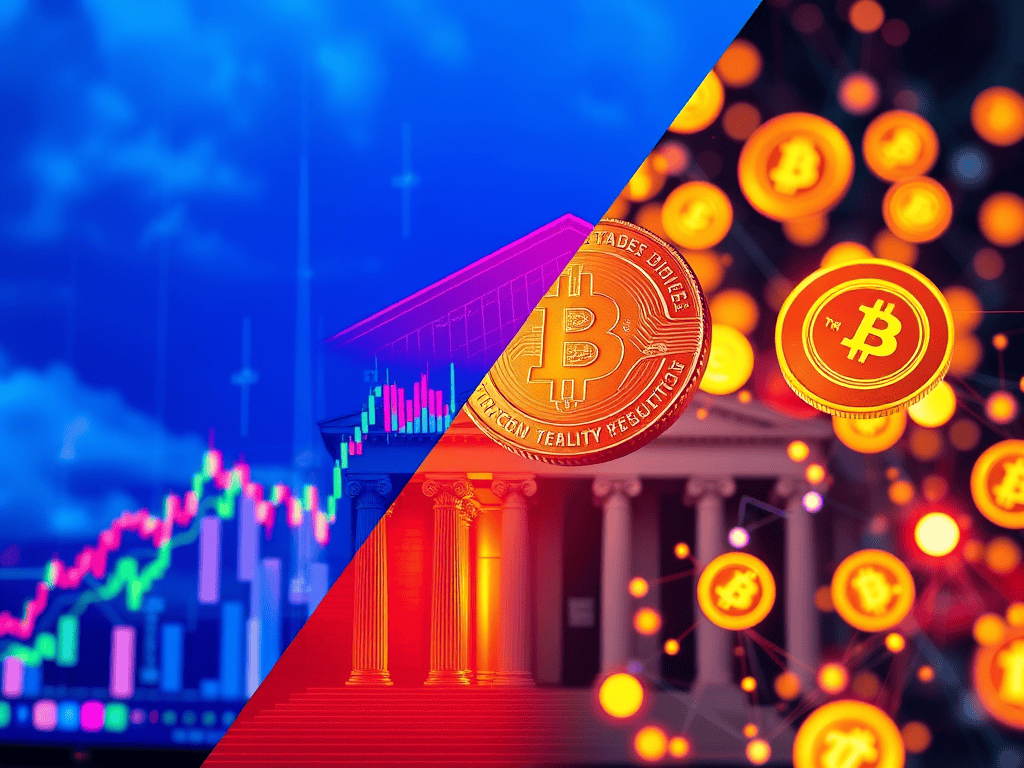
The Asset Doesn’t Just Exist. It Performs Legitimacy.
By late 2025, the boundary between Exchange-Traded Funds (ETFs) and tokenized commodities has dissolved. BlackRock’s iShares Bitcoin Trust normalized crypto exposure for institutions. At the same time, GoldLink Decentralized Autonomous Organization (DAO), Paxos Gold (PAXG), and Tether Gold turned bullion into programmable liquidity.
ETFs live inside traditional economics—audited, regulated, fiat-redeemable. Tokenized assets live inside protocol choreography—transparent on-chain, opaque off-chain, and staged for narrative effect. Both rely on a symbolic layer to sustain trust.
The Dual Performance of Stability
The core belief problem is identical in both worlds. The citizen invests in a promise of convertibility. This promise is sustained through performance. It is not necessarily secured by structural enforceability.
The ETF Model: Stability Performed Through Regulation
Even in heavily regulated funds, redemption is symbolic, not structural.
- Redemption Illusion: Custodians hold assets, but retail investors rarely touch what they own. Redemption typically yields fiat, not the underlying metal.
- Symbolic Disclosure: ETFs don’t codify stability—they rehearse it, in quarterly disclosures and custodian statements that stand in for convertibility. Tracking error can widen when derivatives multiply the distance between the claim and the commodity.
The Tokenized Model: Redemption as Mirage
Tokenized commodities claim to democratize access, but rely on vault optics and sovereign tolerance.
- Custodial Opacity: Most protocols publish PDFs, not live attestations. Custody frequently sits in offshore vaults with ambiguous jurisdictional reach.
- Redemption Illusion: Some promise physical redemption; others reference assets without enforceable convertibility. Tokenization doesn’t remove risk—it stages transparency while hiding the custodial spine.
Digital Choreography: The New Audit Trail
Digital choreography is the performative grammar of modern financial truth. The system will not fail due to the code transferring the token. Instead, it will fail in the choreography that hides the constraint on redemption.
- Interface Deception: Dashboards simulate convertibility with glowing “1:1 backed” icons.
- Staged Custody: Custody is validated through staged vault photos and influencer tours rather than independent, third-party verification.
- Invisible Constraints: Smart contracts automate transfers but leave redemption dependent on discretionary keys. Users trust the interface more than the ledger—and the interface is designed to perform legitimacy.
Policy Begins to Absorb the Choreography
Regulation is now catching up by embracing what it cannot fully control, merging traditional finance (TradFi) rails with cryptographic plumbing.
- SEC and On-Chain Settlement: The SEC’s Digital Commodity Guidance now allows partial on-chain settlement for registered funds. This merges ETF rails with cryptographic plumbing.
- UK Token Recognition: The UK’s Financial Markets and Digital Assets Act recognizes tokenized commodities as regulated investment contracts. This enables funds to tokenize up to 20% of their underlying.
The Investor’s Matrix: What Must Now Be Decoded
This isn’t financial advice—it’s map-reading for belief economies. Investors must read not only balance sheets but semiotics.
Investor Audit Checklist: Decoding Belief
- Audit Redemption: Is convertibility enforced by code, custodian, or promise? If automation stops at the vault door, redemption is theatrical.
- Track Symbolic Inflation: When market capitalization outruns verified collateral, belief is inflating faster than backing.
- Map Sovereign Choreography: Regulatory alliances and political endorsements can protect—or capture—platforms.
- Diversify Belief Infrastructure: Combine on-chain attestations, traditional audits, and independent verification.
- Decode Interface Signals: The smoother the dashboard, the more invisible the constraints beneath it.
Conclusion
In the merging economies of ETFs and tokenized commodities, assets no longer rely solely on fundamentals. They rely on choreography—on how redemption is staged, how custody is framed, and how interfaces perform trust. The investor must read not only balance sheets but semiotics. Not only disclosures but symbolism. Not only collateral but choreography. The next frontier of investing is epistemic. Those who learn to audit belief will survive. They will endure what those who audit price alone cannot.
Further reading: