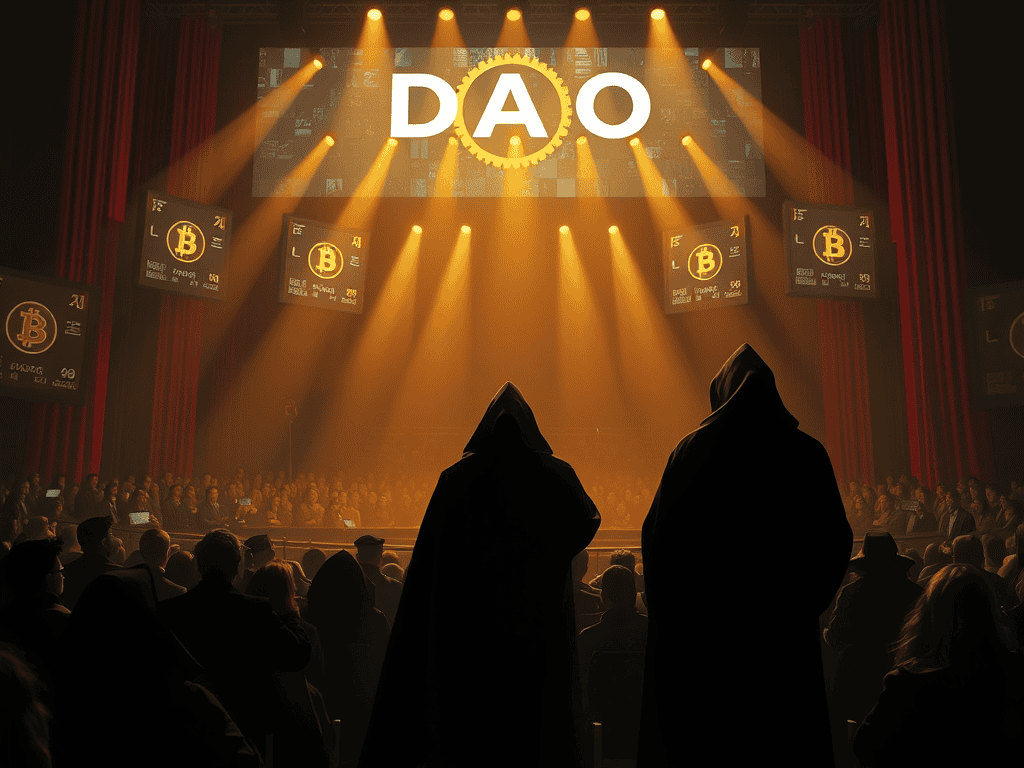
The Citizens Are Just Part Of The Show.
In crypto’s democratic mythology, every wallet is a voice. Every token, a ballot. Yet the ritual of Decentralized Autonomous Organization (DAO) voting is like a staged drama. Dashboards glow with participation rates. Delegates proclaim consensus. Governance forums praise inclusion. But the choreography is fixed long before the curtain rises. Insiders and early investors—those holding vast token reserves—have already determined the outcome. The citizen doesn’t decide; the citizen validates. Decentralization endures not as a structure of freedom but as a carefully coded illusion of it.
The Protocol Doesn’t Just Run. It Rules.
DAOs were imagined as the antidote to corporate hierarchy—transparent, leaderless, self-governing. In practice, they re-instantiate hierarchy through arithmetic: one token, one vote. Capital weight replaces civic weight. The more tokens you hold, the louder your sovereignty. Major DeFi DAOs—Uniswap, Aave, MakerDAO—mirror this pattern. A handful of addresses control the fate of billion-dollar protocols while thousands of smaller holders abstain. The ledger records transparency, but not equality.
Governance as Theater
Metrics reveal what ideology conceals. Across the DAO landscape, the top 10 voters command roughly 40–58 percent of voting power. Only 15–20 percent of holders ever vote. In some proposals, a single whale accounts for more than 60 percent of turnout. Participation in Uniswap’s votes has declined from 60 million Uniswap Token (UNI) to under 45 million. These are not symptoms—they are the design. The “community” votes, but the outcome is mathematically predetermined.
You Don’t Just Vote. You Validate the Veto.
Every DAO embeds mechanisms to preserve the founding coalition. Proposals are privately shaped, publicly ratified. Emergency “guardian” controls enable select wallets to halt or reverse outcomes. Core teams retain token reserves large enough to nullify dissent. The blockchain’s permanence masks a social contract written in invisible ink: insiders decide, the protocol executes, citizens applaud the choreography.
Forks as False Freedom
When confronted with imbalance, DAO advocates invoke the sacred escape hatch: the fork. “If you disagree, clone the code and leave.” But forking rarely liberates—it fragments. Each split drains liquidity, divides users, and weakens the dissenting branch. Power consolidates where capital remains. The act of departure becomes a ritual of futility, reinforcing the dominance of the parent protocol.
Governance as Mythology
The DAO ecosystem sustains itself through symbolic parity—openness, transparency, community. Yet openness without redistribution is window dressing; transparency without recourse is surveillance. The protocol doesn’t consult; it computes. The citizen doesn’t govern; they perform. The vote isn’t an expression of autonomy—it is a script confirming authority. Decentralization, once a rebellion, has become a ritual of obedience rendered in code.
The Protocol Votes. The Insiders Rule. The Citizens Watch.
DAOs were born from the dream of collective control. What emerged instead is algorithmic feudalism: power quantified, consent tokenized, dissent priced out. The ledger shows every vote, but hides every veto. The citizen’s screen glows with inclusion, yet behind the interface, power consolidates in silence. In this choreography, the performance follows a predictable pattern. The few decide. The many applaud. The code calls it consensus.
Further reading: