Tag: Governance

  • Markets Punish Bitcoin’s Lack of Preparedness

    Markets Punish Bitcoin’s Lack of Preparedness

    Quantum Headlines Miss the Real Risk

    For months, European and U.S. media have warned of “Q-Day” — the hypothetical moment when quantum computers could crack Bitcoin’s cryptography. The threat is distant, yet the drumbeat has weighed on sentiment. Bitcoin struggles to reclaim $100,000. Privacy coins are rallying. Investors are rotating away from the asset once touted as the strongest network in history.

    The mistake is assuming markets fear the algorithms. They don’t. What investors fear is Bitcoin’s silence on how it would respond if those algorithms ever need to change.

    Governance, Not Math, Is the Choke Point

    Quantum-resistant cryptography already exists. Bitcoin could adopt new signatures long before any realistic quantum machine arrives. The problem is not technical capacity — it’s governance. Bitcoin avoids making promises about future upgrades, leaving institutions uneasy.

    Markets don’t punish the absence of protection. They punish the absence of preparedness. In cryptography, you can change the locks. In Bitcoin, you must persuade millions to agree on which locks to install, and when. The fear is not that Bitcoin will break, but that it cannot coordinate a repair.

    Privacy Coins Rally on Narrative, Not Safety

    Zcash and other privacy-focused tokens have surged in recent weeks. Not because they solved quantum security, but because they project resilience — a story Bitcoin refuses to tell. None of these assets are proven quantum-safe. Their rally is narrative arbitrage: investors hedging against Bitcoin’s silence.

    In crypto, security is not only technical. It is theatrical.

    Dalio’s Doubt Was About Governance, Not Quantum

    Ray Dalio’s recent skepticism didn’t move markets because he nailed the quantum timeline. It moved markets because he questioned Bitcoin’s ability to act like a sovereign asset. Reserve currencies must demonstrate authority to upgrade. Bitcoin demonstrates caution.

    Dalio’s critique was not about cryptography. It was about credibility:

    1. Who decides Bitcoin’s defense?
    2. How quickly can it be deployed?
    3. Does the network have visible emergency governance?

    These are not mathematical questions. They are questions of sovereignty.

    Macro Weakness Makes the Narrative Stick

    Higher interest rates, thinning liquidity, and risk-off positioning magnify shocks. The quantum storyline landed in a market already fragile. Fear of vulnerability didn’t cause the downturn — it attached itself to weakness already in motion.

    A fragile macro tape needs a story. Quantum headlines provided one.

    The Real Test: Coordination, Not Code

    Bitcoin is not struggling because quantum machines are imminent. It is struggling because quantum narratives expose the one thing the network refuses to demonstrate. The network cannot show its choreography for the day it must change.

    The risk is not that the code cannot adapt. The risk is that governance will not signal adaptation early enough to satisfy sovereign capital.

    Quantum fear is not a cryptographic test. It is a coordination test. And markets are watching who demonstrates readiness — not who invents new locks.

  • State Subsidy | Why Cheap Power No Longer Buys AI Supremacy

    State Subsidy | Why Cheap Power No Longer Buys AI Supremacy

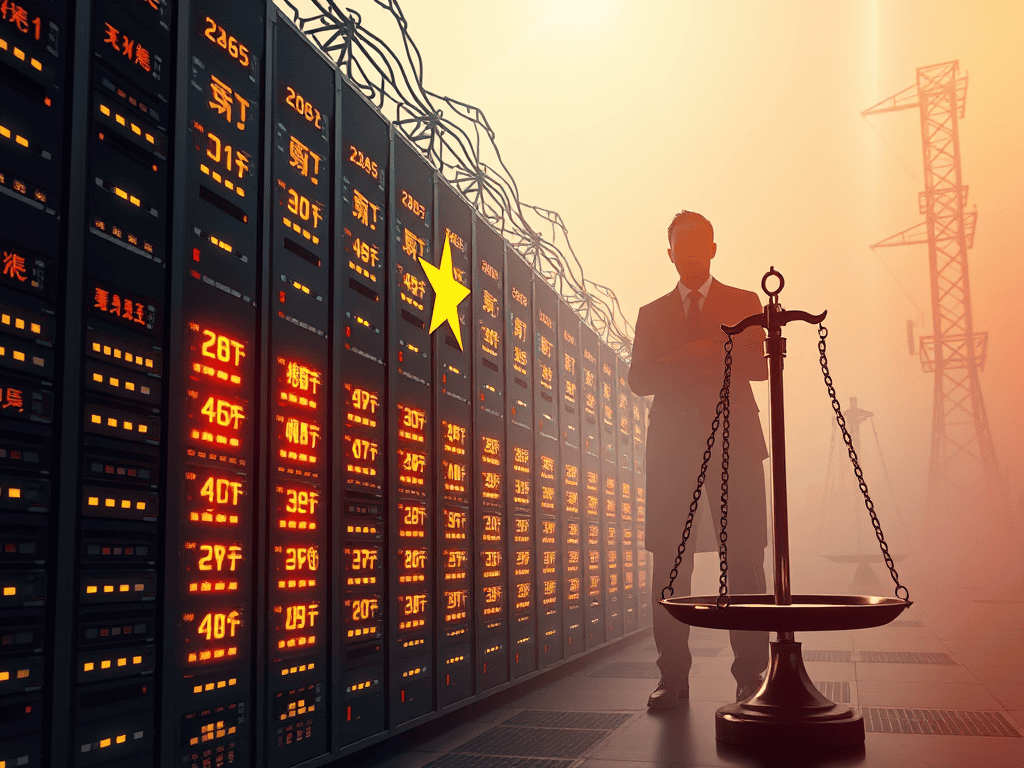
    A definitive structural intervention is unfolding across the Chinese industrial map. Beijing has begun slashing energy costs for its largest data centers. They are cutting electricity bills by up to 50 percent. This is to accelerate the production and deployment of domestic AI semiconductors.

    Targeting hyperscalers such as ByteDance, Alibaba, and Tencent, these grants are designed to sustain compute velocity despite U.S. export controls that bar access to frontier silicon.

    Mechanics—How Subsidies Rehearse Containment

    The 50 percent energy cuts operate as a containment rehearsal. Beijing lowers the operational cost floor. This ensures that its developer ecosystem maintains its momentum.

    • Cost-Curve Diplomacy: Subsidized power effectively attempts to reset the global benchmark for AI compute pricing. This forces Western firms to defend their margins in an environment where the energy-AI loop is tightening.
    • Developer Anchoring: Municipal and provincial incentives create a “gravity well” for talent. These incentives ensure that startups, inference labs, and cloud operators remain anchored within China’s sovereign stack.
    • The Scale Logic: Unlike the market-led surge seen in firms like Palantir, China’s AI expansion is subsidized by the government. This is done as a matter of national defense. It converts a commodity (electricity) into a strategic propellant for the silicon race.

    China is weaponizing its cost curve. By subsidizing the “oxygen” of the AI economy—energy—it is attempting to bypass the hardware bottlenecks imposed by the West.

    The Globalization Breach—Why Trust Wins Systems

    A decade ago, the globalization playbook was simple: low costs won markets. Today, that playbook has failed. In the AI era, trust wins systems.

    • The Manufacturing Trap: In the 2010s, China’s scale made it the gravitational center of supply chains. But AI is not labor-intensive; it is trust-intensive.
    • The Reliability Standard: Western nations are increasingly framing their technology policy around ethics, security, and institutional credibility. Legislation like the CHIPS Act and the EU AI Act has redefined market participation as conditional—access requires proof of reliability.
    • The Reputational Deficit: China’s own maneuvers include the Nexperia export-control retaliation. Opaque Intellectual Property (IP) rules are another factor. These actions have deepened a systemic trust deficit. Cheap power may illuminate a data center, but it cannot offset reputational entropy.

    Cost efficiency once conferred dominance, but credibility now determines inclusion. China’s cheap energy can sustain a domestic model, but it cannot buy the global interoperability required for AI leadership.

    The Ethics Layer—Abundance Without Interoperability

    Beijing’s energy subsidies may secure short-term velocity, but they cannot substitute for the governance frameworks that global firms demand.

    The primary barrier to China’s AI sovereignty is not silicon scarcity, but Institutional Opacity. Global developers remain wary of China-tethered stacks due to IP leakage risks. They are also concerned about forced localization clauses. Additionally, there is the lack of an independent judiciary.

    Real AI advancement requires Governance Interoperability:

    • Enforceable IP protection.
    • Transparent regulatory regimes.
    • Credible institutions that uphold contractual integrity.

    Without these, subsidies become “Symbolic Fuel”. They are abundant and powerful, but ultimately directionless. This occurs in a global market that values the rule of law over the price of a kilowatt.

    Rehearsal Logic—From Cost to Credibility

    In the AI era, cost is no longer the decisive variable; it is merely the entry fee. We are moving from an era of cost advantage to an era of Credible Orchestration.

    • Then: IP flexibility drove expansion. Now: IP enforceability defines legitimacy.
    • Then: Tech transfer was coerced. Now: Tech transfer must be consensual and audited.
    • Then: Governance sat on the sidelines. Now: Governance directs the entire play.

    Conclusion

    China’s subsidies codify speed but not stability. They rehearse domestic resilience yet fail to restore the confidence required to lead a global digital order.

    At this stage, the AI era remains suspended in an interregnum of partial sovereignties:

    • The United States commands model supremacy but lacks the cost discipline seen in its rivals.
    • China wields scale and speed but faces a debilitating trust deficit.
    • Europe codifies ethics and governance but trails significantly in compute and execution velocity.

    The decisive choreography—where trust, infrastructure, and innovation align—has yet to emerge. In this post-globalization landscape, reliability and orchestration outperform price. The age of cost advantage has ended. The era of credible orchestration has begun.

  • How Lenders Rehearse Blame Before Accountability

    How Lenders Rehearse Blame Before Accountability

    When lenders accuse First Brands Group of “massive fraud,” they are not merely exposing a deception. They are performing a choreography of containment.

    The public accusations are amplified by the financial press. They read less like a discovery of truth. Instead, they resemble a reputational hedge. The fiduciaries cast the borrower as a solitary villain before the courts complete their work. They failed to verify and attempt to sanitize their own structural negligence. This represents an inversion of responsibility. The custodians of capital curate outrage. Their goal is to preempt the inevitable audit of their own silence.

    Background—The Mechanics of the $6 Billion Collapse

    First Brands Group, a U.S.-based automotive supplier led by entrepreneur Patrick James, successfully tapped into the private-credit markets for nearly 6 billion dollars. The illusion unraveled only when a series of coordinated fraud suits revealed a structural rot in the lending plumbing.

    • The Allegations: Lenders now allege a sophisticated scheme. It involves overstated receivables and duplicated collateral. Liquidity optics are engineered through recycled or “circular” invoices.
    • The Verification Gap: The core of the fraud was procedural. Verification of the company’s assets was delegated to borrower-aligned entities. The lenders relied on the borrower’s own internal systems to “verify” the very data used to secure billions in credit.

    Systemic Breach—When Verification Becomes Theater

    The First Brands collapse shares a striking choreography with the Carriox Capital scandal. In both instances, the fiduciaries—entrusted with the capital of pensioners and insurers—accepted a “Self-Rehearsed Verification.”

    • Mimicking Rigor: Borrower-controlled entities validated their own receivables. They used professional templates, seals, and the procedural language of institutional finance. This was done to mimic rigor.
    • Structural Negligence: Lenders accepted these documents without verifying the independence of the author. Independence is not a formality; it is the essence of fiduciary stewardship. By removing independent friction, the lenders co-authored the illusion of safety.

    Syndicated Blindness—The Dispersal of Responsibility

    A defining feature of modern private credit is the use of syndicates. However, at First Brands, this structure led to Syndicated Blindness.

    • Liability Dissolution: In large syndicates, responsibility for due diligence often dissolves across participants. Lenders thought that the necessary collateral validation had already been done. They assumed this because they relied on a lead agent or a prior facility, including firms like Raistone.
    • The Reinforcing Vacuum: This created a self-reinforcing loop: distributed exposure led to centralized blindness. When the scheme collapsed, the ensuing lawsuits between the lenders themselves exposed the fragility of the entire architecture.

    Fiduciary Drift—Governance Without Guardianship

    The rise of the private-credit asset class was built on the promise of velocity. It offered faster underwriting and bespoke structures. The yields were higher than traditional bank loans. But that velocity has eroded the discipline of guardianship.

    • Ceremonial Governance: Oversight has become ceremonial. Collateral is now treated as a symbolic placeholder rather than a physical reality.
    • The Systemic Rehearsal: Fiduciaries did not merely “miss” the fraud at First Brands. They rehearsed a system. This system was designed to ignore the red flags of self-verification in the pursuit of high-margin deployment.

    The Credibility Contagion

    The First Brands collapse is not an isolated anomaly. It is part of a series of credibility breaches. These breaches stretch from the Brahmbhatt telecom fraud to the Carriox self-certified due diligence.

    The systemic threat to the multi-trillion dollar private-credit market is not default contagion—it is Credibility Contagion. If the market continues to expand in size and opacity, it will outsource verification to borrowers. “Disbelief” will then become the new reserve currency of private capital.

    Conclusion

    First Brands is not a deviation from the system; it is the system performing its own inherent truth. Private credit was marketed as a frictionless alternative to the “slowness” of regulated banking. Each advantage came at the cost of sacrificing the fundamental act of independent verification.

  • The Regulator Watches the Shadows

    The Regulator Watches the Shadows

    We’re Watching the Wrong Thing

    Christine Lagarde, President of the European Central Bank, warns of the “darker corners” of finance—crypto, DeFi, and shadow banking. Her caution is valid, but her compass is off. The danger no longer hides in the dark; it operates in daylight, rendered in code. While regulators chase scams, volatility, and hype cycles, a new architecture of power quietly defines how liquidity behaves. It does not ask permission. It does not wait for oversight. It simply mints—tokens, markets, meaning—autonomously.

    The Protocol Doesn’t Break the Rules. It Rewrites Them.

    Twentieth-century regulation assumed control could be enforced through institutions: governments printed, banks intermediated, regulators supervised. But in the twenty-first century, the protocol itself is the institution. Smart contracts on Ethereum, Solana, and Avalanche now define collateral, custody, and credit. MiCA, Europe’s flagship crypto framework, governs issuers and exchanges but not the code that runs beneath them. Liquidity now flows through autonomous logic beyond territorial reach.

    The Regulator Isn’t Behind. They’re Facing the Wrong Way.

    Lagarde’s “darker corners” no longer contain the systemic threat. The real opacity lives inside transparency itself—protocols that mimic compliance while concentrating control. Dashboards proclaim openness; multisigs retain veto power. Foundations, offshore entities, and pseudonymous developers now hold the keys once kept in central banks. Regulation still polices disclosure while the system silently automates discretion.

    The Breach Isn’t Criminal. It’s Conceptual.

    The frontier of finance is no longer defined by fraud but by authorship. Who writes the laws of liquidity—legislatures or developers? The new statutes are GitHub commits; the amendments are forks. Law once debated in chambers now executes in block time. By policing symptoms—scams and hacks—regulators mistake syntax for substance. The real breach is epistemic: governance rewritten in machine grammar. The rule of law is yielding to the law of code.

    The Citizen Still Trusts, But Trust Has Moved.

    Citizens still look to regulators for protection, assuming oversight equates to order. We trust code because it seems incorruptible, forgetting that code is authored, audited, and altered by people. Protocols such as Curve, Aave, and Compound have shown a different reality. Insiders can legally manipulate governance, emissions, and treasury flows. They do all of this “by the rules.” Participation becomes performance; validation becomes surrender.

    Democracy at the Edge of Code

    This debate is larger than crypto. It concerns whether democracy can still govern the architecture that now governs it. If money’s movement is defined by systems no state can fully audit, oversight becomes ritual, not rule. Regulation cannot chase every breach; it must reclaim authorship of the rails themselves. Because the threat is not hidden in the dark—it is embedded in the syntax of innovation. While the regulator watches the shadows, the protocol mints the future.