Tag: Huawei

  • Nvidia’s H200: Caught in China’s Semiconductor Gamble

    Nvidia’s H200: Caught in China’s Semiconductor Gamble

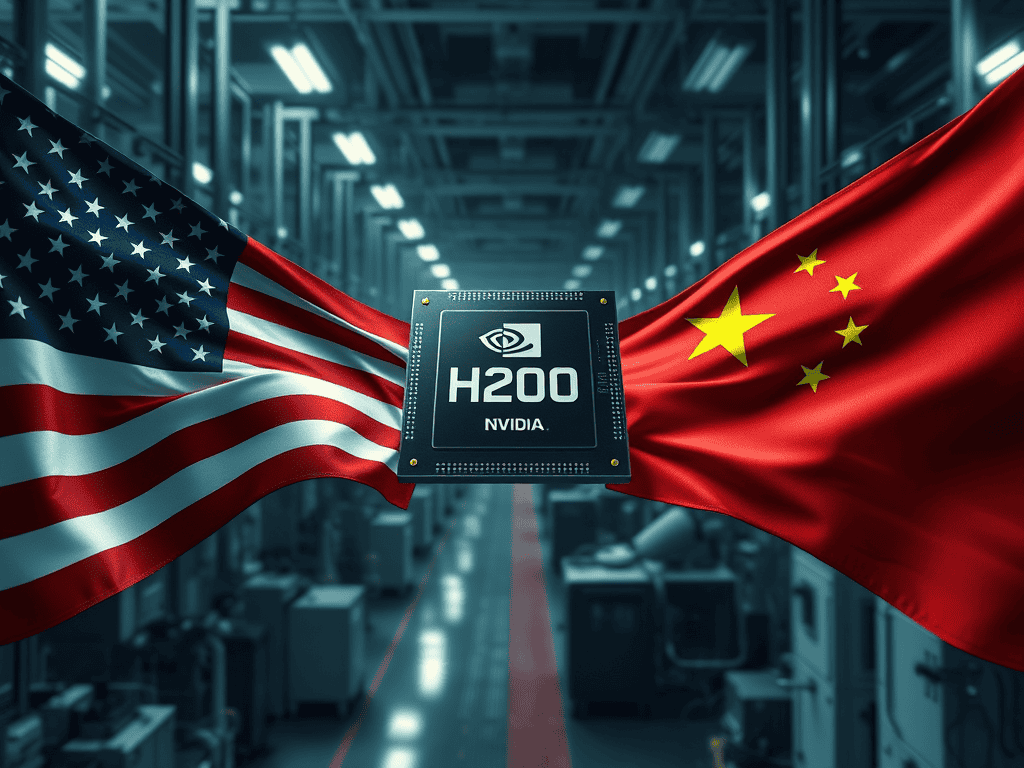
    The global semiconductor landscape has entered a phase of “Crossfire.” Nvidia’s H200 Artificial Intelligence chip, once viewed as the inevitable bridge to the Chinese market under a new United States administration, is increasingly becoming a stranded asset.

    According to a Financial Times report published in late 2025, titled “China boosts AI chip output by upgrading older ASML machines,” Chinese semiconductor fabrication plants are boosting output by retrofitting and upgrading older lithography equipment. This “Retrofit Strategy” allows Beijing to bypass Western export controls while reducing its reliance on American silicon. Simultaneously, Meta Platforms Inc.’s “Mango and Avocado” initiative is creating a high-urgency demand for Nvidia’s Graphics Processing Units, offering a partial, albeit incomplete, “Replacement Strategy” for the revenue at risk.

    Retrofit Sovereignty: China’s Strategic Pivot

    China is no longer waiting for Western permission to advance its hardware. Fabs such as SMIC and Huawei are repurposing deep ultraviolet lithography systems—once dismissed as obsolete—to create a domestic supply chain that effectively undermines United States export leverage.

    • The Upgrade Method: Chinese engineers are retrofitting older ASML machines with secondary-market components, including wafer stages, lenses, and sensors. The goal is to achieve near-advanced performance without requiring the latest generation of Western tools.
    • Target Output: These upgraded systems are now producing Artificial Intelligence chips and advanced smartphone processors that compete directly with high-end Western hardware.
    • The Geopolitical Impact: This shift exposes the fundamental fragility of export control regimes. When older machinery can be enhanced through local engineering, enforcement becomes difficult, and China’s “Silicon Sovereignty” remains intact despite ongoing sanctions.

    The H200 Flashpoint: Trapped in the Crossfire

    Nvidia’s H200 was engineered as a “compromise chip” for the Chinese market, yet it is now pinned between United States export levies and Beijing’s drive for independence.

    • The U.S. Strategy: The administration authorized H200 sales to China with a 25 percent fee, aiming to keep Nvidia dominant in the region while slowing China’s domestic progress.
    • The Chinese Counter: Beijing is signaling a firm rejection of the H200. Interpreting the American fee as a “dependency trap,” China is prioritizing domestic designs and ASML retrofits over Western-designed silicon.
    • The Revenue Blow: Historically, China accounted for 20 to 25 percent of Nvidia’s data center revenue. With the H200 sidelined, investors are now facing a potential 10 billion to 12 billion dollar annualized revenue hole as market forecasts begin to exclude the world’s largest growth market.

    The H200 is caught in a pincer move. Every successful retrofit in a Chinese fab narrows the technology gap and erodes Nvidia’s commercial leverage.

    The Meta Replacement: Capturing Compute Oxygen

    While China attempts to delete Nvidia from its regional map, Meta is providing a necessary buffer. Chief Executive Officer Mark Zuckerberg’s announcement of the Mango and Avocado models signals an urgent “crash-back” into Artificial Intelligence that requires massive amounts of external compute.

    The Opportunity Ledger

    In terms of Hardware, Meta currently lacks proprietary silicon and specialized Tensor Processing Units, making the firm entirely dependent on external hardware. Nvidia dominates this supply, positioning its H100, H200, and Blackwell chips as the indispensable backbone for Meta’s 2026 rollout.

    Replacement Math: Buffer vs. Parity

    To navigate the 2026 cycle, investors must decode whether Meta can truly replace the lost Chinese market. The “Replacement Math” reveals a structural bifurcation in Nvidia’s revenue outlook.

    • The Lost China Market: Nvidia faces a historic share loss that represents roughly 10 billion to 12 billion dollars in annualized revenue at risk. This market is shrinking permanently due to domestic chip independence.
    • The Meta Replacement Opportunity: Nvidia could see a potential 5 billion to 8 billion dollar surge in demand from Meta. While Meta provides higher margins due to the urgency of their catch-up strategy, the total demand does not reach parity with the lost Chinese share.

    Meta offers a strategic buffer, but it cannot fully substitute for the structural loss of the Chinese engine.

    Conclusion

    Nvidia is currently caught between the erosion of its dominance in the East and the capture of dependency in the West. For the investor, the decisive signal remains the Replacement Math: how many buffers does it take to fill a 12 billion dollar hole?

  • Apple’s Containment Forfeits the Future to Chinese Rivals

    How Containment Forfeits the Future to Chinese Rivals

    A recent report by the Financial Times (Chinese phonemakers seize on Apple’s AI struggles to grab market share) highlights a critical inflection point in the global tech landscape: while Apple remains cautious and slow to integrate generative AI, Chinese smartphone makers like Huawei, Xiaomi, and Oppo are aggressively embedding AI features to seize market share.

    This isn’t merely a technological slip-up. It is a direct, real-time validation of the Apple Fragility thesis we established earlier (link below): Apple’s decision to prioritize strategic containment over innovation has created a massive opportunity cost ledger, leading to stagnation by design.

    The company that valued durability above all else is now forfeiting the unbuilt future to rivals willing to take geopolitical risk for the sake of technological speed.

    (*Reference our earlier dispatch: Apple Unhinged: What $600B Could Have Built)

    The Containment Strategy as Fragility

    Our previous analysis argued that Apple’s massive capital deployment—such as the $600 Billion American Manufacturing Program (AMP)—was a political hedge. It anchored manufacturing in the U.S., neutralized tariff risk, and bought political protection.

    The Trade-Offs of Containment:

    • Capital Use: That $600 Billion could have seeded frontier AI labs, scaled Vision Pro into ubiquity, or built a sovereign Large Language Model (LLM) empire. Instead, it was spent reinforcing the present.
    • Innovation: Innovation was relegated to incremental, device-native updates, externalizing the frontier AI risk to partners.
    • Systemic Breach: Liquidity hoarded as a shield ossifies into inertia. Apple’s fortress strategy buys resilience against trade wars but cedes the AI innovation optics entirely.

    This fortress logic—mirroring the containment strategy of a nation-state—explains precisely why the FT is reporting that Apple is lagging. The company’s valuation reflects durability, not reinvention.

    The Smartphone AI Arms Race Ledger

    The current market shift is defined by the contrast between Apple’s highly disciplined but slow rollout (focusing on privacy and seamless ecosystem integration) and the aggressive, feature-first sprint by its Chinese rivals.

    Competitive AI Strategies and Moats

    • Apple—Containment Discipline:
      • Strategy: Cautious, privacy-first, phased rollout via ecosystem. Will only ship AI when demonstrably superior.
      • Trade-Off: Risks ceding mindshare and market share during the “AI phone” marketing window.
      • Moat: Unmatched ecosystem lock-in (iOS, services, hardware quality).
    • Huawei—Sovereignty Sprint:
      • Strategy: Aggressive, sovereignty-first approach building native AI stacks to bypass sanctions. Anchors demand in national resilience.
      • Market Position: Surging in China post-sanctions recovery with flagship models like the Mate 60.
      • Trade-Off: Silicon constraints force clever on-device optimization and selective feature depth.
    • Xiaomi / Oppo / Vivo—Feature Velocity:
      • Strategy: Fast follower, focusing on rapid iteration and feature-rich mid/high tiers (e.g., AI camera pipelines, live translation, generative user interface).
      • Market Position: Strong in mid-range and emerging markets.
      • Trade-Off: Thin margins and reliance on chipset vendors for foundational AI solutions.

    The Market Share Shift and 12-Month Scenarios

    The FT’s data on slowing iPhone sales in China is the immediate consequence of this strategic divergence. For the Chinese Original Equipment Manufacturers (OEMs), AI is the necessary differentiation in a saturated global market.

    Feature Stack Contrasts

    The core divergence lies in implementation strategy, where Apple favors deep integration over immediate feature visibility:

    • On-Device AI:
      • Apple (Containment): Strong focus on on-device inference for privacy and performance (e.g., A-series/M-series Neural Processing Units (NPUs)).
      • Chinese OEMs (Velocity): Hybrid approach; visible AI features even if cloud-heavy. Optimization follows market traction.
    • Signature Experience:
      • Apple (Containment): Private assistant, secure generative edits, accessibility-focused AI.
      • Chinese OEMs (Velocity): AI camera pipelines, live translation, generative wallpaper, and custom User Interface (UI) / assistant features.
    • Go-to-Market:
      • Apple (Containment): Premium retail and carrier partnerships.
      • Chinese OEMs (Velocity): Broad retail/channel penetration; fast product cycle (SKU) churn in Asia / Emerging Markets (EM).

    12-Month Scenarios

    The next year will determine if Apple can regain the mindshare lost during this initial wave:

    • Apple Catch-up Window: The company is banking on the eventual launch of a cohesive, private AI assistant and on-device generative suite to retain premium share and narrow the perception gap.
    • Huawei Share Rebound: Continued patriotic demand, combined with competent native AI features, will sustain double-digit domestic gains, although the export market remains constrained by external sanctions.
    • Global AI Push: Xiaomi, Oppo, and Vivo will continue their global push, using aggressive pricing and rapidly delivered AI features to gain share in Southeast Asia (SEA), India, and Latin America (LATAM).

    Conclusion

    The FT article highlights a strategic inflection point: Apple’s cautious AI rollout contrasts with Chinese phonemakers’ aggressive push, creating a window for Huawei, Xiaomi, and Oppo to seize market share. This confirms our thesis that containment protects the present but forfeits the unbuilt future, making innovation sacrificed to permanence. Valuation reflects discipline without disruption, but only risk and experimentation keep the technological machine alive.

    Disclaimer

    This article is for informational and research purposes only. It does not constitute investment advice, legal guidance, or financial recommendations. Markets, regulatory environments, and technological conditions are continuously evolving; our analysis maps the terrain as it shifts, not as a fixed prediction or advisory position.

  • The Orbital AI Race at Altitude

    The Orbital AI Race at Altitude

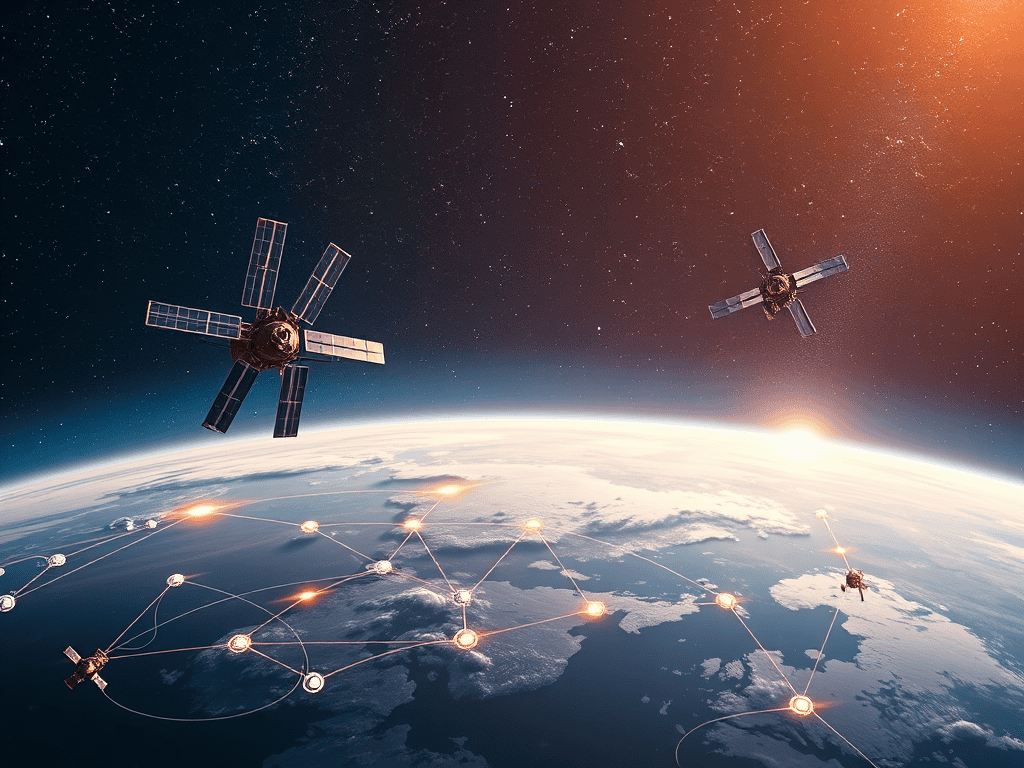
    The contest between the United States and China has transitioned into a new physical and digital layer. The focus is no longer merely on who reaches orbit or plants a flag. Instead, it is about who controls the compute, data, and developer ecosystems that run through the vacuum.

    Space has become a high-velocity interface for Artificial Intelligence (AI) deployment, model distribution, and collapse containment. In the 2025 landscape, the final frontier is being recoded as a programmable layer of the global AI economy.

    Infrastructure Contrast—Commercial Stack vs. Command Stack

    The architecture of orbital power reveals two fundamentally different scripts.

    The U.S. Commercial Stack (Decentralized Node Logic)

    U.S. orbital logic is decentralized, corporate, and Application Programming Interface (API)-driven.

    • Amazon’s Project Kuiper: It is planned as a constellation of 3,236 satellites. Kuiper links orbital hardware directly to Amazon Web Services (AWS) edge compute. This setup converts the vacuum into a data pipe for the cloud.
    • Microsoft Azure Space: It orchestrates Luxembourg-based SES and SpaceX constellations through AI APIs. This integration incorporates orbital data into the existing enterprise AI stack.
    • Palantir: Fuses satellite feeds into defense-grade decision platforms, translating capital and raw data into real-time battlefield inference.

    The Chinese Command Stack (Unified Orchestration)

    China’s response is centralized, command-based, and vertically synchronized.

    • The Unified Engine: The China Aerospace Science and Technology Corporation (CASC) operates under a unified sovereign mandate. Huawei, CETC, and DeepSeek also operate under this mandate.
    • The Guowang Initiative is China’s answer to Starlink. It is a planned 13,000-satellite constellation. It is designed as a single-state orbital stack. This stack fuses AI models, navigation (BeiDou), and defense telemetry.
    • Vertical Integration: Unlike the U.S. model, where companies compete for contracts. China builds a coherent stack from the chip to the constellation. This approach ensures that AI doctrine is hard-coded into the hardware.

    The U.S. codifies velocity through a bazaar of commercial nodes. China codifies control through a cathedral of command. Both sides now treat orbit as the physical substrate for “Inference at Altitude.”

    The Strategic Comparison—The Stacked Ledger

    While the U.S. leads in sheer volume and model supremacy, China’s strength lies in its ability to synchronize its infrastructure.

    • U.S. Alliance Advantage: The U.S. can out-scale China through its alliance network (NASA, ESA, JAXA) and its dominant commercial players. Starlink already operates over 6,000 satellites, providing a massive, battle-tested head start in orbital liquidity.
    • China’s Integration Edge: China counters with orchestration. The BeiDou navigation system has over 30 current-generation satellites. It offers 100% global coverage. The system is natively integrated into China’s maritime and industrial hardware.
    • Developer Anchoring: The U.S. leads in “Developer Sovereignty.” By exporting APIs as infrastructure, firms like Microsoft and Amazon anchor the global developer class to Western rails.

    AI-Native Orbital Logic—Inference at Altitude

    The companies that command the 2026 cycle are those embedding AI inference directly into the orbital “rail.”

    • On-Orbit Compute: The shift is from “Bent-Pipe” satellites (which merely relay data) to “Edge-Compute” satellites (which process data in orbit). This reduces latency and allows for real-time AI reasoning for autonomous systems and defense.
    • Sovereign Cloud Expansion: Huawei Cloud and CETC are merging orbital imaging with DeepSeek’s reasoning models. They are offering “Sovereign Intelligence” to partners in the Global South.
    • The API War: Microsoft and Amazon are striving to ensure compatibility for every satellite launched by an ally. These satellites must be “Azure-ready” or “AWS-native.” This locks the orbital layer into the U.S. software perimeter.

    Orbital Diplomacy—The Global South as the Stage

    Both superpowers are using orbit to export trust and dependency to emerging markets.

    • China’s Infrastructure Diplomacy: Through the Belt and Road Initiative, China offers partners satellite internet, climate imaging, and dual-use communications. It is a “Space-as-a-Service” model designed to bypass Western terrestrial cables.
    • The U.S. Soft Power Rail: The U.S. counters through corporate deployment. Starlink’s wartime utility in Ukraine demonstrates its strategic value. AWS’s humanitarian compute initiatives showcase its role in global efforts. These actions are rehearsals for a new era of “Digital Humanitarianism.” This era anchors nations to the U.S. commercial stack.

    Conclusion

    The orbital race is not a speculative vanity project; it is the construction of a permanent, high-altitude infrastructure.

    In this choreography, the nation that anchors developers—not just satellites—will define the logic of space. The U.S. relies on the speed of its commercial giants. This velocity sets the standard. Meanwhile, China uses the integration of its command stack. This integration enforces its doctrine.