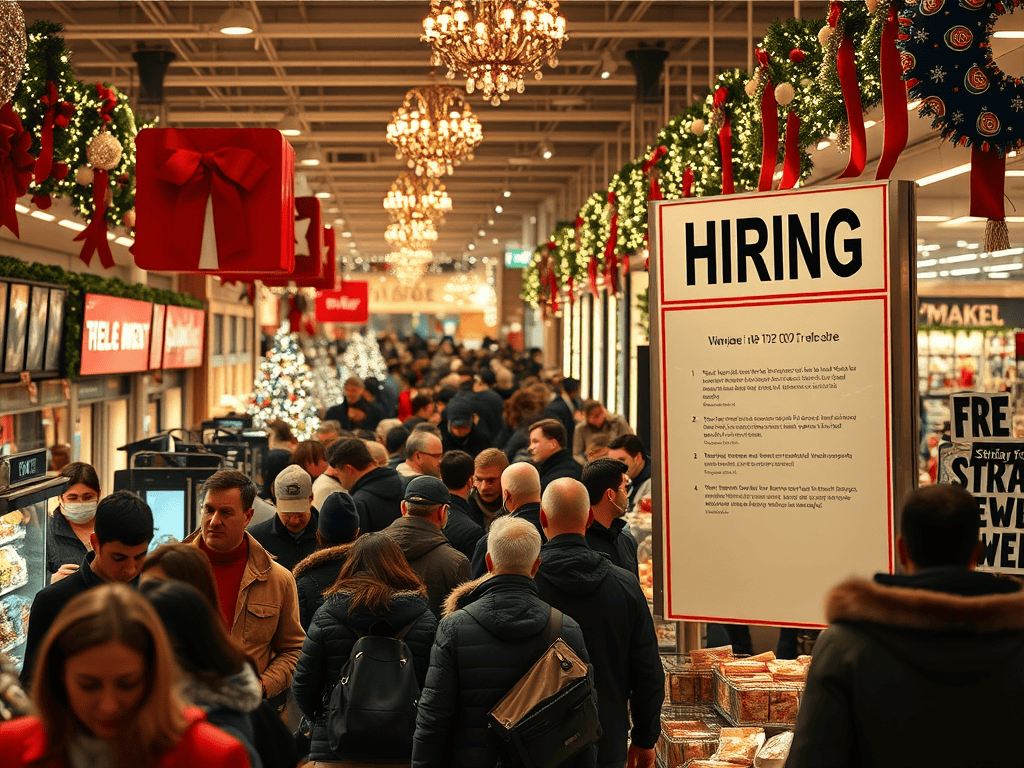
The U.S. holiday retail season has reached a symbolic threshold. Sales are projected to surpass 1 trillion dollars for the first time in history. To the casual observer, this figure suggests a booming economy and a resilient consumer.
However, the trillion-dollar milestone is an Optical Illusion. While the headline suggests expansion, the architecture of the season reveals a structural retreat. U.S. retailers are currently hiring fewer seasonal workers than at any time since the Great Recession. We are witnessing Nominal Expansion. This is a regime where inflation, pricing power, and automation sustain the spectacle of growth. Meanwhile, the human and volume-based foundations of the industry continue to thin.
The Trillion-Dollar Mirage—Price vs. Volume
The National Retail Federation’s estimate of a $1 trillion season marks a steady climb. It increased from $964 billion in 2023. In 2022, it was $936 billion. Yet, when adjusted for the structural inflation of the last three years, real growth is near zero.
- The Paradox: We are experiencing the most expensive holiday season on record, but not the most active. Fewer goods are being moved across the counter, but at significantly higher price points.
- The Spending Pivot: PwC’s 2025 outlook shows a 5 percent decline in average household spending. Gen Z is cutting back by nearly a quarter.
- The Spectacle: Retailers are maintaining topline optics by focusing on high-margin essentials and premium electronics. Meanwhile, the middle-market discretionary volume—the true engine of a healthy economy—is in a state of fatigue.
Profitability has learned to grow without volume. The trillion-dollar headline is a rehearsal of stability, but beneath the surface, the household economy is practicing restraint.
Mechanics—The Tariff Squeeze and Retail Austerity
The illusion of growth is being squeezed by a new industrial friction: The Tariff Wall. Tariffs on imports from China and Southeast Asia have fundamentally changed costs. Major players like Walmart, Target, Best Buy, and Dollar Tree are affected.
- Margin Compression: A KPMG survey found that 97 percent of retail executives saw no actual sales increase. This was due to tariff-related price adjustments. Nearly 40 percent reported shrinking gross margins.
- Cost Containment: The holiday season has transitioned from a race for market share into a “Cost-Containment Exercise.” Retailers need to protect the bottom line against rising import costs. They have been forced to treat labor as a negotiable variable.
The Automation Substitution—Revenue Without Headcount
The most definitive breach in the traditional retail model is the Decoupling of Revenue and Labor. E-commerce now accounts for over 30 percent of holiday revenue, allowing retailers to scale without matching headcount.
- Efficiency Substitution: Self-checkout kiosks, robotic fulfillment centers, and AI-driven logistics algorithms allow firms to maintain output. These technologies eliminate the need for the seasonal staff that once defined the holiday workforce.
- Engineered Flexibility: By tightening inventory cycles and reducing store hours, retailers have engineered labor flexibility out of the system.
- The Result: The seasonal worker has been replaced by a “Digital Proxy.” This change converts a variable labor cost into a fixed capital expenditure for robotics.
Topline growth and hiring rehearsal are diverging. Optics rise, but opportunity retracts. In this choreography, productivity is merely margin defense disguised as technological innovation.
The Investor’s Forensic Audit
To navigate the 2026 retail cycle, investors must move beyond the “Sales Velocity” metric. They need to adopt a protocol focused on Labor Visibility.
How to Audit the Retail Retrenchment
- Monitor Hiring Slumps: Treat a slump in seasonal hiring not as a cyclical dip. Instead, view it as a signal of structural transformation. If sales rise while headcount falls, the firm is in “Austerity Mode.”
- Track CapEx Reallocation: Follow the capital. Is the money being spent on new store formats or on warehouse robotics? The latter signals a permanent retreat from the human labor market.
- Audit the Discount Cycle: The flattening of discount cycles is evident. There are fewer “doorbuster” events and more algorithmic pricing. This shift indicates a move toward margin preservation over volume growth.
- Price the Real Growth: Always adjust the trillion-dollar headline against the Consumer Price Index (CPI). If the real volume is negative, the “growth” is a temporary gift of inflation. This temporary growth will eventually hit a demand wall.
Conclusion
The U.S. holiday retail season has become a study in Symbolic Economics. We see record sales and record profits, but we no longer see the record employment that once validated those numbers.
In this statistical theater, the real signal is not the trillion-dollar headline. It is the worker who disappears beneath it. Profitability that grows without people leads to the most fragile expansion. This kind of growth erodes the very consumer base required to sustain the next cycle.