Tag: inflation

  • The Warsh Gamble: Underwriting the Data Cathedral

    Summary

    • Greenspan vs. Warsh: Greenspan waited for productivity gains to show in the data before easing. Warsh wants to cut rates in anticipation of AI productivity gains — a regime change in Fed doctrine.
    • Monetary Policy as Subsidy: By framing AI as disinflationary, Warsh effectively subsidizes massive corporate capex — Google’s $185B build‑out and Microsoft’s $100B Stargate projects.
    • Policy Shock: Lower rates would fuel equity markets and reduce borrowing costs for AI‑heavy industries, making the Fed a silent partner in the infrastructure war for compute sovereignty.
    • Integrity Risk: If AI productivity gains lag, inflation could resurface, creating a legitimacy breach. Warsh’s pre‑emptive bet puts Fed credibility on the line.

    The End of the Greenspan Era

    In the 1990s, Fed chair Alan Greenspan saw the rise of computing power but waited for proof in the numbers — like falling unit labor costs — before easing policy. Greenspan’s caution meant the Fed acted only once productivity gains were visible, preserving its credibility.

    Warsh signals a break from that tradition. He isn’t waiting to see productivity gains in the rear‑view mirror. Instead, he wants to cut rates now to fund their construction — a regime change in how monetary policy is used.

    How We Decoded Warsh’s Stance

    • Nomination Coverage (Jan 2026): When Donald Trump announced Kevin Warsh as his choice for Fed chair, reports highlighted his belief that AI‑driven productivity gains could justify faster rate cuts.
    • Warsh’s Prior Commentary: He has long argued for a “regime change” at the Fed, criticizing reliance on backward‑looking data and pushing for forward‑looking policy.
    • Analytical Reports: Investor notes described Warsh’s philosophy as productivity‑anchored, suggesting he would align monetary policy with AI‑driven growth expectations.

    This is the stance we decoded: Warsh wants the Fed to act ahead of the data, betting that AI will deliver a productivity boom.

    Monetary Policy as Infrastructure Subsidy

    Warsh argues that AI is a disinflationary force — meaning it will lower costs and tame inflation. That belief gives him cover to cut rates sooner.

    Why does this matter? Because building AI infrastructure is enormously expensive. Google is planning $185 billion in spending, while Microsoft is chasing $100 billion “Stargate” projects. Lower interest rates make it easier for these companies to borrow and build. In this way, Warsh is positioning the Fed as a silent partner in the AI infrastructure war. Cheap money becomes the rails on which corporate nations construct their Data Cathedral — vast networks of chips and data centers.

    The Policy Shock

    If Warsh is right, rate cuts could arrive faster than markets expect. That would:

    • Boost equity markets.
    • Lower borrowing costs for AI‑heavy industries like semiconductors and cloud platforms.
    • Align Fed policy with corporate capex shocks, effectively underwriting the next layer of the global economy.

    The Integrity Risk: What if the Gains Don’t Arrive?

    Greenspan’s caution meant the Fed only acted once productivity gains were visible. Warsh’s pre‑emptive bet puts credibility at risk.

    If AI productivity takes years to show up, but rate cuts happen immediately, inflation could resurface. That would create a legitimacy breach: the Fed would be seen as gambling on a productivity miracle that turned out to be a mirage.

    Investor Takeaway

    The contrast is stark: Greenspan observed the productivity miracle before cutting. Warsh wants to cut in anticipation of one. The former was cautious empiricism; the latter is speculative sovereignty.

    For investors, this means:

    • Upside: Equity markets and AI infrastructure could surge if productivity gains arrive quickly.
    • Risk: If gains lag, inflation could return, forcing a painful reversal.
    • Strategic lens: Monetary policy is no longer just about inflation. It is becoming a structural bet on AI as the next utility layer of the global economy.

    Subscribe to Truth Cartographer — because here we map the borders of power, the engines of capital, and the infrastructures of the future.

    Further reading:

  • How Consumer Weakness and Margin Squeeze Are Reshaping U.S. Holiday Jobs

    How Consumer Weakness and Margin Squeeze Are Reshaping U.S. Holiday Jobs

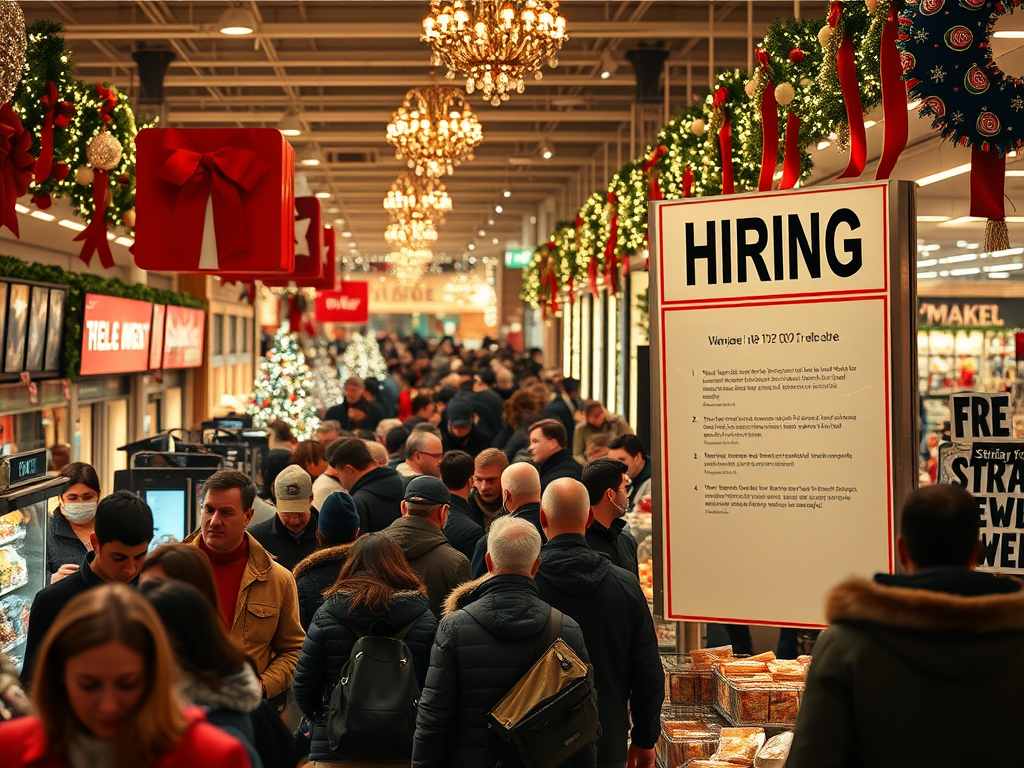
    The U.S. holiday retail season has reached a symbolic threshold. Sales are projected to surpass 1 trillion dollars for the first time in history. To the casual observer, this figure suggests a booming economy and a resilient consumer.

    However, the trillion-dollar milestone is an Optical Illusion. While the headline suggests expansion, the architecture of the season reveals a structural retreat. U.S. retailers are currently hiring fewer seasonal workers than at any time since the Great Recession. We are witnessing Nominal Expansion. This is a regime where inflation, pricing power, and automation sustain the spectacle of growth. Meanwhile, the human and volume-based foundations of the industry continue to thin.

    The Trillion-Dollar Mirage—Price vs. Volume

    The National Retail Federation’s estimate of a $1 trillion season marks a steady climb. It increased from $964 billion in 2023. In 2022, it was $936 billion. Yet, when adjusted for the structural inflation of the last three years, real growth is near zero.

    • The Paradox: We are experiencing the most expensive holiday season on record, but not the most active. Fewer goods are being moved across the counter, but at significantly higher price points.
    • The Spending Pivot: PwC’s 2025 outlook shows a 5 percent decline in average household spending. Gen Z is cutting back by nearly a quarter.
    • The Spectacle: Retailers are maintaining topline optics by focusing on high-margin essentials and premium electronics. Meanwhile, the middle-market discretionary volume—the true engine of a healthy economy—is in a state of fatigue.

    Profitability has learned to grow without volume. The trillion-dollar headline is a rehearsal of stability, but beneath the surface, the household economy is practicing restraint.

    Mechanics—The Tariff Squeeze and Retail Austerity

    The illusion of growth is being squeezed by a new industrial friction: The Tariff Wall. Tariffs on imports from China and Southeast Asia have fundamentally changed costs. Major players like Walmart, Target, Best Buy, and Dollar Tree are affected.

    • Margin Compression: A KPMG survey found that 97 percent of retail executives saw no actual sales increase. This was due to tariff-related price adjustments. Nearly 40 percent reported shrinking gross margins.
    • Cost Containment: The holiday season has transitioned from a race for market share into a “Cost-Containment Exercise.” Retailers need to protect the bottom line against rising import costs. They have been forced to treat labor as a negotiable variable.

    The Automation Substitution—Revenue Without Headcount

    The most definitive breach in the traditional retail model is the Decoupling of Revenue and Labor. E-commerce now accounts for over 30 percent of holiday revenue, allowing retailers to scale without matching headcount.

    • Efficiency Substitution: Self-checkout kiosks, robotic fulfillment centers, and AI-driven logistics algorithms allow firms to maintain output. These technologies eliminate the need for the seasonal staff that once defined the holiday workforce.
    • Engineered Flexibility: By tightening inventory cycles and reducing store hours, retailers have engineered labor flexibility out of the system.
    • The Result: The seasonal worker has been replaced by a “Digital Proxy.” This change converts a variable labor cost into a fixed capital expenditure for robotics.

    Topline growth and hiring rehearsal are diverging. Optics rise, but opportunity retracts. In this choreography, productivity is merely margin defense disguised as technological innovation.

    The Investor’s Forensic Audit

    To navigate the 2026 retail cycle, investors must move beyond the “Sales Velocity” metric. They need to adopt a protocol focused on Labor Visibility.

    How to Audit the Retail Retrenchment

    • Monitor Hiring Slumps: Treat a slump in seasonal hiring not as a cyclical dip. Instead, view it as a signal of structural transformation. If sales rise while headcount falls, the firm is in “Austerity Mode.”
    • Track CapEx Reallocation: Follow the capital. Is the money being spent on new store formats or on warehouse robotics? The latter signals a permanent retreat from the human labor market.
    • Audit the Discount Cycle: The flattening of discount cycles is evident. There are fewer “doorbuster” events and more algorithmic pricing. This shift indicates a move toward margin preservation over volume growth.
    • Price the Real Growth: Always adjust the trillion-dollar headline against the Consumer Price Index (CPI). If the real volume is negative, the “growth” is a temporary gift of inflation. This temporary growth will eventually hit a demand wall.

    Conclusion

    The U.S. holiday retail season has become a study in Symbolic Economics. We see record sales and record profits, but we no longer see the record employment that once validated those numbers.

    In this statistical theater, the real signal is not the trillion-dollar headline. It is the worker who disappears beneath it. Profitability that grows without people leads to the most fragile expansion. This kind of growth erodes the very consumer base required to sustain the next cycle.

    Further reading: