Tag: Meta Mango

  • Nvidia’s H200: Caught in China’s Semiconductor Gamble

    Nvidia’s H200: Caught in China’s Semiconductor Gamble

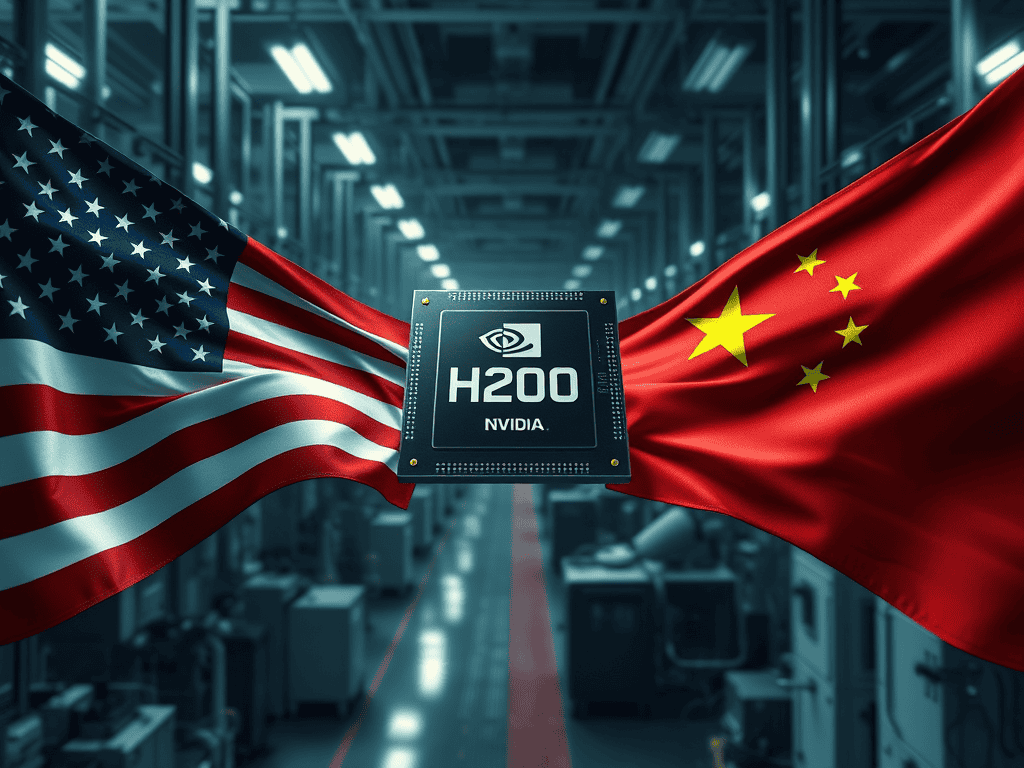
    The global semiconductor landscape has entered a phase of “Crossfire.” Nvidia’s H200 Artificial Intelligence chip, once viewed as the inevitable bridge to the Chinese market under a new United States administration, is increasingly becoming a stranded asset.

    According to a Financial Times report published in late 2025, titled “China boosts AI chip output by upgrading older ASML machines,” Chinese semiconductor fabrication plants are boosting output by retrofitting and upgrading older lithography equipment. This “Retrofit Strategy” allows Beijing to bypass Western export controls while reducing its reliance on American silicon. Simultaneously, Meta Platforms Inc.’s “Mango and Avocado” initiative is creating a high-urgency demand for Nvidia’s Graphics Processing Units, offering a partial, albeit incomplete, “Replacement Strategy” for the revenue at risk.

    Retrofit Sovereignty: China’s Strategic Pivot

    China is no longer waiting for Western permission to advance its hardware. Fabs such as SMIC and Huawei are repurposing deep ultraviolet lithography systems—once dismissed as obsolete—to create a domestic supply chain that effectively undermines United States export leverage.

    • The Upgrade Method: Chinese engineers are retrofitting older ASML machines with secondary-market components, including wafer stages, lenses, and sensors. The goal is to achieve near-advanced performance without requiring the latest generation of Western tools.
    • Target Output: These upgraded systems are now producing Artificial Intelligence chips and advanced smartphone processors that compete directly with high-end Western hardware.
    • The Geopolitical Impact: This shift exposes the fundamental fragility of export control regimes. When older machinery can be enhanced through local engineering, enforcement becomes difficult, and China’s “Silicon Sovereignty” remains intact despite ongoing sanctions.

    The H200 Flashpoint: Trapped in the Crossfire

    Nvidia’s H200 was engineered as a “compromise chip” for the Chinese market, yet it is now pinned between United States export levies and Beijing’s drive for independence.

    • The U.S. Strategy: The administration authorized H200 sales to China with a 25 percent fee, aiming to keep Nvidia dominant in the region while slowing China’s domestic progress.
    • The Chinese Counter: Beijing is signaling a firm rejection of the H200. Interpreting the American fee as a “dependency trap,” China is prioritizing domestic designs and ASML retrofits over Western-designed silicon.
    • The Revenue Blow: Historically, China accounted for 20 to 25 percent of Nvidia’s data center revenue. With the H200 sidelined, investors are now facing a potential 10 billion to 12 billion dollar annualized revenue hole as market forecasts begin to exclude the world’s largest growth market.

    The H200 is caught in a pincer move. Every successful retrofit in a Chinese fab narrows the technology gap and erodes Nvidia’s commercial leverage.

    The Meta Replacement: Capturing Compute Oxygen

    While China attempts to delete Nvidia from its regional map, Meta is providing a necessary buffer. Chief Executive Officer Mark Zuckerberg’s announcement of the Mango and Avocado models signals an urgent “crash-back” into Artificial Intelligence that requires massive amounts of external compute.

    The Opportunity Ledger

    In terms of Hardware, Meta currently lacks proprietary silicon and specialized Tensor Processing Units, making the firm entirely dependent on external hardware. Nvidia dominates this supply, positioning its H100, H200, and Blackwell chips as the indispensable backbone for Meta’s 2026 rollout.

    Replacement Math: Buffer vs. Parity

    To navigate the 2026 cycle, investors must decode whether Meta can truly replace the lost Chinese market. The “Replacement Math” reveals a structural bifurcation in Nvidia’s revenue outlook.

    • The Lost China Market: Nvidia faces a historic share loss that represents roughly 10 billion to 12 billion dollars in annualized revenue at risk. This market is shrinking permanently due to domestic chip independence.
    • The Meta Replacement Opportunity: Nvidia could see a potential 5 billion to 8 billion dollar surge in demand from Meta. While Meta provides higher margins due to the urgency of their catch-up strategy, the total demand does not reach parity with the lost Chinese share.

    Meta offers a strategic buffer, but it cannot fully substitute for the structural loss of the Chinese engine.

    Conclusion

    Nvidia is currently caught between the erosion of its dominance in the East and the capture of dependency in the West. For the investor, the decisive signal remains the Replacement Math: how many buffers does it take to fill a 12 billion dollar hole?

    Further reading:

  • Late Entry Risks: Meta’s Challenge Against Google and OpenAI

    Late Entry Risks: Meta’s Challenge Against Google and OpenAI

    Summary

    • Crash‑Back Strategy: Meta launches Mango (image/video) and Avocado (text reasoning) in 2026, aiming to counter Google’s Gemini 3 and OpenAI’s multimodal systems — but urgency exposes fragility.
    • Talent Grab: Zuckerberg recruits over 20 ex‑OpenAI researchers, building a 50‑person elite team under Meta Superintelligence Labs, mirroring OpenAI’s early talent‑density play.
    • Late Entrant Risk: Google and OpenAI already own entrenched ecosystems and user loyalty. Meta’s late arrival magnifies switching costs and risks permanent follower status.
    • Infrastructure Gap: Unlike Google’s sovereign TPUs, Meta depends on Nvidia and AMD GPUs. This compute dependency leaves Meta vulnerable to bottlenecks, pricing volatility, and geopolitical constraints.

    On December 18, 2025, Chief Executive Officer Mark Zuckerberg announced Meta Platforms Inc.’s newest Artificial Intelligence models, Mango and Avocado. This announcement signals an aggressive attempt to reclaim relevance in a landscape currently dominated by the “Sovereign Giants” — Google and OpenAI.

    This is more than a product launch; it is a “Crash‑Back” Strategy. Meta is attempting to bypass its late‑entrant status by hiring elite talent and focusing on World Models — AI systems that learn by ingesting visual data from their environment. While the announcement feels urgent, it reveals a structural fragility: Meta remains dependent on the very compute supply chains that its rivals are actively working to bypass.

    The Mango and Avocado Choreography

    Meta is positioning Mango (image and video generation) and Avocado (text reasoning) as direct counters to Google’s Gemini 3 and OpenAI’s Sora/DALL‑E ecosystem. Slated for release in early 2026, these models represent Meta’s high‑stakes bid for “AI stickiness” — features that keep users locked into daily workflows.

    The Talent Acquisition Signal

    Meta has moved to “crash the party” by aggressively recruiting from its rivals. Zuckerberg has hired more than 20 ex‑OpenAI researchers, forming a team of over 50 specialists under Meta Superintelligence Labs, reportedly led by Alexandr Wang.

    • This mirrors OpenAI’s own early strategy — building sovereignty not through infrastructure, but through talent density and speed.
    • Our finding: Mango and Avocado represent a “crash‑back” move leveraging urgency and elite talent. Meanwhile, Google choreographs permanence with sovereign stack ownership, and OpenAI choreographs urgency by bypassing traditional gatekeepers.

    Late Entrant Risk: Urgency vs. Entrenched Sovereignty

    Google’s Gemini 3 suite and OpenAI’s multimodal systems were already integrated into massive user bases by late 2025. This creates a significant Late Entrant Risk for Meta.

    The Late Entrant Risk Ledger

    • Timing: Meta’s release window is 2026, while rivals already enjoy entrenched ecosystems.
    • User Loyalty: Meta must fight to overcome switching costs as users adopt Google’s productivity tools or OpenAI’s creative suites.
    • Strategic Intent: Meta’s catch‑up positioning reveals vulnerability — it must prove relevance instantly or risk being viewed as a permanent follower.
    • Risk Profile: Meta faces the danger of being boxed out by giants who already own the distribution rails.

    In AI, user loyalty forms early. Once a user adopts a platform for daily workflows, switching costs rise — much like trying to move a city’s population after the roads and utilities are already built.

    The Infrastructure Gap: Sovereignty vs. Dependency

    The most profound fragility in Meta’s strategy is its reliance on external compute. Unlike Google, which owns its own sovereign hardware in the form of Tensor Processing Units (TPUs), Meta does not have proprietary silicon or a vertically integrated compute stack.

    The Compute Dependency Ledger

    • Hardware Sourcing: Meta’s labs plan to use third‑party Nvidia GPUs (H100, B100, Blackwell) and possibly AMD accelerators. Google, by contrast, designs its own TPUs (Ironwood, Trillium).
    • Supply Chain: Meta remains dependent on vendor availability, pricing, and export controls. Google’s sovereign stack reduces exposure to shortages or geopolitical constraints.
    • Optimization and Cost: Meta’s models must be tuned to external hardware. Google benefits from deep co‑optimization between TPUs and its software stack, achieving lower costs per inference.
    • Strategic Risk: Meta’s reliance on external vendors exposes it to bottlenecks and volatility. Google’s infrastructure sovereignty shields it from these risks, anchoring its long‑term resilience.

    The Decisive Battleground: Image and Video Generation

    Meta’s Mango model focuses on image and video generation because these features are the “stickiest” drivers of user retention in consumer AI applications. By targeting this layer, Meta hopes to bypass the entrenched search and text dominance of its rivals.

    However, the World Model approach — learning from environmental visual data — is a high‑beta bet. It requires massive compute power and continuous data ingestion, further highlighting Meta’s dependency on Nvidia and AMD supply chains.

    Conclusion

    Meta’s Mango and Avocado are ambitious bids to reclaim a seat at the sovereign table. But by entering the race after infrastructure and user habits have already ossified, the firm is navigating a high‑risk terrain.

    Meta signals urgency, leveraging elite talent to compete head‑on. But without sovereign hardware, it faces the risk of being boxed out by giants who already own the stack.

    Late entry magnifies fragility, and compute dependency defines the risk profile in the AI sovereignty race.