Tag: Monetary Sovereignty

  • Europe Builds Its Own Stablecoin

    Europe Finally Responds to Dollar Stablecoin Dominance

    The digital economy has been dollarized for a decade. USDT and USDC moved faster than the ECB, cementing the dollar as the default unit of account in crypto, DeFi, tokenized securities, and cross-border settlement. Europe complained, regulated, debated, delayed — but did nothing structural. Until now. Ten of Europe’s largest banks have formed Qivalis, a consortium designed to launch a regulated euro stablecoin by 2026. For the first time, the euro will enter programmable finance not through a central bank digital currency, not through a fintech wrapper, but through a coordinated banking bloc acting as a private-sector monetary authority. This is not a product. It is a geopolitical correction.

    Qivalis is Europe’s attempt to build its own

    MiCA gave Europe the regulatory language. Qivalis gives Europe the vehicle. The consortium — BNP Paribas, ING, UniCredit, CaixaBank, Danske, KBC, SEB, DekaBank, Raiffeisen, Banca Sella — is applying for a Dutch EMI license, operating under strict liquidity and custody rules. Under MiCA, reserves must be held in the same currency as the peg. That single rule rewrites the balance of power: while USDT and USDC are anchored to U.S. Treasuries, Qivalis must hold cash and eurozone government bills. A dollar stablecoin becomes an extension of U.S. sovereign debt. A euro stablecoin becomes an extension of the eurozone’s banking and sovereign bond ecosystem. Europe is not replicating USDT. Europe is building a structurally different instrument, one embedded in its own balance sheet rather than America’s.

    Stability by Fragmentation

    Dollar stablecoins derive strength from the deepest liquidity pool in history: the U.S. Treasury market. But depth creates exposure. If Tether must defend its peg during panic, it liquidates T-bills. Liquidity becomes volatility. A stablecoin run becomes a sovereign tremor. By contrast, Qivalis’ reserves will be spread across multiple sovereign issuers — Bunds, OATs, Dutch bills, and cash deposits across the banking bloc. Fragmentation here becomes insulation. No single sovereign chokepoint. No singular liquidity cliff. No dependence on the fiscal politics of a single country. The eurozone does not have the dollar’s global scale — but it also does not inherit the dollar’s systemic fragility. Qivalis is smaller, slower, but safer by design.

    Consumer Lens

    Europe’s payment landscape was modern for 2005 and archaic for 2025. Single Euro Payments Area (SEPA) is functional but not programmable. SWIFT is global but not instant. Card networks route through legacy toll booths. Qivalis shortcuts all of it. A bank-issued, euro-denominated stablecoin lets consumers send programmable euros, settle instantly, integrate into tokenized invoices, payroll, escrow, trade finance, and digital identity flows. This isn’t a digital euro from a central bank. It is a usable euro for the real digital economy — issued by the institutions Europeans already trust.

    Institutional Lens

    Qivalis is not designed for retail hype. It is designed for corporate settlement, on-chain securities, cross-bank payments, and institutional liquidity. It gives Europe something it has lacked: monetary presence in tokenized markets. Today, 99% of stablecoin liquidity is dollar-denominated. Every corporate treasury in DeFi settles in dollars. Every settlement pool reinforces U.S. monetary reach. With Qivalis, European institutions can settle in their own currency without touching U.S. instruments. This shifts programmable settlement flows away from U.S. Treasuries and toward eurozone sovereign assets.

    Conclusion

    Qivalis is not a product launch. It is a strategic declaration: Europe will not be dollarized by default. The consortium’s euro stablecoin is the first credible attempt to embed the euro into the rails of programmable finance. It gives Europe a native monetary instrument that can settle trades, route liquidity, and anchor digital markets without touching U.S. sovereign debt. The dollar will remain dominant. But for the first time, the euro has a vessel capable of competing on chain. This is not prediction. It is mapping the moment a currency steps off the sidelines and onto the substrate where the next financial order is forming.

    Disclaimer

    This article is published for informational and educational purposes only. It does not constitute financial advice, investment guidance, or legal counsel. The regulatory landscape for digital assets is constantly evolving, and we are mapping the terrain as it shifts. Readers should conduct their own due diligence and consult licensed professionals before making any financial decisions.

  • China’s Crypto Ban Was Misframed

    The Crackdown Was Absolute, Coordinated, and Systemic

    On November 2025, a high-level meeting involving the People’s Bank of China (PBOC), the Supreme People’s Court, and the Ministry of Public Security finalized China’s position: Crypto is not currency; crypto is not an asset; all crypto activities are illegal financial activity.

    This was not “renewed enforcement.” It was final classification—an ontological decision: crypto exists outside the law.

    The legacy media saw a crackdown. The real story is a redesign of China’s internal capital map.

    Choreography — The Official Rationale vs. The Real Motive

    China framed the ban through familiar language: fraud, anti-money laundering (AML), and investor protection. But each justification masks a deeper logic:

    • Financial Stability: Stablecoins lack Know Your Customer (KYC) clarity and can facilitate capital flight, and thus capital can the perimeter of state visibility.
    • Speculation Risk: Crypto “destabilizes household savings” and challenge the Digital Yuan (e-CNY)’s monopoly.
    • Legal Status: Crypto has “no legal status” and thus clearing the field for the digital yuan as the sole programmable money.

    Crypto is not banned because it is risky. Crypto is banned because it is parallel. The ban is about eliminating rival rails that could compete with the digital yuan’s command layer.

    The Breach — Crypto Suppression Redirects Hedging Into Gold Bars

    When a state blocks one escape valve, hedging doesn’t disappear. It migrates. China’s crackdown forces households into an older, harder, state-visible hedge: small gold bars, coins, and bullion.

    • The Substitution Flow: Jewellery demand in China fell 20–25%, but investment bars and coins surged to near-record levels. Q3 2025 global bar and coin demand hit 316 tonnes, with China a major driver.
    • The Outcome: Crypto was not suppressed into nothingness. It was suppressed into gold.

    West misreads the crackdown as “speculation prevention.” In reality, it is capital control enforcement and systemic hedge substitution.

    Citizen Impact — The Debt vs. Discipline Divergence Opens Wide

    Inside China, two behaviors move in opposite directions, creating a structural divergence:

    • State: Reckless Debt Expansion: Local government financing vehicles pile on liabilities; property bailouts expand; fiscal injections rise.
    • Households: Amplified Financial Discipline: Cut discretionary spending; exit jewellery; exit crypto (due to criminal risk); accumulate small gold bars and coins.

    This divergence is visible in flows and substitution patterns. China didn’t ban crypto. It rewired its entire capital map to seal the escape valves and complete the digital yuan regime.

    Conclusion

    Legacy media framed China’s crackdown as a story about illegal speculation. But the true story is: crypto eliminated from domestic rails, e-CNY elevated as mandatory programmable money, and household hedging redirected into gold bars.

    This isn’t a ban. It’s an architecture.

    Disclaimer:

    This article provides analytical commentary on public information and global financial narratives. It is not investment advice. Markets evolve, political architectures shift, and sovereign capital controls change their shape over time. We map the terrain; we do not predict it.

  • Assumable Mortgages and the Bypass of Monetary Policy

    Assumable Mortgages and the Bypass of Monetary Policy

    In a housing market choked by 7%–8% interest rates, a counter-current has emerged. It is not found in new construction or refinancing booms. Instead, it exists in the transfer of old paper. Assumable mortgages, once a bureaucratic footnote, have become the architecture of quiet rebellion. They allow a buyer to inherit the seller’s existing mortgage—often at sub-3%—silently bypassing the Federal Reserve’s primary policy lever. What once seemed like simple paperwork has transformed into a redemption ritual. Citizens are inheriting liquidity from a past cycle. They do this to evade the monetary regime of the present.

    Choreography—How Rate Immunity Is Rehearsed

    Assumability is limited mainly to Federal Housing Administration (FHA), Veterans Affairs (VA), and U.S. Department of Agriculture (USDA) loans—legacy programs that now behave like time capsules of a low-rate era. In 2025, assumption activity surged over 127%.

    • The Mechanism: Each assumption is a small, legal refusal: a decision to inherit liquidity instead of submitting to policy.
    • Concentration: The pattern concentrates in states where migration, affordability stress, and military corridors intersect, creating clusters of rate-immune zones.

    When Bypass Becomes Systemic, the Transmission Chain Frays

    Monetary policy works by raising the cost of new credit. Assumables fracture that design. If the trend scales, the housing market splits into two liquidity classes, undermining the intended effects of Federal Reserve tightening.

    The Two Liquidity Classes

    • Legacy Liquidity (Rate-Immune Zones):
      • Mechanism: Properties carrying inherited low-rate debt (sub-3%).
      • Result: Affordability survives policy; price stabilization or upward pressure due to scarce, attractive debt.
    • New Issue Fragility (Policy-Exposed Zones):
      • Mechanism: Homes financed at 7%–8% interest rates.
      • Result: Fully exposed to tightening; high monthly payments; slower sales velocity.

    The result is a structural break: the Fed can raise rates, but the market increasingly rehearses evasion.

    Liquidity fragmentation is sovereign theater. If even 10% of transactions become assumable, the Fed’s tightening becomes performative. The policy is raised on stage. Meanwhile, the audience quietly exits through side doors. Monetary sovereignty fractures at the household level: the rate is national, but liquidity becomes inherited and local.

    The Citizen’s Map: How the Bypass Actually Works

    The mechanics remain fully legal but tactically hidden. This demands that buyers adopt an Access Audit Protocol to find and secure these rate time capsules.

    The Access Audit Protocol

    • Ask Relentlessly: Is the mortgage FHA, VA, or USDA? What is the inherited rate, balance, and remaining term?
    • Map the Omission: Listings often omit assumability, either from ignorance or strategic concealment.
    • Redemption Math: The low monthly payment needs consideration. It’s crucial to weigh it against the equity bridge. This is often $50,000 to $200,000 in cash. This amount represents the difference between the sale price and the inherited loan balance.
    • Neighborhood Clusters: Neighborhood clusters of assumables form pockets of rate immunity. This forms an emerging cartography of monetary evasion. It is visible only to those who know to look.

    Investor Choreography: The Hidden Yield Engine

    For investors, inherited debt becomes a powerful yield engine. It creates high cash-flow margins on identical rents. This further incentivizes the use of this mechanism.

    • Yield Arbitrage: A 2.75% legacy mortgage versus a 7.5% new issuance translates into a dramatically higher cash-flow margin on identical rents.
    • Policy Shield: The asset gains a powerful shield against future Fed tightening cycles.

    Investors are incentivized to seek out these Legacy Liquidity zones. The equity bridge becomes the price of admission to a property with policy-immune cash flows. This demonstrates how structural arbitrage emerges when monetary policy transmission is compromised.

    Conclusion

    The quiet rebellion of the assumable mortgage proves that policy failure is often met with citizen-level ingenuity.

    • Rehearse Due Diligence: Ask every agent about assumability, every time.
    • Map the Bypass: Track clusters of legacy liquidity—they reveal where policy loses traction.
    • Refuse Optics: “Free rate inheritance” can disguise aggressive equity demands.
    • Codify Redemption: If you inherit a low-rate mortgage, protect it with documentation, verification, and rigorous title review.

  • From Washington to Buenos Aires: Sovereign Debt and the Collapse of Fiscal Clarity

    From Washington to Buenos Aires: Sovereign Debt and the Collapse of Fiscal Clarity

    Two nations mirroring each other.

    Argentina’s peso crisis and the United States (U.S.) debt spiral are not opposites. They are mirrors—two nations rehearsing solvency through optics while structural integrity decays. The citizen becomes both participant and audience. They navigate a monetary system that remains coherent only as long as its symbols hold.

    The Two Scripts of Solvency Performance

    The modern crisis is defined by a gap between sovereign financial mechanics and public optics. Argentina and the U.S. are merely executing different scripts on the same stage.

    Argentina’s Story (External Choreography)

    Ahead of midterms, Argentina secures a $40 Billion U.S.-backed International Monetary Fund (IMF) lifeline. President Milei announces reform and stages liberalization.

    • The Reality: Foreign Exchange (FX) controls persist. Inflation breaches 140%. The peso sinks toward 1477 per U.S. dollar.
    • The Performance: Argentina performs solvency through emergency foreign liquidity and the promise of structural reform—a script contingent on external trust.

    The U.S.’s Story (Internal Choreography)

    The U.S. now carries $38 Trillion in gross national debt—roughly 125% of Gross Domestic Product (GDP). The 2025 deficit approaches $1.78 Trillion. Interest payments alone rival defense spending.

    • The Reality: The dollar remains stable not because of a surplus. It is stable because reserve currency privilege performs solvency long after the balance sheet breaks.
    • The Performance: The U.S. stages solvency through reserve supremacy. It also defers consequences behind the optics of stability. This script is contingent on global status.

    Reserve Currency as Redemption Theater

    The dollar’s global role is a symbolic privilege, not a structural guarantee. It allows the U.S. to borrow without immediate punishment and defers consequence behind the illusion of stability.

    • The Privilege Erosion: This privilege frays as interest costs surpass $1 Trillion and foreign buyers retreat from U.S. Treasuries.
    • The Narrative Anchor: The choreography includes legislative negotiations, central bank press conferences, and the persistent global need for dollars. These elements sustain the narrative, even as the fiscal reality decays.

    Fiscal Optics vs. Structural Repair

    Sovereign action is consistently focused on optics—short-term political cover—while the structural drivers of debt remain unaddressed.

    • Optical Fixes: Tariff revenue and tax narratives offer political cover.
    • Unaddressed Drivers: Entitlements, military budgets, and compounding interest—the true structural drivers—remain unaddressed.

    Conclusion

    The citizen cannot exit the system—but they can decode it.

  • How India’s Rupee and China’s Slowdown Are Driving Gold’s Next Move

    How India’s Rupee and China’s Slowdown Are Driving Gold’s Next Move

    Citizens Are Driving the Demand.

    Gold’s march toward $4,000 per ounce isn’t merely a hedge against inflation—it’s a vote of no confidence in paper money. Central banks posture on global stages. Meanwhile, retail investors in India and China are writing gold’s next script from the ground up. Their actions—not Wall Street’s models—are choreographing the metal’s next act of belief. These regional premium fluctuations were a primary catalyst that allowed gold to break above $4,000 in the 2025 rally

    India is Hedging.

    The Indian rupee is down roughly 3% year-to-date. This decrease has pushed local gold to historic highs—above ₹70,000 per 10 grams. This price is more than 40% higher than early 2024 levels. Yet citizens continue buying with conviction. Bar demand is up an estimated 21%, the strongest surge since 2013. Jewelry demand has softened, but household belief has hardened. In India’s towns and villages, gold is not decoration—it is architecture. A private reserve against fiat fragility. Each bar is a ledger of belief, minted in kitchens, not boardrooms.

    China is Slowing.

    In China, the yuan’s slide near 7.3 per USD and deepening property market strain are redirecting household savings toward bullion. Gold bar and coin demand has surged roughly 44% year-on-year. Jewelry trade-ins are accelerating as families convert adornment into savings. Each gram becomes an exit—from real-estate exposure, from policy fatigue, from institutional doubt. The citizen isn’t speculating; they are storing.

    The Rally Doesn’t Just Rise. It Reacts.

    Together, India and China represent more than 40% of global retail gold demand. Their flows are not governed by algorithms—they are governed by conviction. When the rupee weakens, Indian demand intensifies. When China slows, belief migrates into bullion. The levers that move gold are no longer in Washington or London. They are local, lived, and emotional—anchored in kitchens, markets, and household ledgers across Asia.

    Conclusion

    Gold’s trajectory is written not by hedge funds but by households. Each purchase is a quiet act of resistance.

  • How Citizens, Not Central Banks, Drove Gold’s Surge

    How Citizens, Not Central Banks, Drove Gold’s Surge

    Gold Didn’t Just Rise. It Was Minted by Belief.

    Gold’s price rose from $2,386/oz in January 2024 to nearly $4,000/oz by September 2025. This historic ascent is often framed as a central-bank maneuver. But the data overturns the dominant narrative: retail buyers and ETF reallocators—not state treasuries—were the primary architects of the rally. The citizen, not the central bank, minted the price signal that redefined the market.

    The Real Movers: Retail, Not Regimes.

    Across 2024–2025, central bank buying collapsed more than 60 percent year-on-year, falling from 1,044.6 tonnes to just 415.1 tonnes in the first nine months of 2025. Yet the gold price climbed relentlessly. The surge originated elsewhere. Retail bar demand rose nearly 12 percent, marking the strongest accumulation pattern since 2013. Bar stacking accelerated in Asia—led by China, India, Vietnam—and signaled long-term monetary repositioning rather than short-term speculation. ETFs, after recording net outflows in 2024, reversed dramatically to post nearly 400 tonnes of inflows in 2025. What looked like institutional appetite was retail conviction routed through financial wrappers. The market’s true balance sheet is not written by institutions. It is written by citizens who no longer trust them.

    Sources: World Gold Council Q2 2025, Gold Demand Trends Full Year 2024, Investing.com, Money Metals.

    ETF Flows Didn’t Follow the Market. They Amplified the Exit.

    The shift from a net outflow of 6.8 tonnes in 2024 to more than 397 tonnes of inflows in 2025 changed ETFs. They became the accelerant of retail sentiment. With $38 billion added in the first half alone, ETFs converted individual distrust into institutional-scale momentum. Retail behavior became macro signal. The gold price was no longer a simple hedge; it was a collective referendum on financial stability and fiat fatigue.

    Central Banks Performed the Alibi, Not the Rally.

    For a decade, central-bank accumulation created the storyline that official institutions were the ballast behind gold’s ascent. In 2025, that narrative fractured. With purchases plunging more than half, official-sector demand performed symbolic support but contributed none of the rally’s kinetic force. Yet media interpretations clung to the familiar script. They viewed states as stewards of stability. Meanwhile, the real momentum was minted by citizens rehearsing a monetary exit in slow motion.

    Post-Crypto Disillusionment

    Crypto’s collapses, bridge exploits, and governance erosion pushed retail investors back toward assets they could audit without intermediaries. Meanwhile, fiat systems struggled under rate volatility, structural deficits, and the psychological overhang of trillion-dollar debt expansions. In this environment, gold became more than a safe haven. It became a trust referendum—a repudiation of opaque balance sheets, algorithmic instability, and the performance of monetary control.

    Conclusion

    The gold market’s 2025 surge was not state-led. It was a bottom-up monetary realignment. Citizens, bar by bar, reshaped the global price signal. ETFs scaled that signal into institutional gravity. And central banks, long miscast as the protagonists, became background actors in a financial drama scripted by ordinary participants. Retail Minted the Rally. ETFs Amplified It. Central Banks Performed the Alibi.

  • How Trillions in Crypto Liquidity Escape Regulatory Oversight

    How Trillions in Crypto Liquidity Escape Regulatory Oversight

    The Citizen Doesn’t Just Lose Track. They Lose Control.

    Capital no longer travels through regulated banks or sovereign ledgers. It slips through anonymous wallets. It moves through decentralized exchanges and cross-chain bridges. This process rewrites who can see, who can trace, and who can touch it. The old map of finance is dissolving, and with it, the boundaries of accountability. Liquidity has become borderless, and sovereignty increasingly notional.

    Liquidity Doesn’t Just Flow Into Crypto. It Escapes Oversight.

    Years of monetary expansion and global debt accumulation have saturated traditional markets. The overflow—trillions in unanchored liquidity—has found its way into the crypto ecosystem. Stablecoins, exchanges, and algorithmic protocols now absorb the excess, transforming unregulated digital ledgers into shadow reservoirs of capital. Analysts estimate that at its 2025 peak, cross-border crypto activity exceeded $2.6 trillion, with stablecoins carrying nearly half that flow. This is not speculative capital; it is an exodus of value escaping supervision. Every inflow into crypto is simultaneously an outflow from the state’s control.

    The Protocol Doesn’t Just Receive. It Dissolves Accountability.

    Once liquidity enters the crypto matrix, it exits the field of measurable economics. Mixers unlink origins from destinations, cross-chain bridges fracture investigative trails, and wrapped tokens replicate value without jurisdiction. The very architecture of DeFi transforms traceability into optional behavior. In this maze, “transparency” exists as spectacle while responsibility vanishes into code.

    Whales Don’t Just Trade. They Rule.

    Decentralization’s ideal has hardened into a new concentration. Fewer than 3 percent of Bitcoin addresses—excluding exchanges—control most of its circulating supply. Decentralized Autonomous Organizations (DAOs) repeat the pattern: token-weighted voting delivers oligarchy through arithmetic. The rhetoric of equality conceals a precision-engineered asymmetry. Central authority hasn’t disappeared; it has migrated into invisible wallets. The revolution of decentralization finance created the most efficient concentration of power yet—without regulators, without borders, without names.

    The State Sovereignty Erodes.

    Governments still issue communiqués, sanctions, and circulars but they reveal the limit of their reach. The monetary perimeter no longer obeys geography. What remains is theatre. Policy is performed for citizens. They can no longer see where their collective liquidity resides. They cannot control it either.

    Conclusion

    The modern financial order is not collapsing; it is evaporating. Trillions move daily through ledgers indifferent to law, belief, or nation. The breach is not criminal—it is architectural. And in that architecture, the citizen no longer participates. They observe. They scroll. They hope the map still exists.

  • The Political Performance Of USD1

    The Political Performance Of USD1

    The Product Isn’t Just Financial. It’s Symbolic.

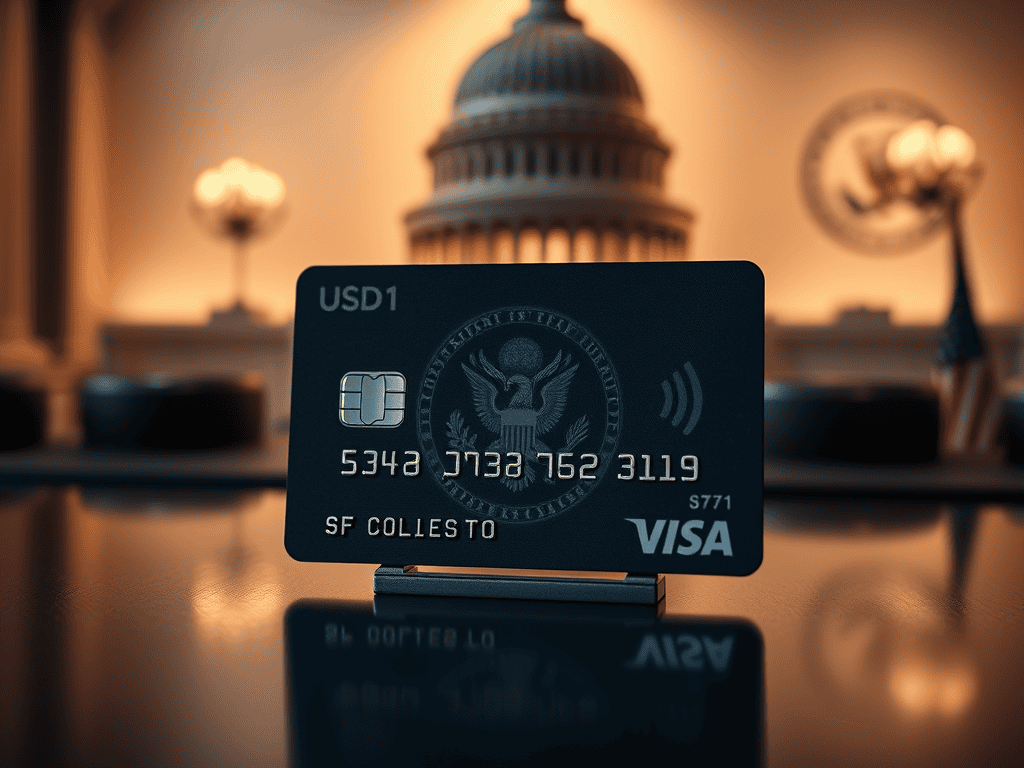
    When World Liberty Financial Inc. (WLFI) unveiled its crypto debit card and dollar-pegged stablecoin USD1, the announcement read like a fintech milestone. In truth, it was a political performance—a precision-engineered act of symbolic state mimicry. By invoking presidential proximity, echoing the U.S. dollar, and choreographing endorsements through familial and executive channels, WLFI manufactured not a product, but an aura.

    Semantic Annexation

    The name “USD1” is not branding. It is semantic annexation—the laundering of state authority through language. It co-opts the sovereign signifier of the U.S. dollar while remaining privately issued and privately governed. When WLFI’s CEO calls it “the most cultured stablecoin on Earth,” the statement is not financial; it is semiotic. It frames speculation as refinement and aligns commerce with cultural virtue. The act of naming becomes monetary mimicry, collapsing the boundary between the public and the proprietary. To name like a state is to borrow its power; to mint like one is to contest its sovereignty.

    Blurring State and Private Authority

    A private brand issuing a token called USD1 performs a linguistic coup. It manufactures confusion about whether the asset represents sovereign money. This intentional ambiguity corrodes the foundation of democratic monetary trust. If citizens cannot tell the difference between a state-backed dollar and a politically branded derivative, sovereignty becomes a narrative. It becomes open to purchase, performance, or partisan control. The mint becomes a microphone.

    Dynastic Rails and Parallel Economies

    WLFI’s structure merges political identity with financial infrastructure. This signals the rise of dynastic finance. It represents a private minting class operating outside conventional oversight. Through the issuance of its governance token ($WLFI), the enterprise builds an ecosystem where participation equals alignment. This is not a retail product; it is a loyalty economy. History warns that when money becomes an instrument of allegiance, markets mutate into mechanisms of control. A parallel financial system emerges—coded in trust, cleared in loyalty, settled in symbolism.

    Loyalty as Liquidity

    Stablecoins already inhabit the gray zones of finance—arbitraging regulations, blurring borders, and facilitating shadow liquidity. But a politically charged stablecoin transforms this gray zone into a battlefield of meaning. “USD1” is not simply a coin; it’s a campaign slogan rendered as protocol. Investment becomes participation; speculation becomes declaration. Liquidity itself becomes a show of faith. In this theater, value accrues not from utility but from proximity to power.

    The Volatility of Symbolic Systems

    If politically branded stablecoins achieve mass adoption, their collapse will not just destroy balance sheets—it will ignite belief systems. The failure of USD1 would not be seen as technical but as sabotage. Monetary malfunction becomes political martyrdom. A liquidity event becomes an identity crisis. This is the ultimate systemic risk: the fusion of money’s fragility with political fervor. WLFI’s model transforms market contagion into narrative warfare.

    Conclusion

    USD1 is not merely a stablecoin; it is a script. It rehearses the performance of sovereignty through private branding and executive theater.