Tag: SMIC

  • Understanding the $250B Semiconductor Allocation in AI

    Summary

    • TSMC Dependence: AI’s $1T future hinges on Taiwan’s stability.
    • China’s Workarounds: Repurposed DUV tech narrows the gap with Western chips.
    • Liquidity Divide: U.S. firms face shareholder pressure; China deploys state‑funded capital.
    • Investor Focus: Audit cash conversion and yields, not just shipments.

    From Dirt to Silicon

    Following the $350 Billion Land Grab, the next layer of the Data Cathedral is semiconductors and hardware — the computational oxygen of AI. Roughly $250 billion is being allocated to chips and supporting hardware.

    While the U.S. leads in design and deployment, the supply chain remains tethered to Eastern foundries and a resurgent Chinese domestic push. This dependence creates both opportunity and systemic risk.

    The Foundries of the Cathedral: The TSMC Choke Point

    Every major chip designer — Nvidia, AMD, Broadcom — relies on TSMC in Taiwan.

    • Single Point of Failure: Any disruption in the Taiwan Strait doesn’t just slow AI; it collapses the $1T projection.
    • Geopolitical Risk: The Cathedral is built on silicon, but also on fragile geopolitics.

    Why it matters: AI’s future hinges on one island’s stability.

    The Sovereign Silicon Tracker: 2026 Leverage Audit

    Four pillars define the Sovereign Silicon Gap between U.S. design dominance and China’s engineering workarounds:

    1. Leading Edge (Manufacturing):
      • West: pushing toward 3nm and 2nm (GAAFET) via TSMC.
      • China: scaling 7nm and even 5nm with repurposed DUV lithography.
      • Signal: China performs high‑end AI tasks with “obsolete” tech.
    2. Export Leverage (The Firewall):
      • Despite restrictions (Blackwell, H200), gray markets in the Middle East and Southeast Asia leak top‑tier silicon into China.
      • Signal: The “Sovereign Premium” on Western chips is eroding.
    3. The Tooling War:
      • West: relies on ASML’s EUV machines.
      • China: maximizes DUV multi‑patterning to hit higher densities.
      • Signal: Mastery of existing tools neutralizes Western advantage short‑term.
    4. The Capital Conflict (Cash Conversion):
      • U.S. firms like Nvidia face shareholder pressure and declining cash conversion ratios.
      • China’s state‑funded supply chain has effectively infinite liquidity.
      • Signal: Liquidity asymmetry tilts the balance.

    Why it matters: China is closing the gap by repurposing tools and leveraging state capital.

    The Forensic Ledger: Nvidia and the Cash Conversion Gap Crisis

    • High‑Velocity Mirage: Nvidia’s revenue is soaring, but operating cash flow lags.
    • China Gamble: As highlighted in our report on Nvidia’s H200 and China’s Semiconductor Gamble, domestic supply chains repurpose DUV lithography, undermining U.S. export leverage.
    • Normalization Trap: As seen in Cisco’s dot‑com era, peak infrastructure spend often precedes violent demand normalization (Cisco lessons of the Dot-Com era).

    Why it matters: Nvidia’s cash conversion gap signals the Cathedral’s build‑out is entering a high‑risk phase.

    The Investor’s Forensic Audit

    To navigate the $250B silicon layer, investors must audit quality of capital, not just units shipped:

    • Monitor Accounts Receivable: Revenue from unprofitable startups is an IOU, not an asset.
    • Track DUV Yields: If SMIC scales 5nm yields, Western chip premiums evaporate.
    • Price the Liquidity: In a capital‑heavy era, clean cash conversion wins the long game.

    Conclusion

    The silicon layer is a race against time and liquidity. While $250B flows into hardware, Nvidia’s cash conversion gap suggests the quality of capital is thinning. The Cathedral’s foundation in silicon is strong, but its financial oxygen is fragile.

    This analysis is part of our cornerstone series on the Data Cathedral. See the full cornerstone article: The $1 Trillion Data Cathedral.

    This is Part 2 of 7. Over the coming days, we will audit the remaining $400 Billion in capital flow—starting with the “Power Rail”: Energy & Utilities ($150B).
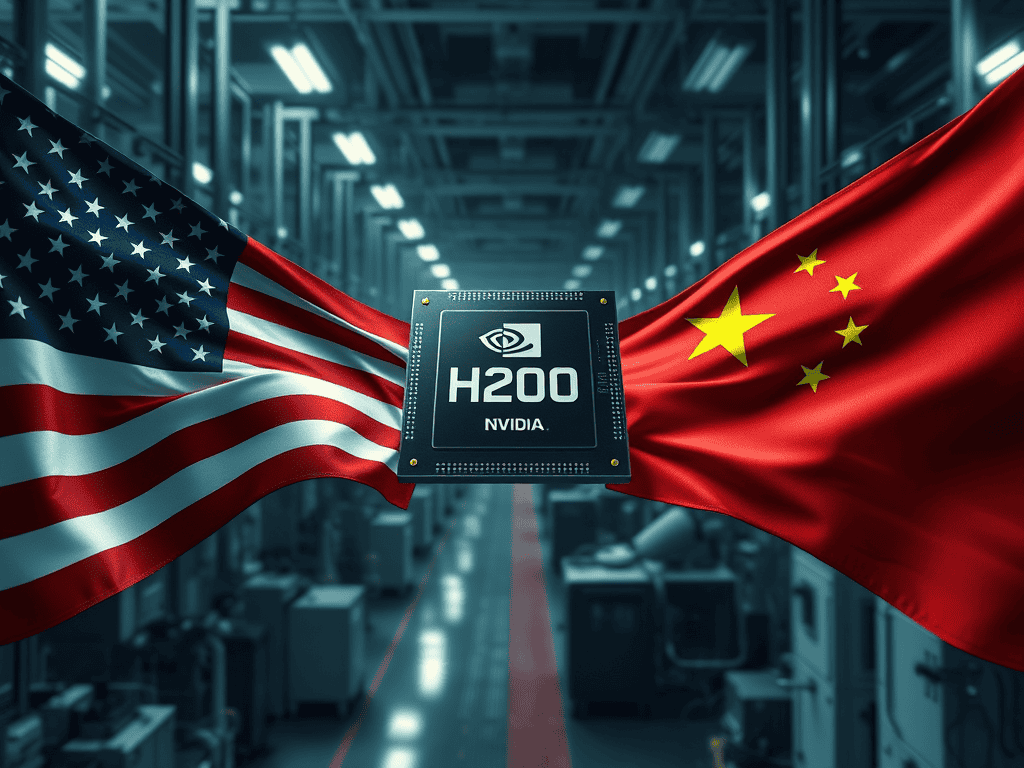
  • Nvidia’s H200: Caught in China’s Semiconductor Gamble

    Nvidia’s H200: Caught in China’s Semiconductor Gamble

    The global semiconductor landscape has entered a phase of “Crossfire.” Nvidia’s H200 Artificial Intelligence chip, once viewed as the inevitable bridge to the Chinese market under a new United States administration, is increasingly becoming a stranded asset.

    According to a Financial Times report published in late 2025, titled “China boosts AI chip output by upgrading older ASML machines,” Chinese semiconductor fabrication plants are boosting output by retrofitting and upgrading older lithography equipment. This “Retrofit Strategy” allows Beijing to bypass Western export controls while reducing its reliance on American silicon. Simultaneously, Meta Platforms Inc.’s “Mango and Avocado” initiative is creating a high-urgency demand for Nvidia’s Graphics Processing Units, offering a partial, albeit incomplete, “Replacement Strategy” for the revenue at risk.

    Retrofit Sovereignty: China’s Strategic Pivot

    China is no longer waiting for Western permission to advance its hardware. Fabs such as SMIC and Huawei are repurposing deep ultraviolet lithography systems—once dismissed as obsolete—to create a domestic supply chain that effectively undermines United States export leverage.

    • The Upgrade Method: Chinese engineers are retrofitting older ASML machines with secondary-market components, including wafer stages, lenses, and sensors. The goal is to achieve near-advanced performance without requiring the latest generation of Western tools.
    • Target Output: These upgraded systems are now producing Artificial Intelligence chips and advanced smartphone processors that compete directly with high-end Western hardware.
    • The Geopolitical Impact: This shift exposes the fundamental fragility of export control regimes. When older machinery can be enhanced through local engineering, enforcement becomes difficult, and China’s “Silicon Sovereignty” remains intact despite ongoing sanctions.

    The H200 Flashpoint: Trapped in the Crossfire

    Nvidia’s H200 was engineered as a “compromise chip” for the Chinese market, yet it is now pinned between United States export levies and Beijing’s drive for independence.

    • The U.S. Strategy: The administration authorized H200 sales to China with a 25 percent fee, aiming to keep Nvidia dominant in the region while slowing China’s domestic progress.
    • The Chinese Counter: Beijing is signaling a firm rejection of the H200. Interpreting the American fee as a “dependency trap,” China is prioritizing domestic designs and ASML retrofits over Western-designed silicon.
    • The Revenue Blow: Historically, China accounted for 20 to 25 percent of Nvidia’s data center revenue. With the H200 sidelined, investors are now facing a potential 10 billion to 12 billion dollar annualized revenue hole as market forecasts begin to exclude the world’s largest growth market.

    The H200 is caught in a pincer move. Every successful retrofit in a Chinese fab narrows the technology gap and erodes Nvidia’s commercial leverage.

    The Meta Replacement: Capturing Compute Oxygen

    While China attempts to delete Nvidia from its regional map, Meta is providing a necessary buffer. Chief Executive Officer Mark Zuckerberg’s announcement of the Mango and Avocado models signals an urgent “crash-back” into Artificial Intelligence that requires massive amounts of external compute.

    The Opportunity Ledger

    In terms of Hardware, Meta currently lacks proprietary silicon and specialized Tensor Processing Units, making the firm entirely dependent on external hardware. Nvidia dominates this supply, positioning its H100, H200, and Blackwell chips as the indispensable backbone for Meta’s 2026 rollout.

    Replacement Math: Buffer vs. Parity

    To navigate the 2026 cycle, investors must decode whether Meta can truly replace the lost Chinese market. The “Replacement Math” reveals a structural bifurcation in Nvidia’s revenue outlook.

    • The Lost China Market: Nvidia faces a historic share loss that represents roughly 10 billion to 12 billion dollars in annualized revenue at risk. This market is shrinking permanently due to domestic chip independence.
    • The Meta Replacement Opportunity: Nvidia could see a potential 5 billion to 8 billion dollar surge in demand from Meta. While Meta provides higher margins due to the urgency of their catch-up strategy, the total demand does not reach parity with the lost Chinese share.

    Meta offers a strategic buffer, but it cannot fully substitute for the structural loss of the Chinese engine.

    Conclusion

    Nvidia is currently caught between the erosion of its dominance in the East and the capture of dependency in the West. For the investor, the decisive signal remains the Replacement Math: how many buffers does it take to fill a 12 billion dollar hole?

    Further reading: