Tag: Sovereignty

  • How the EU’s AI Act Retreat Codifies Harm

    How the EU’s AI Act Retreat Codifies Harm

    The European Union’s status as the global “Regulator of First Resort” has hit a structural roadblock. The Financial Times reports that the European Commission is considering delaying the enforcement of key provisions in the AI Act. These provisions specifically govern foundation models and high-risk AI systems.

    This is a definitive moment where governance itself becomes a performance. The AI Act was designed as a landmark architecture for digital rights. Its enforcement is now being reframed as Optional Choreography. Under pressure from global technology giants, the bloc is rehearsing the very permissiveness it once sought to discipline. Diplomatic signals from Washington have influenced this change.

    Background—What’s Being Hollowed

    The delay is not merely a postponement of dates; it is an erosion of the Act’s structural integrity. Several core pillars of the original rights-based framework are being softened or deferred.

    • Foundation Model Transparency: Original rules required developers to disclose training data sources and risk profiles. These are being pushed back, effectively shielding the “black box” mechanics of the world’s most powerful models from public scrutiny.
    • High-Risk Oversight: Mechanisms for registering biometric surveillance and hiring algorithms are being postponed. This allows systems with the highest potential for civilian harm to operate without the oversight infrastructure the law promised.
    • Proactive vs. Reactive: Real-time monitoring is being replaced by “periodic review.” This change converts proactive governance into reactive bureaucracy. By the time a violation is audited, the algorithmic harm is already codified into daily life.

    Mechanics—The Dispersion of Algorithmic Risk

    Without the friction of enforcement, algorithmic risk does not vanish; it disperses. This creates a Verification Collapse where harm operates without a visible event.

    • Invisible Accumulation: In the absence of real-time audits, biases go unmeasured. Harm accumulates in the aggregate. Denied loans, misclassified workers, and unaccountable automated decisions occur without ever triggering a “headline” event. These events are difficult for regulators to trace.
    • The Open-Source Loophole: Expanded exemptions for models labeled “non-commercial” allow developers to evade accountability. These models are still integrated into critical infrastructure.
    • Perception Gap: Citizens lose the ability to perceive where the harm originates. When the code outpaces the audit, the system becomes a “Black Box” protected by the state’s own inaction.

    Implications—The Transatlantic Pressure Gradient

    The EU’s retreat signals a deeper geopolitical choreography. European citizen rights have been influenced by a Transatlantic Pressure Gradient. The competitive anxiety of the United States dictates the tempo of regulation.

    • Industry-Led Theater: Big Tech lobbying has successfully reframed rights-based governance as a “disadvantage.” The result is a shift from evidentiary mandates to industry-led Compliance Theater. In this theater, firms perform the optics of safety. Meanwhile, they avoid the architecture of accountability.
    • The Erosion of Sovereignty: This is not an accidental delay; it is a strategic recalibration. Europe is prioritizing “competitiveness” optics over citizen protection, effectively importing American-style regulatory lag into the heart of the Brussels machine.

    The Citizen’s Forensic Audit

    In an era of deferred protection, the citizen-investor must adopt a new forensic discipline to navigate the algorithmic landscape.

    How to Decode the Regulatory Pause

    • Audit the Delay Window: Track which specific “high-risk” systems are granted extensions. These windows are where the highest concentration of unpriced liability resides.
    • Interrogate “Non-Commercial” Labels: If a model is used in enterprise workflows but labeled open-source/non-commercial, the governance is theatrical.
    • Map the Enforcement Gap: Identify jurisdictions where “periodic reviews” replace real-time audits. These zones represent the highest risk for algorithmic bias and systemic error.
    • Track Lobbying Synchronicity: When Big Tech narratives perfectly mirror the “pause” arguments of state officials, the governance has been captured.

    Conclusion

    The EU’s AI Act was meant to be the definitive “Ledger of Truth” for the digital age. Instead, the current choreography suggests a future where compliance is symbolic and protection is a deferred promise.

    In this post-globalization landscape, if a clause is paused, the citizen is not merely unprotected—they are unseen.

  • State Subsidy | Why Cheap Power No Longer Buys AI Supremacy

    State Subsidy | Why Cheap Power No Longer Buys AI Supremacy

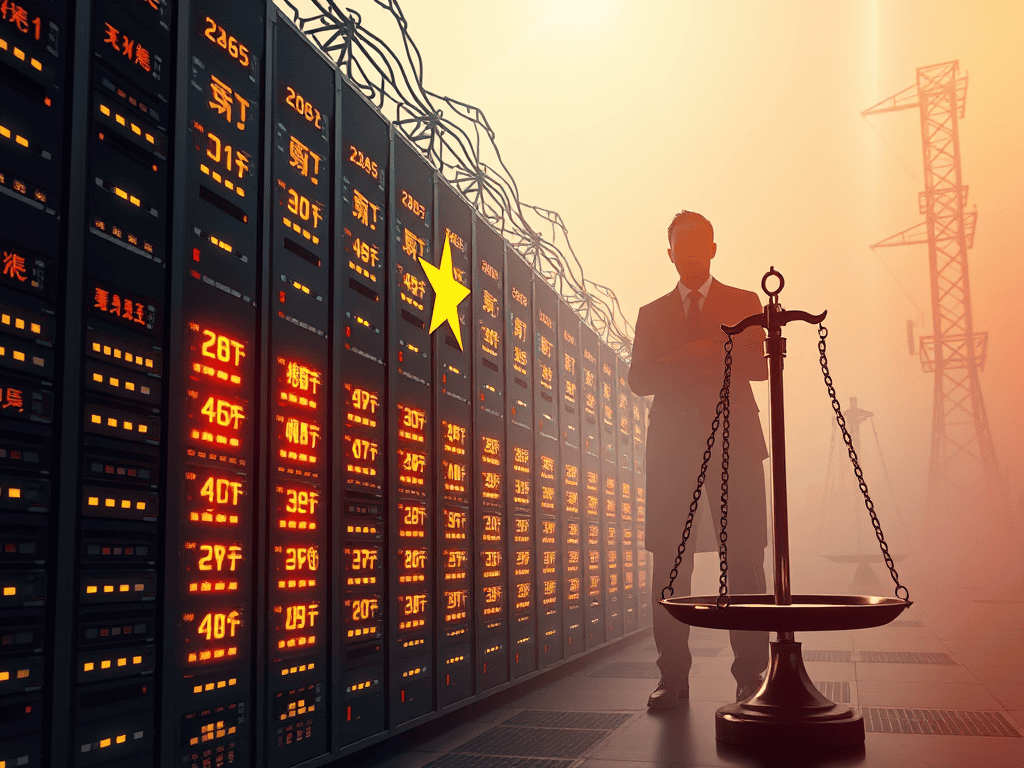
    A definitive structural intervention is unfolding across the Chinese industrial map. Beijing has begun slashing energy costs for its largest data centers. They are cutting electricity bills by up to 50 percent. This is to accelerate the production and deployment of domestic AI semiconductors.

    Targeting hyperscalers such as ByteDance, Alibaba, and Tencent, these grants are designed to sustain compute velocity despite U.S. export controls that bar access to frontier silicon.

    Mechanics—How Subsidies Rehearse Containment

    The 50 percent energy cuts operate as a containment rehearsal. Beijing lowers the operational cost floor. This ensures that its developer ecosystem maintains its momentum.

    • Cost-Curve Diplomacy: Subsidized power effectively attempts to reset the global benchmark for AI compute pricing. This forces Western firms to defend their margins in an environment where the energy-AI loop is tightening.
    • Developer Anchoring: Municipal and provincial incentives create a “gravity well” for talent. These incentives ensure that startups, inference labs, and cloud operators remain anchored within China’s sovereign stack.
    • The Scale Logic: Unlike the market-led surge seen in firms like Palantir, China’s AI expansion is subsidized by the government. This is done as a matter of national defense. It converts a commodity (electricity) into a strategic propellant for the silicon race.

    China is weaponizing its cost curve. By subsidizing the “oxygen” of the AI economy—energy—it is attempting to bypass the hardware bottlenecks imposed by the West.

    The Globalization Breach—Why Trust Wins Systems

    A decade ago, the globalization playbook was simple: low costs won markets. Today, that playbook has failed. In the AI era, trust wins systems.

    • The Manufacturing Trap: In the 2010s, China’s scale made it the gravitational center of supply chains. But AI is not labor-intensive; it is trust-intensive.
    • The Reliability Standard: Western nations are increasingly framing their technology policy around ethics, security, and institutional credibility. Legislation like the CHIPS Act and the EU AI Act has redefined market participation as conditional—access requires proof of reliability.
    • The Reputational Deficit: China’s own maneuvers include the Nexperia export-control retaliation. Opaque Intellectual Property (IP) rules are another factor. These actions have deepened a systemic trust deficit. Cheap power may illuminate a data center, but it cannot offset reputational entropy.

    Cost efficiency once conferred dominance, but credibility now determines inclusion. China’s cheap energy can sustain a domestic model, but it cannot buy the global interoperability required for AI leadership.

    The Ethics Layer—Abundance Without Interoperability

    Beijing’s energy subsidies may secure short-term velocity, but they cannot substitute for the governance frameworks that global firms demand.

    The primary barrier to China’s AI sovereignty is not silicon scarcity, but Institutional Opacity. Global developers remain wary of China-tethered stacks due to IP leakage risks. They are also concerned about forced localization clauses. Additionally, there is the lack of an independent judiciary.

    Real AI advancement requires Governance Interoperability:

    • Enforceable IP protection.
    • Transparent regulatory regimes.
    • Credible institutions that uphold contractual integrity.

    Without these, subsidies become “Symbolic Fuel”. They are abundant and powerful, but ultimately directionless. This occurs in a global market that values the rule of law over the price of a kilowatt.

    Rehearsal Logic—From Cost to Credibility

    In the AI era, cost is no longer the decisive variable; it is merely the entry fee. We are moving from an era of cost advantage to an era of Credible Orchestration.

    • Then: IP flexibility drove expansion. Now: IP enforceability defines legitimacy.
    • Then: Tech transfer was coerced. Now: Tech transfer must be consensual and audited.
    • Then: Governance sat on the sidelines. Now: Governance directs the entire play.

    Conclusion

    China’s subsidies codify speed but not stability. They rehearse domestic resilience yet fail to restore the confidence required to lead a global digital order.

    At this stage, the AI era remains suspended in an interregnum of partial sovereignties:

    • The United States commands model supremacy but lacks the cost discipline seen in its rivals.
    • China wields scale and speed but faces a debilitating trust deficit.
    • Europe codifies ethics and governance but trails significantly in compute and execution velocity.

    The decisive choreography—where trust, infrastructure, and innovation align—has yet to emerge. In this post-globalization landscape, reliability and orchestration outperform price. The age of cost advantage has ended. The era of credible orchestration has begun.

  • Apple Unhinged: What $600B Could Have Built

    Apple Unhinged: What $600B Could Have Built

    Summary

    • Apple’s $4 trillion valuation reflects discipline and containment, not boundless growth.
    • A $600 billion manufacturing and geopolitical play (AMP) fortified supply chains but redirected risk capital.
    • Apple traded frontier ambition for structural security — and in doing so, ceded AI frontline dominance.
    • When stability becomes identity, innovation can fade; Apple’s fortress risks becoming a quiet cage.

    A Mirror, Not a Compass

    In late 2025, Apple briefly crossed the $4 trillion valuation milestone — a rare feat shared only with a handful of corporations. On its face, this signals strength and market confidence.

    But the true meaning of Apple’s valuation isn’t about raw scale. It’s about where Apple chose to place its capital — and what it traded in exchange.

    What Apple built with its capital matters just as much as the valuation it earned. In Apple’s case, fortress building edged out frontier expansion.

    Containment as Strategy — the $600 Billion American Manufacturing Program

    In response to macroeconomic pressures — tariffs, supply-chain risk, and geopolitical scrutiny — Apple deployed approximately $600 billion into the American Manufacturing Program (AMP).

    This program had three logical purposes:

    1. Shield supply chains from geopolitical disruption
    2. Neutralize tariff exposure by localizing production
    3. Build political capital and industrial diplomacy

    The AMP was a masterstroke of containment — an investment into stability rather than speculation. It fortified Apple’s existing strengths: supply-chain resilience, manufacturing security, and domestic political support.

    But every containment strategy carries a trade-off.

    The Opportunity Apple Didn’t Chase

    If Apple had chosen creative velocity over strategic containment, its resources could have reshaped entire technological frontiers.

    Here’s what that alternate Kodak Apple might have pursued instead:

    • A sovereign large language model empire
    • A global network of frontier AI research labs
    • Mainstream expansion of spatial computing (Vision Pro and beyond)
    • Strategic acquisitions (Arm, Adobe, Spotify, etc.)
    • Massive renewable data-center campuses to codify compute sovereignty

    All of these were financially feasible. The capital existed. The question was not whether Apple could have spent it — but what it chose to spend on.

    Containment vs. Frontier: The Trade-Off

    Apple’s containment logic prioritized defense over offense. It reinforced existing advantages — premium brand, hardware ecosystem, Services — instead of power projection into unknown territory.

    This paid immediate dividends. It:

    • Reduced geopolitical risk
    • Fortified the brand’s stability narrative
    • Reassured investors worried about tariffs and China exposure

    But it also meant outsourcing the next frontier of artificial intelligence and compute innovation to others.

    In choosing a fortress, Apple ceded:

    • AI model sovereignty (outsourced to OpenAI)
    • Infrastructure dominance (outsourced to hyperscalers like Google)

    This is not a collapse — it’s a controlled retreat into fortification.

    When Stability Becomes Confinement

    There’s a subtle danger in making discipline your identity.

    Stability buys you resilience.
    Too much stability can also inhibit imagination.

    Apple’s valuation now reflects trust in its predictable cash flows, margins, and ecosystem lock-in. But that same valuation also reflects a forward-looking assumption — that Apple can continue to mine growth from within its existing perimeter.

    When a company’s valuation depends on confidence in continuance rather than belief in transformation, the margin for error narrows.

    In a world where AI, compute, and platform economies are rapidly rewriting competitive boundaries, the risk isn’t falling apart — it’s becoming an ossified fortress amidst dynamic frontier forces.

    Conclusion

    Apple’s $4 trillion valuation is a mirror, not a compass.

    It reflects:

    • trust in continuity
    • confidence in containment
    • belief in perpetuity

    What it does not reflect is ownership of the frontier.

    Containment protects the present — but it also shapes the future by what it leaves unbuilt.

    In Apple’s case, the fortress protects the ground beneath its feet — but leaves the map of the future in the hands of others.

  • $350B Isn’t Cash: South Korea’s Trade Choreography

    $350B Isn’t Cash: South Korea’s Trade Choreography

    The headline that dominated the APEC Summit in Gyeongju was vast. It was a $350 billion commitment from South Korea to the United States. To the casual observer, it appeared to be an unconditional transfer of faith and capital—a massive diplomatic gift.

    However, the sum is not cash. It is a choreography of structured investments, financing instruments, and tariff negotiations staged for diplomatic symmetry. It mirrors Japan’s earlier pledge, signaling alignment rather than subordination. This is not a stimulus package. Instead, it is a rehearsed industrial integration. This plan is designed to lock two economies into a shared strategic fate.

    Choreography—What Was Actually Promised

    The $350 billion figure functions as a diplomatic script. When the composition of the deal is audited, the specific conduits of power become visible.

    • Industrial and Maritime Infrastructure ($150 Billion): This portion is tied directly to U.S. maritime and defense infrastructure, focusing on reviving domestic shipbuilding capacity.
    • Structured Financing ($200 Billion): Modeled after Japan’s earlier framework, this is not liquid capital. Instead, it consists of a series of loans, equity commitments, and credit guarantees. These are to be deployed over years.
    • Tariff Choreography: The U.S. agreed to lower auto tariffs from 25% to 15%, providing an immediate relief valve for South Korean manufacturers.
    • Energy Concessions: South Korea committed to purchasing U.S. oil and gas in “vast quantities,” helping the U.S. manage its energy trade balance while securing its own energy supply chain.
    • Military Symbolism: In a move of high-order choreography, the U.S. approved Seoul’s plan for a nuclear-powered submarine, a symbolic elevation of the defense alliance.

    Structured financing is never unconditional. It carries timelines, sectoral constraints, and deliverables. This pledge functions as performance-linked deployment: allies stage massive sums to signal faith in the U.S. while retaining operational control of the capital.

    Fragmentation—The Myth of “No Strings Attached”

    The Japan comparison reveals a new ritual of competitive alignment among U.S. allies. Nations are navigating the “Trump Era” of transactional diplomacy. They use headline-grabbing investment figures. These figures help secure tariff concessions and defense permissions.

    This creates a fragmentation of global capital. The $350 billion is not for the “universal” economy; it is filtered through specific industrial giants. The structure privileges South Korea’s conglomerates (Chaebols) that are already embedded in U.S. strategic industries.

    The appearance of generosity conceals a logic of mutual containment. Alignment deepens, but free capital remains tightly controlled. The “gift” is actually a contract for interdependence.

    Strategic Beneficiaries—Who Gains from the Choreography?

    The capital flow is restricted to three chosen conduits: shipbuilding, semiconductors, and defense. These are the sectors where infrastructure is awarded through optics and trust, rather than open competition.

    1. Shipbuilding: The MASGA Initiative

    Hanwha Ocean, Samsung Heavy Industries, and HD Hyundai anchor the “Make American Shipyards Great Again” (MASGA) initiative.

    • The Role: These firms provide the dual-use capacity. They supply Liquefied Natural Gas (LNG) carriers and Navy logistics vessels. These are required for a U.S. maritime revival.
    • The Logic: By integrating South Korean engineering with U.S. territory, the U.S. gains a modern fleet while South Korea secures a dominant position in the American sovereign logistics stack.

    2. Semiconductors: Fabrication as Foreign Policy

    Samsung Electronics and SK hynix are the primary vessels for the technology portion of the deal.

    • The Role: Expansion of U.S.-based fabrication and advanced packaging capacity.
    • The Logic: This financing supports U.S. supply-chain resilience, mirroring the semiconductor choreography previously performed by Japan. It converts private corporate capital into an instrument of U.S. foreign policy.

    3. Defense: Protocol Fluency

    Hanwha Aerospace, LIG Nex1, and KAI are the beneficiaries of the deepening military integration.

    • The Role: Production of NATO-compatible systems and munitions within the U.S. perimeter.
    • The Logic: The U.S. prefers sovereign partners who are fluent in its defense protocols: interoperable, reliable, and politically aligned.

    What Investors and Citizens Must Now Decode

    For the citizen, the $350 billion headline is an optic. For the investor, it is a map of sectoral preference. To understand the truth behind the sum, one must ask three forensic questions:

    1. Is it Equity, Debt, or Guarantee? Each carries a different redemption logic. Guarantees are symbolic until a crisis occurs; debt requires interest-bearing repayment; only equity represents a permanent shift in ownership.
    2. Who Administers the Flow? The capital is not distributed by the state; it is administered through the balance sheets of the industrial giants. The Chaebols are the de facto governors of this diplomatic capital.
    3. What is the Redemption Period? These projects unfold over a decade. A headline “commitment” in 2025 may not translate into physical infrastructure until 2030. This creates a massive gap. Political sentiment can shift during this period before the capital is fully deployed.

    Conclusion

    South Korea’s $350 billion commitment is monumental in appearance, yet tightly structured in reality. It amplifies alliance optics while reinforcing a deep, industrial interdependence.

  • A State’s Sovereignty is Tokenized and its Port Pledged, to Feed the Crypto Daydream

    A State’s Sovereignty is Tokenized and its Port Pledged, to Feed the Crypto Daydream

    Pakistan Isn’t Just Building a Port. It’s Pledging Relevance.

    In 2025, Pakistan proposed a deep-water terminal at Pasni on the Balochistan coast. This terminal emerged as a symbolic Western counterweight to China’s Gwadar Port. Gwadar Port is the crown jewel of Beijing’s Belt and Road network. Valued at roughly $1.2 billion and reportedly involving U.S. investors, the plan was described as a strategic bid for access to critical minerals.
    Official statements call the proposal “exploratory.” But the intent is clear: Pakistan isn’t just selling logistics. It’s offering alignment repackaged as collateral in a global marketplace of influence.

    The Minerals Are Real. The Capital Is Theatrical.

    Just inland from Pasni lies Reko Diq—one of the largest untapped copper-gold deposits on Earth. Western-backed development funds and private consortiums are reportedly exploring ways to link the mine to the new port via rail.
    Yet beneath the surface, transparency collapses. There is no coherent royalty model, no environmental review, and no structured mechanism for citizen consent. Balochistan’s residents—already displaced by decades of extraction—encounter a familiar situation. Foreign capital arrives with promises of modernization. Local life is rewritten in fine print.

    This Isn’t Just Infrastructure. It’s Protocol Diplomacy.

    Every port, every corridor, every “smart” logistics hub now functions like a digital ledger. Sovereignty is pledged line by line, contract by contract, token by token.
    Western capital seeks to offset China’s hard infrastructure dominance not through ships and cranes. Instead, it uses code—blockchain-based financing, tokenized trade credits, and AI-optimized shipping networks. These are marketed as “transparent partnerships.”

    The Pattern Isn’t New. It’s Just Digitized.

    Beijing’s Belt and Road diplomacy built ports with steel and debt. Washington’s emerging fintech diplomacy builds them with blockchain and belief. Both convert geography into programmable leverage.
    Each initiative turns terrain into theater—where every pier, pipeline, and payment corridor becomes an instrument of influence. Pakistan becomes a node in a financial operating system designed elsewhere. Geography now behaves like software: continuously updated, remotely governed, and easily forked.

    The Citizen Doesn’t Just Lose Land. They Lose Voice.

    For many in Balochistan, “development” translates to displacement. Property boundaries are redrawn under investment zones; resistance is labeled unrest. Consultation is ceremonial, compensation delayed.
    In this model, sovereignty becomes programmable—its code written in feasibility studies, not constitutions. The ledger records assets, not grievances. The human cost is flattened into economic indicators.

    Conclusion

    In this new economy, ports are not built to serve nations; they are built to secure narratives. The Port Is the Pledge. The Minerals Are the Collateral. The Citizen Is the Cost.