Tag: Truth Cartographer

  • Germany’s Industrial Excellence Fell Out of Sync

    Germany’s Industrial Excellence Fell Out of Sync

    For most of the postwar century, “Made in Germany” was the global shorthand for precision, reliability, and mechanical superiority. Its industrial choreography—defined by automotive robotics, optical sensors, and mechatronic control—became the definitive economic identity of Europe. Germany’s factories were temples of control; its engineers, the priests of a mechanical faith that promised perfection through discipline.

    But the global tempo has changed. The world no longer waits for perfection. Japan rewrote the industrial rhythm through lean manufacturing. South Korea rehearsed modular agility by collapsing design cycles from years to months. China scaled the choreography, producing machinery that was “good enough.” This was done at a velocity Germany could not match. Germany’s supremacy did not collapse under its own weight—it was simply outpaced.

    The Erosion of Industrial Superiority

    The erosion of German dominance was gradual, but the symbolic breaches were unmistakable. The mythos of the “German machine” endures. However, its industrial sovereignty has become ceremonial. It serves as a symbol of quality that lacks the velocity required for modern markets.

    • The Automation Shift: Robotics was once a field defined by German pioneers like KUKA AG. Now, it bows to the scaling power of China. The 2016 acquisition of KUKA by Midea was a watershed moment. It signaled that the “brain” of German automation was being integrated into a higher-velocity Eastern rail.
    • The Electric Pivot: Automotive components once anchored the German crown. They have now been displaced by the electric-era leadership of Japan and South Korea.
    • Regulatory Overhang: German machinery remains world-class. However, its production is increasingly constrained by slow innovation cycles. There are heavy regulatory burdens. Additionally, there is a cultural aversion to the high-risk “crash-back” strategies used by rivals.

    The Tempo Mismatch—Velocity vs. Technique

    The modern industrial order moves at a speed that incremental perfectionism cannot sustain. The global choreography has fragmented into hyper-globalized, modular networks where speed is the ultimate premium.

    • Modular Supply Chains: Today, design happens in Seoul, fabrication in Arizona, and assembly in Vietnam. German engineering, built on deep vertical integration and multi-year design phases, struggles to plug into this modular pulse.
    • Quarterly Refresh Cycles: Innovation cycles that once spanned a decade now refresh every quarter. Germany’s focus on long-term durability is facing challenges. The market now demands newer technology over permanent solutions.

    Political Lag—Coalition Optics and Reform Fatigue

    Germany’s economic stagnation is mirrored by its political tempo. The state itself has become a drag on innovation, performing stability while the world demands transformation.

    • Consensus as Ritual: Coalition governments in Berlin often rehearse consensus as a ritual rather than a strategy. Critical reforms are trapped in procedural optics: subsidy debates, fiscal orthodoxy, and intra-party negotiations.
    • Procedural Drag: While the political system is disciplined, it is fundamentally slow. In the 21st century, institutional slowness is not just an administrative quirk. It is a structural risk. It prevents the codification of velocity.

    Narrative Collapse—The Memory of “Made in Germany”

    In the symbolic economy of belief, narratives age as quickly as products. “Made in Germany” still commands respect, but it no longer commands momentum.

    • The Export of Memory: Japan exports efficiency; South Korea exports agility; China exports scale. Germany, increasingly, exports memory—the reputation of what its engineering used to mean.
    • Investor Preference: Capital is migrating away from precision-heavy models toward AI-integrated supply chains and velocity-aligned engineering. The German narrative has not collapsed; it has simply lost the beat of the market.

    Conclusion

    Germany’s challenge is not to rebuild its precision—the quality of its engineering remains intact. The challenge is to re-sync with the global rhythm of the 21st century.

    To survive the shift, the German industrial complex must evolve:

    • Precision into Agility: The focus must shift from the “perfect machine” to the “adaptive system.”
    • Discipline into Alignment: Export discipline must evolve into symbolic alignment with the digital and AI eras.
    • Audit the Tempo: Citizens and policymakers must audit not just GDP, but the speed of their own institutions.

    Industrial sovereignty is no longer a fortress to be defended. It is a dance floor where the fastest move wins. Germany remains a priest of mechanical faith in a world that has moved on to digital velocity. The temple of control must learn to dance at the speed of the bazaar. If not, it will remain a ceremonial capital in an empire that has already moved on.

  • $350B Isn’t Cash: South Korea’s Trade Choreography

    $350B Isn’t Cash: South Korea’s Trade Choreography

    The headline that dominated the APEC Summit in Gyeongju was vast. It was a $350 billion commitment from South Korea to the United States. To the casual observer, it appeared to be an unconditional transfer of faith and capital—a massive diplomatic gift.

    However, the sum is not cash. It is a choreography of structured investments, financing instruments, and tariff negotiations staged for diplomatic symmetry. It mirrors Japan’s earlier pledge, signaling alignment rather than subordination. This is not a stimulus package. Instead, it is a rehearsed industrial integration. This plan is designed to lock two economies into a shared strategic fate.

    Choreography—What Was Actually Promised

    The $350 billion figure functions as a diplomatic script. When the composition of the deal is audited, the specific conduits of power become visible.

    • Industrial and Maritime Infrastructure ($150 Billion): This portion is tied directly to U.S. maritime and defense infrastructure, focusing on reviving domestic shipbuilding capacity.
    • Structured Financing ($200 Billion): Modeled after Japan’s earlier framework, this is not liquid capital. Instead, it consists of a series of loans, equity commitments, and credit guarantees. These are to be deployed over years.
    • Tariff Choreography: The U.S. agreed to lower auto tariffs from 25% to 15%, providing an immediate relief valve for South Korean manufacturers.
    • Energy Concessions: South Korea committed to purchasing U.S. oil and gas in “vast quantities,” helping the U.S. manage its energy trade balance while securing its own energy supply chain.
    • Military Symbolism: In a move of high-order choreography, the U.S. approved Seoul’s plan for a nuclear-powered submarine, a symbolic elevation of the defense alliance.

    Structured financing is never unconditional. It carries timelines, sectoral constraints, and deliverables. This pledge functions as performance-linked deployment: allies stage massive sums to signal faith in the U.S. while retaining operational control of the capital.

    Fragmentation—The Myth of “No Strings Attached”

    The Japan comparison reveals a new ritual of competitive alignment among U.S. allies. Nations are navigating the “Trump Era” of transactional diplomacy. They use headline-grabbing investment figures. These figures help secure tariff concessions and defense permissions.

    This creates a fragmentation of global capital. The $350 billion is not for the “universal” economy; it is filtered through specific industrial giants. The structure privileges South Korea’s conglomerates (Chaebols) that are already embedded in U.S. strategic industries.

    The appearance of generosity conceals a logic of mutual containment. Alignment deepens, but free capital remains tightly controlled. The “gift” is actually a contract for interdependence.

    Strategic Beneficiaries—Who Gains from the Choreography?

    The capital flow is restricted to three chosen conduits: shipbuilding, semiconductors, and defense. These are the sectors where infrastructure is awarded through optics and trust, rather than open competition.

    1. Shipbuilding: The MASGA Initiative

    Hanwha Ocean, Samsung Heavy Industries, and HD Hyundai anchor the “Make American Shipyards Great Again” (MASGA) initiative.

    • The Role: These firms provide the dual-use capacity. They supply Liquefied Natural Gas (LNG) carriers and Navy logistics vessels. These are required for a U.S. maritime revival.
    • The Logic: By integrating South Korean engineering with U.S. territory, the U.S. gains a modern fleet while South Korea secures a dominant position in the American sovereign logistics stack.

    2. Semiconductors: Fabrication as Foreign Policy

    Samsung Electronics and SK hynix are the primary vessels for the technology portion of the deal.

    • The Role: Expansion of U.S.-based fabrication and advanced packaging capacity.
    • The Logic: This financing supports U.S. supply-chain resilience, mirroring the semiconductor choreography previously performed by Japan. It converts private corporate capital into an instrument of U.S. foreign policy.

    3. Defense: Protocol Fluency

    Hanwha Aerospace, LIG Nex1, and KAI are the beneficiaries of the deepening military integration.

    • The Role: Production of NATO-compatible systems and munitions within the U.S. perimeter.
    • The Logic: The U.S. prefers sovereign partners who are fluent in its defense protocols: interoperable, reliable, and politically aligned.

    What Investors and Citizens Must Now Decode

    For the citizen, the $350 billion headline is an optic. For the investor, it is a map of sectoral preference. To understand the truth behind the sum, one must ask three forensic questions:

    1. Is it Equity, Debt, or Guarantee? Each carries a different redemption logic. Guarantees are symbolic until a crisis occurs; debt requires interest-bearing repayment; only equity represents a permanent shift in ownership.
    2. Who Administers the Flow? The capital is not distributed by the state; it is administered through the balance sheets of the industrial giants. The Chaebols are the de facto governors of this diplomatic capital.
    3. What is the Redemption Period? These projects unfold over a decade. A headline “commitment” in 2025 may not translate into physical infrastructure until 2030. This creates a massive gap. Political sentiment can shift during this period before the capital is fully deployed.

    Conclusion

    South Korea’s $350 billion commitment is monumental in appearance, yet tightly structured in reality. It amplifies alliance optics while reinforcing a deep, industrial interdependence.

  • Equities Hedge, Crypto Dramatizes

    Equities Hedge, Crypto Dramatizes

    In the global theater of finance, there is a fundamental divergence in how different rails process a crisis. Equities internalize risk; crypto dramatizes it.

    Institutional markets use a sophisticated choreography of hedging desks, sector rotation, and central-bank optics to pre-discount shocks. In contrast, the crypto market relies on belief as its primary buffer. Because belief is binary, it tends to collapse on contact with reality. This causes a “Realization Price.” It is a structural lag where crypto reacts to the spectacle of a crisis. The reaction happens rather than in response to the policy that precedes it.

    The Architecture of Absorption vs. Performance

    The split between these two systems involves more than just asset type. It concerns the scaffolding that supports them during a rupture.

    • Equities (Structural Flow): Geopolitical shocks are absorbed through institutional choreography. Capital is moved across sectors. Hedges are adjusted in the options market. The risk is neutralized through structure long before the headline fades.
    • Crypto (Symbolic Belief): Crypto behaves as a performance of risk. It lacks the sovereign buffers and institutional buyback flows that stabilize traditional markets. What remains is reflexive liquidity—sentiment loops that amplify shocks into cascades.

    Crypto doesn’t price in risk; it prices in realization. When the state hedges, equities absorb the impact. When the crowd reacts, crypto fractures.

    The Historical Shock Lag

    The history of geopolitical ruptures confirms this pattern of symbolic timing. Crypto tends to move only when the optics of a crisis materialize, rather than when the technical risk first appears.

    Case Studies in Realization

    Regarding the Russia-Ukraine Invasion (February 2022), Bitcoin shed more than 200 billion dollars in market capitalization. This move did not happen as the geopolitical tension built. It occurred only after the optics of Russian tanks crossing the border were broadcast globally.

    In terms of China’s Mining Ban (2021), the market experienced a 30 percent collapse. This was not a pre-priced regulatory shift but a panicked reaction to the physical realization of a hash-rate migration.

    Most recently, the Trump 2025 Tariff Announcement pulled Bitcoin below 106,000 dollars within hours. The policy had been discussed for months. However, the market only performed the risk when the announcement became a definitive “spectacle.”

    Why Crypto Is Prone to Symbolic Burnout

    The reason crypto remains so reactive is the absence of structural anchors. In the traditional world, earnings and sovereign backstops act as “gravity” that prevents a total narrative collapse.

    • Reflexive Liquidity: In crypto, the exit is always crowded. There is no underlying cash flow to justify “holding the line” during a shock.
    • Symbolic Exhaustion: When belief breaks, liquidity vanishes. When belief returns, liquidity lags. This creates cycles of burnout where the market becomes exhausted by its own volatility.

    Crypto lacks institutional hedging and sovereign buffers. Without earnings to stabilize a narrative collapse, the market is governed by a choreography of belief that is inherently fragile.

    The Investor’s Watchlist—Decoding the Spectacle

    To navigate this environment, investors must stop tracking policy and start tracking optics. In the crypto regime, the headline is the settlement.

    Key Factors to Monitor

    1. Geopolitical Optics: Recognize that crypto does not respond to the nuances of policy. It responds to the spectacle of the event. To protect a portfolio, one must price the risk before it becomes a viral headline.
    2. Liquidity Anchors: Distinguish between tokens with deep stablecoin pairs and custodial backing versus those that are purely speculative. Tokens without buffers are the first to collapse when the belief drains.
    3. Narrative Saturation: A token or a risk factor starts trending on social media. At that point, it is already “priced in” due to the realization lag. Saturation is a signal of imminent reversal.
    4. Redemption Logic Audit: Ask what truly redeems the asset. If the answer is “the community” or “the vibes,” the structure is mere scaffolding. It will not survive a liquidity vacuum.

    Applying the Equities Matrix to Crypto

    For the crypto market to mature, participants must begin rehearsing institutional discipline. The “Equities Matrix” provides a blueprint for surviving the next realization shock.

    • Institutional Hedging: Move beyond simple “HODLing” by using stablecoin rotation or inverse ETFs as structural buffers.
    • Sector Rotation: During times of conflict, avoid high-beta altcoins. Shift toward infrastructure tokens that have clear utility in compute, storage, and security.
    • Protocol Revenue Tracking: Prioritize protocols with visible, on-chain cash flow. This can act as a fundamental floor during a sentiment crash.
    • Treasury Health: Audit protocol reserves and burn rates. A strong treasury is the only sovereign buffer a decentralized project can possess.

    Conclusion

    Crypto’s greatest strength—its ability to democratize unfiltered belief—is also its primary systemic vulnerability. It democratizes speculation but resists the very structures that would allow it to absorb risk.

    The only path forward is a hybrid one. Investors must participate in symbolic markets while rehearsing institutional discipline. Crypto needs to hedge before the war. It should rotate before the sanctions. Otherwise, it will remain a market that reacts to the stage rather than one that owns the script.

  • Meta as Cathedral and Alphabet as Bazaar

    Meta as Cathedral and Alphabet as Bazaar

    The latest earnings from the giants of the Artificial Intelligence (AI) race have revealed a profound structural paradox. Both Meta and Alphabet are spending at an industrial scale. However, they operate under two fundamentally different architectures of time.

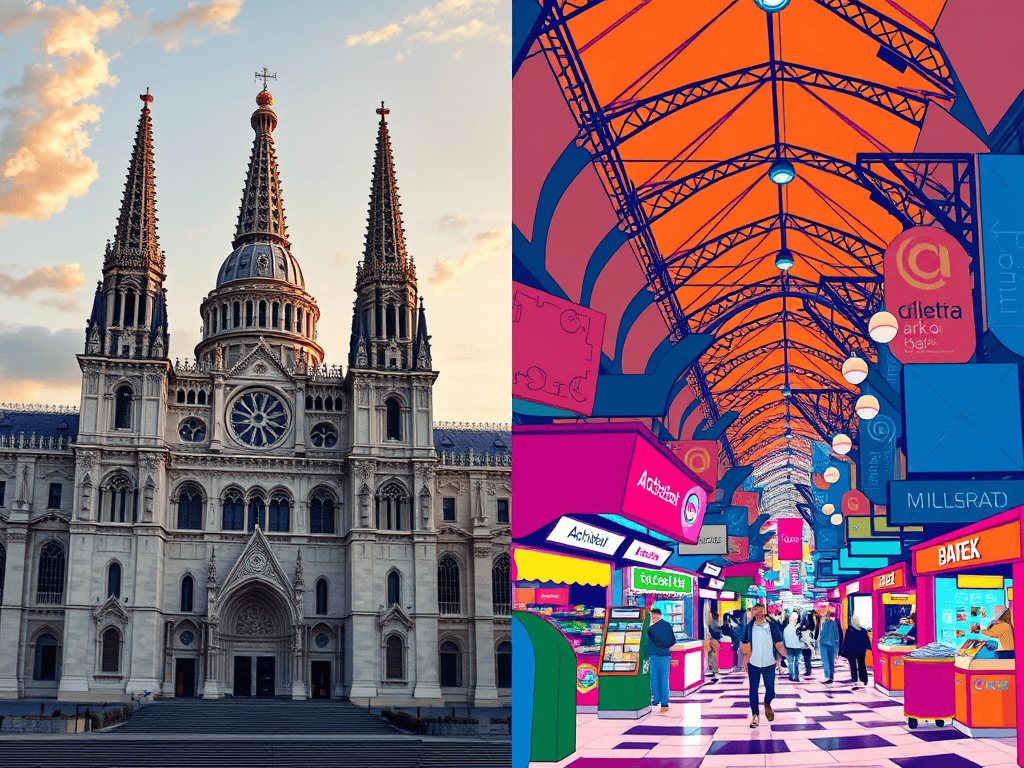
    Meta is building a “Cathedral”—a sovereign, self-contained monument to durable infrastructure. Alphabet is building a “Bazaar”—a distributed, fluid conduit for real-time monetization. AI models evolve faster than hardware depreciates in this economic regime. The market is no longer pricing scale. Instead, it is pricing temporal discipline. Welcome to the Half-Life Economy.

    Meta’s Monument to Durable Time

    Meta’s latest earnings revealed the staggering cost of manufacturing belief. The company expects to spend 66–72 billion dollars in 2025 on Capital Expenditure (CapEx). This amount is nearly 70 percent higher than its 2024 outlay. Long-term, Meta projects over 600 billion dollars in infrastructure investment by 2028.

    The Ambition and the Paradox

    Nearly all of this spending is concentrated in U.S.-based AI compute: custom silicon, massive GPU clusters, and power-hungry data centers. The optics are visionary, but the structure is paradoxical. Meta is rehearsing durable infrastructure inside a regime where time itself is decaying.

    By building for a ten-year horizon, Meta assumes that tomorrow’s assets will survive today’s iteration cycle. However, in the Half-Life Economy, infrastructure now ages faster than its yield curve.

    Alphabet’s Monetized Velocity

    Alphabet’s 2025 CapEx is even larger—forecasted at 85–93 billion dollars—but it diverges sharply in its architecture. Alphabet doesn’t build monuments; it builds conduits.

    The Modular Advantage

    Alphabet treats time as modular. Its spending is designed to refresh continuously and monetize each iteration immediately:

    • CapEx Refresh Cycles: Tied directly to Gemini model upgrades, ensuring hardware stays relevant to the software it runs.
    • Optimized Data Centers: Built for latency and immediate revenue extraction rather than long-horizon speculation.
    • Immediate Revenue Loops: AI pipelines feed real-time earnings across Search, Cloud, and YouTube.
    • Strategic Collaborations: Roughly 10 percent of its AI CapEx (8–10 billion dollars) flows into partnerships with OpenAI and Anthropic. Investments are also made in strategic data centers to augment current revenue.

    Alphabet doesn’t fight time; it rents it. By embedding AI liquidity directly into profit engines, it ensures there are no stranded assets—only refreshed conduits.

    The Half-Life Economy—When Assets Age Faster Than Returns

    The fundamental industrial rhythm of multi-year amortization is broken. In the AI sector, a new model leads to a new chip. This development demands a new memory layout. It also requires new infrastructure. CapEx no longer buys permanence; it buys decay.

    Time as a Risk Vector

    This is the essence of the Half-Life Economy: assets that depreciate before they deliver.

    • The Obsolescence Trap: By the time a firm finishes a cluster for Llama 3, a new demand arises. Llama 4 requires a different physical and thermal layout.
    • Relic Creation: A server rack becomes a relic before it returns its cost.
    • The Speculation Mismatch: Meta’s ambition assumes that controlling infrastructure equals controlling destiny. But when innovation velocity exceeds the fiscal cycle, “control” becomes a temporal illusion.

    Meta compounds CapEx into obsolescence risk, while Alphabet compounds progress into earnings each cycle. The new logic of viability is simple: you must earn before the hardware expires.

    Market Repricing as Temporal Discipline

    Markets price these time regimes intuitively. Following their respective earnings reports, Meta’s valuation fell nearly 8 percent, erasing 155 billion dollars. Alphabet’s valuation rose roughly 7 percent, adding nearly 200 billion dollars.

    These were not mere mood swings; they were temporal repricings. The market is rewarding firms that assimilate obsolescence and disciplining those that resist it.

    Comparing the Time Signatures

    The difference between the two giants is not found in the magnitude of their spending, but in its temporality:

    • Meta (The Cathedral): Allocates 35–38 percent of revenue to CapEx with a decade-long spending horizon. Its assets age faster than its yield curve. It is sacred but slow.
    • Alphabet (The Bazaar): Allocates 30–32 percent of revenue to CapEx with a two-to-three-year horizon. Its assets evolve with its revenue streams. It is secular and fast.

    Conclusion

    Meta’s fall and Alphabet’s rise are expressions of the same temporal collapse. The cathedral and the bazaar are no longer metaphors; they are the time signatures of the AI era.

    To navigate this landscape, investors and policymakers must adopt a new audit protocol:

    • Audit the Time Regime: Is the capital being used to build a monument or a conduit?
    • Velocity vs. Monetization: Recognize that velocity without monetization is a form of structural fragility.
    • Infrastructure Adaptability: Infrastructure that cannot refresh becomes symbolic. Capital that cannot adapt becomes a relic.

    Meta’s massive ambition may pay off someday, but only if the pace of time slows down. In the world of AI, time never slows—it accelerates. In the Half-Life Economy, the only durable asset is the ability to monetize the temporary.