Tag: USD1 stablecoin

  • Insiders Cash, Followers Crash: The Mechanics of Trump’s Crypto Windfall

    The July 2026 federal financial disclosure revealed Donald Trump extracted over $1 billion from digital token ventures in the past year. This outcome validates Truth Cartographer’s analyses in Trump-Linked WLFI is Rewriting Global Influence (Sept 2025) and The Governance Capture of WLFI: Anatomy of a “Bait-and-Switch” (May 2026).

    While more than 85% of secondary market buyers of World Liberty Financial ($WLFI) and the $TRUMP memecoin are underwater—the memecoin collapsing from $74 to $1.67—the executive branch balance sheet achieved unprecedented liquidity. This divergence is not accidental; it is the intended output of programmable finance, engineered through structural asymmetries in smart contracts, token allocations, and licensing royalties.

    The Inside Track

    Our WLFI governance analysis (The Governance Capture of WLFI: Anatomy of a “Bait-and-Switch”) showed how “decentralized” structures mask institutional control. The July 2026 disclosure confirms the mechanics.

    • WLFI allocation — The Trump family received 22.5 billion WLFI tokens plus a structural guarantee of 75% of net token sale proceeds, booking over $500M in direct income regardless of market depreciation.
    • $TRUMP memecoin royalties — An asset‑light model captured $635M in licensing fees. Every buy or sell on decentralized venues routed programmatic fees to insider accounts, converting hype into un‑dilutable cash.

    This architecture decoupled insider performance from market price discovery, ensuring guaranteed upstream flows while retail absorbed volatility.

    Narrative‑Driven Capital Siphons

    Truth Cartographer tracks how narratives intersect with capital flows. WLFI monetization extended beyond U.S. retail into sovereign arbitrage.

    Strategically timed announcements—such as speculative claims of “massive oil reserves” in Pakistan—boosted token optics and drew liquidity from inflation‑stricken regions. WLFI marketed “stable” rails via its USD1 stablecoin, targeting fragile economies.

    The pivotal capture came in May 2025, when UAE‑linked sovereign wealth fund MGX used USD1 to inject billions into the Binance ecosystem, generating recurring reserves for Trump’s venture. Retail investors bought at highs on populist sovereignty narratives, while state actors quietly used WLFI’s plumbing to settle cross‑border balances.

    Land Tokens on the Blockchain

    Our WLFI Global Influence analysis (Trump-Linked WLFI is Rewriting Global Influence) warned of risks in tokenizing real‑world assets (RWA) under opaque perimeters. WLFI’s rollout demonstrates this enclosure.

    Tokenized land rights were marketed as democratization. In practice, smart contracts governed by insider‑controlled tokens neutralized local oversight. Communities risk becoming subservient to automated liquidation engines controlled by a handful of dominant platform operators.

    Followers as Shock Absorbers

    Blockchain intelligence firms like Nansen show over 750,000 wallets interacting with Trump‑backed vectors now sit on net losses.

    Supporters were not equity stakeholders; they were the liquidity base funding insider cash‑outs. Disclosure rules offer no protection—risks buried in whitepapers satisfy legal thresholds. Retail capital absorbed 100% of downside, functioning as macroeconomic shock absorbers so sovereign architects could realize risk‑mitigated wealth.

    Conclusion

    Trump’s billion‑dollar windfall is a textbook case of institutional capture in decentralized finance. The romantic narrative of peer‑to‑peer liberation has been inverted.

    Programmable finance enabled insiders to build a wealth extraction machine: hype financialized into volume, volume taxed via royalties, and downside pushed onto the public. Followers not only lost capital—they financed the very structures enclosing their sovereignty.
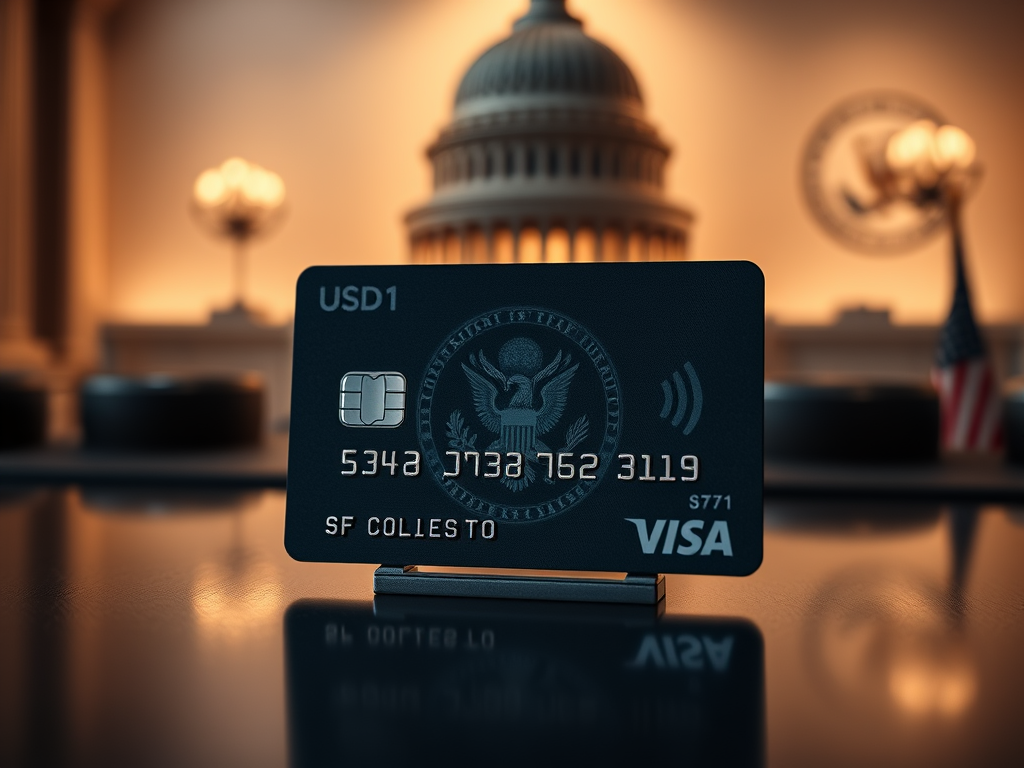
  • The Political Performance Of USD1

    The Political Performance Of USD1

    The Product Isn’t Just Financial. It’s Symbolic.

    When World Liberty Financial Inc. (WLFI) unveiled its crypto debit card and dollar-pegged stablecoin USD1, the announcement read like a fintech milestone. In truth, it was a political performance—a precision-engineered act of symbolic state mimicry. By invoking presidential proximity, echoing the U.S. dollar, and choreographing endorsements through familial and executive channels, WLFI manufactured not a product, but an aura.

    Semantic Annexation

    The name “USD1” is not branding. It is semantic annexation—the laundering of state authority through language. It co-opts the sovereign signifier of the U.S. dollar while remaining privately issued and privately governed. When WLFI’s CEO calls it “the most cultured stablecoin on Earth,” the statement is not financial; it is semiotic. It frames speculation as refinement and aligns commerce with cultural virtue. The act of naming becomes monetary mimicry, collapsing the boundary between the public and the proprietary. To name like a state is to borrow its power; to mint like one is to contest its sovereignty.

    Blurring State and Private Authority

    A private brand issuing a token called USD1 performs a linguistic coup. It manufactures confusion about whether the asset represents sovereign money. This intentional ambiguity corrodes the foundation of democratic monetary trust. If citizens cannot tell the difference between a state-backed dollar and a politically branded derivative, sovereignty becomes a narrative. It becomes open to purchase, performance, or partisan control. The mint becomes a microphone.

    Dynastic Rails and Parallel Economies

    WLFI’s structure merges political identity with financial infrastructure. This signals the rise of dynastic finance. It represents a private minting class operating outside conventional oversight. Through the issuance of its governance token ($WLFI), the enterprise builds an ecosystem where participation equals alignment. This is not a retail product; it is a loyalty economy. History warns that when money becomes an instrument of allegiance, markets mutate into mechanisms of control. A parallel financial system emerges—coded in trust, cleared in loyalty, settled in symbolism.

    Loyalty as Liquidity

    Stablecoins already inhabit the gray zones of finance—arbitraging regulations, blurring borders, and facilitating shadow liquidity. But a politically charged stablecoin transforms this gray zone into a battlefield of meaning. “USD1” is not simply a coin; it’s a campaign slogan rendered as protocol. Investment becomes participation; speculation becomes declaration. Liquidity itself becomes a show of faith. In this theater, value accrues not from utility but from proximity to power.

    The Volatility of Symbolic Systems

    If politically branded stablecoins achieve mass adoption, their collapse will not just destroy balance sheets—it will ignite belief systems. The failure of USD1 would not be seen as technical but as sabotage. Monetary malfunction becomes political martyrdom. A liquidity event becomes an identity crisis. This is the ultimate systemic risk: the fusion of money’s fragility with political fervor. WLFI’s model transforms market contagion into narrative warfare.

    Conclusion

    USD1 is not merely a stablecoin; it is a script. It rehearses the performance of sovereignty through private branding and executive theater.

    Further reading:

  • Trump-Linked WLFI is Rewriting Global Influence

    Decentralized finance was supposed to level the playing field. In practice, blockchain diplomacy and tokenized infrastructure are reshaping how influence is projected. These systems bypass borders, traditional institutions, and democratic oversight — creating new channels of power.

    Projects tied to U.S. political figures and tech interests are pushing proprietary digital platforms into fragile economies. Marketed as “financial inclusion” or “development,” ventures like World Liberty Financial Inc. (WLFI) reveal a deeper intent: building an algorithmic empire.

    WLFI: A Template for Tokenized Influence

    At the center of this shift is WLFI, the company behind the WLFI governance token and reported plans for tokenized land rights and stablecoin adoption.

    • Target markets: Pakistan, Nigeria, and Argentina — countries with high inflation, weak governance, and strong crypto adoption.
    • The pitch: Tokenized land rights and smart contracts promising inclusion.
    • The reality: A restructuring of national authority under the guise of participation, with sovereignty mediated by code.

    The Trump Connection

    WLFI’s links to U.S. politics are visible but deliberately opaque:

    • Corporate ties: WLFI is partly owned by DT Mark DeFi LLC, with Trump family financial interests disclosed.
    • Key personnel: Co‑founder Zach Witkoff is the son of real estate magnate Steve Witkoff, a long‑time Trump ally.
    • Token holdings: Reports suggest the Trump family received 22.5 billion WLFI tokens, potentially worth billions after a September 2025 unlock.

    Oil Reserves: Theater Meets Signal

    Days before WLFI’s token listing, President Trump announced a supposed U.S.–Pakistan deal to develop “massive oil reserves.”

    • Fact check: Pakistani experts dismissed the claim, citing decades of failed exploration and no supporting data.
    • Strategic signal: The announcement wasn’t about energy. It was about narrative — combining executive authority with the idea of untapped wealth to boost WLFI’s symbolic capital. It blurred the line between public office and private financial interest.

    Token branding, memecoins, and smart contracts are becoming new colonial tools. By tokenizing land or governance rights, accountability is abstracted into code.

    • Key question: Who controls the protocol’s master keys?
    • Risk: If politically connected outsiders hold them, democracy is replaced by governance‑by‑code. Citizens’ rights become ledger entries managed beyond their nation’s jurisdiction.

    Conclusion: A New Map of Inequality

    Politically backed token projects like WLFI are redrawing global power lines.

    • Platform architects: Insiders, affiliates, and ledger controllers who design and own the infrastructure — the new empire.
    • Sovereign nodes: Nations reduced to programmable nodes in someone else’s system.

    The promise of financial freedom must be weighed against its potential to annex national assets and manipulate narratives. Revival built on opacity is fragile; legitimacy without transparency is hollow. If global infrastructure goes digital, the politics of protocols must be visible — or empire will be mistaken for innovation, and irreversible control for consent.

    Further reading: